Build F05: a sequence of applicable registration, insurance, tax, and local checks to complete before entering the market.
Open the full-size illustration ↗
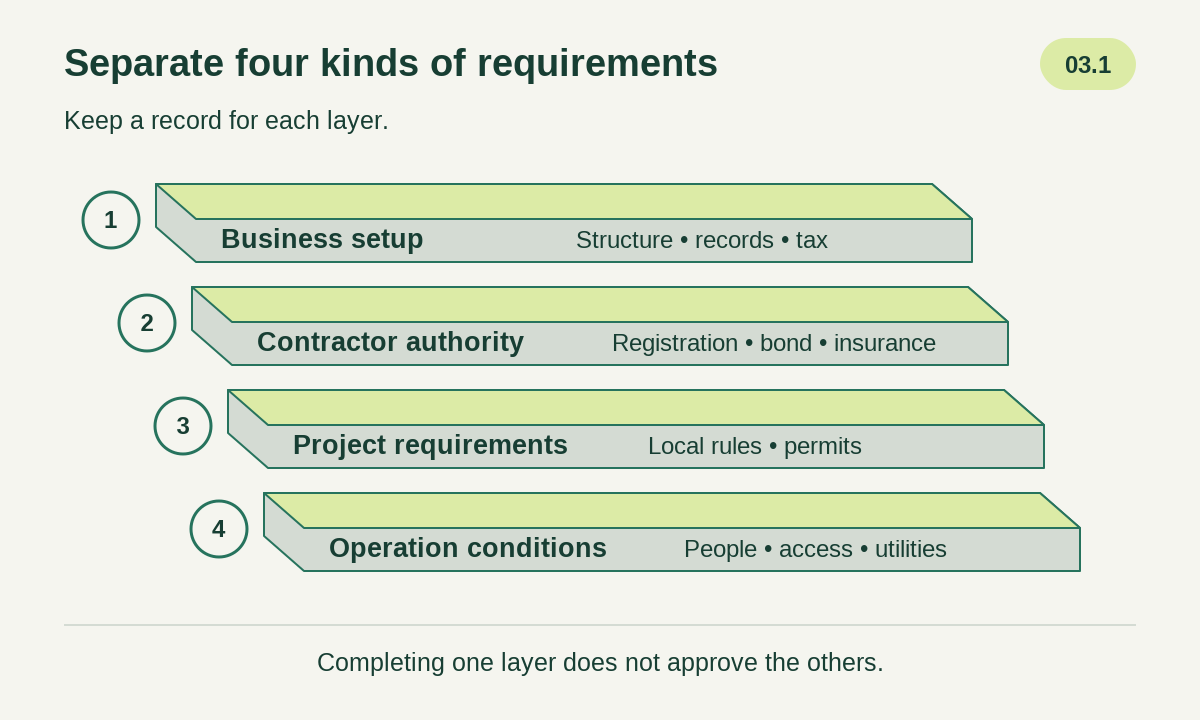
Separate Four Different Types of Checks
A business has a name, a contractor has authority to perform certain work, a property has its own restrictions, and a specific operation has its own conditions. Those are four different questions. Forming a legal entity does not automatically establish contractor registration. Contractor registration does not authorize every fence in every location. A permit for one project does not become permission for the next customer’s project. That is why you need a requirements record rather than a single “paperwork complete” checkbox.
Open F05 and begin with the exact activity described in F01. Identify your state, the municipalities you will serve, your base location, your chosen delivery model, and whether you will have employees. For each question, record the agency, official source, date checked, documented result, next step, and event that should trigger a recheck. “Someone told me” is not enough: it must be clear what specific question was asked and which conditions the answer applies to.
In Washington, contractor registration must be checked before advertising, making offers, and performing construction work. L&I also distinguishes general contractors from specialty contractors; a specialty contractor’s work is limited to its specialty, and it may not hire subcontractors [WA-LNI]. This illustrates how your crew model affects the required paperwork. For another state, build your own record rather than simply replacing “Washington” in our table.
Build the Document Sequence and Its Dependencies
First determine your business structure and a single consistent business name. Compare liability, management, recordkeeping, and the owner’s actual circumstances; there is no universal choice for every learner. Washington ORIA’s guide identifies separate stages for creating the chosen structure, registering, determining where the business will operate, and setting up operations [WA-START]. Use it to navigate to the responsible agencies, not as a substitute for a decision based on your own situation.
Then list the dependencies. What information is needed for business licensing? What is needed for the contractor application? Which status must be active before you make an offer to a customer? L&I’s registration page lists business registration, a bond, liability insurance, an application, and a fee; verify the exact conditions before applying [WA-LNI]. A bond’s face amount and the amount you pay to obtain it are different figures. Do not substitute one for the other in your budget.
Create one consistent business information record: legal name, chosen structure, identifiers, business contact information, and a mailing address for documents. Compare the name’s spelling across related records. Determine whether your structure and situation require a federal identification number, what documents your bank needs, and how you will keep records. Do not submit training forms containing invented information. In this course, prepare a list of fields and questions; complete actual applications using current official instructions.
In the course creator’s experience, registration preparation can move quickly when the required information is available. For a learner, that is a reason to gather information early, not a promise that a Social Security number and an address are enough to open a contracting business in one week. The process involves separate registrations, a bond, insurance, an application, and confirmation of active status; timing depends on the submission method and completeness of the package. The creator’s $200 annual estimate for registration or licensing expenses is a line in his own budget. Check current government fees, registration terms, and other local obligations separately [WA-LNI] [WA-START].
Check the Service Limits and the Actual Risks
Now compare your service with the permitted scope. Washington’s fencing specialty definition includes fences and gates but excludes masonry walls; electrical work may have separate requirements [WA-WAC]. That does not mean you can add a retaining wall or automation beside a wood fence without checking. In F05, record your exclusions and the question you must resolve before expanding the offer.
Review insurance by operation, not just by the policy’s name. Describe the actual work to the insurance professional: excavation, removal, material transport, tools, the owner’s work, and planned help. Ask them to explain coverage, exclusions, customer documentation, and when information must be updated. A registration minimum and suitable protection for a particular risk are not the same thing. Do not promise customers protection you have not verified.
For your base, check whether material storage, trailers, equipment, and business operations are permitted at that location. Create separate questions about classification, records, and obligations for employees and independent contractors. The label “helper” or the method of payment does not answer them. The financial module will calculate the cost of your chosen model; this lesson establishes what verification is needed before you can use that model at all.
Organize Records and Check Before Your First Offer
Prepare document storage and a simple event register: registration status, insurance expiration, information updates, tax filings, and project obligations. Separate customer payments from money available to the owner. For every job, retain the offer, accepted scope, purchases, hours, changes, and closeout result. These records are not just for an organized folder: without them, it is difficult to verify what you promised and what information supported the price.
Before your first real offer, work through F05 by action. Is the necessary status active? Does the actual service match the registered activity? Have the required local conditions been checked? Is there a process for recording payments and obligations? In the Shoreline case, the price included sales tax, and work took place November 7–9, 2026. The reported $620 does not become a tax rate for a new customer: determine the amount and separate tax presentation using the applicable rules and transaction documents.
Assign a person responsible and a required result to every open item: obtain a document, check an official registry entry, clarify a classification, or correct information. Do not assign everyone the same startup deadline. If necessary verification is not ready, postpone the affected action rather than remove the check. Completing this lesson means you have a reliable record of your path and can see the conditions that must be met before entering the market.
Put it into practice
Your assignment
Complete F05 for your service area and delivery model. Check the business, contracting activity, base location, and chosen project type separately.
Inputs
F01; official state and municipal pages; information about planned operations and the people performing them. Do not submit actual applications as part of this assignment.
Your deliverable
A requirements record with dependencies, sources, statuses, next actions, and events that trigger rechecks.
Working forms: F05.
Notes are saved only in this browser. Keep a separate copy of important work and avoid entering customer personal information.
Show the worked solution
- Washington training entry: Contractor registration — L&I; the result is confirmed by active status, not merely by a submitted application.
- Service expansion training entry: Automation is excluded; check the separate scope and suitable personnel before promising the service.
- Base location training entry: Trailer and material storage — check applicable local rules; do not treat a residential address as automatic permission.
Show the self-check criteria
- Business registration is distinct from contractor registration and project permits.
- The document sequence is connected to the actual crew model.
- There are no fictitious licenses, submitted training applications, or universal tax rates.
- For critical open items, the action that cannot yet be taken is recorded.
Sources: WA-LNI, WA-WAC, WA-START, A-OWNER-SHORELINE, V2-WA-REG-TERM.