Make and explain a decision: continue the assessment, clarify a condition, change the scope, or decline, without carrying unresolved issues into installation.
Open the full-size illustration ↗
Distinguish an Unsuitable Job From an Unresolved Question
The previous two lessons produced F05 and F06. They support decisions on individual inquiries, not just the collection of documents. An unknown gate dimension usually calls for measurement. A disputed property line calls for a different kind of verification. Missing required registration cannot be fixed with a discount. If you reduce all these situations to a generic “risk” label, the next step remains unclear, and decisions will depend on instinct.
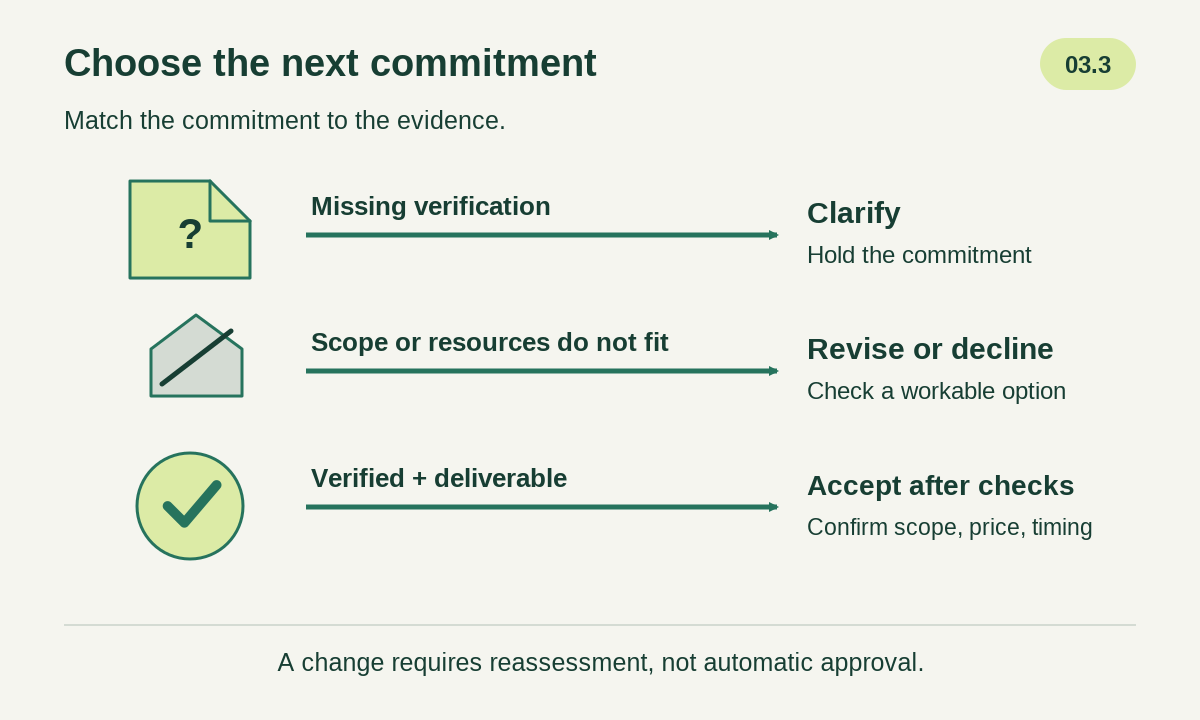
Divide the questions into four categories: conditions that need clarification, insufficient resources, missing preparation or authorization, and unacceptable deal terms. For each category, identify the result needed before you can return to the assessment. Asking for clarification is not a promise to take the job later. It means only that the decision is deferred until specific information is available. Reassessment may lead to either acceptance or refusal.
In F06, add a decision and the limit of your commitment beside each question. For example: “We can review the selected construction after the line has been verified; no start date has been set.” That is more honest than tentatively inserting the job into your workweek and hoping the unknown resolves itself. Your calendar must reflect readiness; otherwise, conditional projects will compete with confirmed obligations for the owner’s same available hours.
Review Three Situations Before Making a Promise
First training situation: A customer wants to keep the old fence line, but a neighbor disputes it. You cannot suggest a slight offset and call the issue resolved. Record the disagreement, request suitable verification, and suspend the decision on the new line’s location. A city’s placement review and private establishment of a boundary serve different purposes; Seattle’s official material explains the limits of municipal involvement in these disputes [A-SEATTLE-BOUNDARY].
Second situation: A private underground system remains uncertain as the installation date approaches. The customer says, “There’s never been anything there.” Keep that as customer-provided information, not a locating result. F06 already has a separate entry for the area to be checked. Do not begin the affected excavation until the necessary verification is available. Rescheduling with an explained reason is better than silently promising an operation whose conditions are still unknown.
The third situation is commercial: Site conditions are clear, but the available workweek and delivery arrangements cannot meet the requested deadline. You can check another date, a smaller scope, or a different delivery method you can actually provide. You cannot sell the original deadline first and solve delivery later. In our first module, the training workweek required 38 hours when only 30 were available. Those missing hours need a real solution; they cannot simply disappear from the record.
Check Service Changes and the Economics
Sometimes a customer suggests changing the scope to reduce the price. Check exactly what changes: material, length, gate, removal, cleanup, or timing. A price reduction must not result from quietly omitting a required operation. If the revised option is technically and legally acceptable, describe and calculate it again. If you are not prepared to deliver it, declining that part of the work may be the right answer.
Expanding through another company is not a universal solution either. In Washington, for example, contractor classification must be checked; L&I limits specialty contractors to their specialty and does not allow them to hire subcontractors [WA-LNI]. “I’ll pass the difficult part to someone I know” therefore does not resolve the delivery-model question. Do not combine employees, separate contractors, and partners under the general term “help.” Work through the full conditions of that model before making a promise to the customer.
Assess the financial result using your own model. In Shoreline, $3,722 remains after the reported tax, materials, and fuel. After the confirmed Square fee of 2.5% of the entire price, $3,567.20 remains. That amount includes the owner’s labor and expenses that have not yet been allocated. It does not prove that every similar job is profitable or that you can reduce the price by the same amount. When a project changes, recalculate costs, time, cash by date, and constraints rather than copying the result of one case.
Communicate the Decision and Keep a Clear Record
Use a short structure when requesting clarification. Start with the customer’s goal, then identify the specific unresolved issue, required verification, and next step. A training example: “To assess the proposed line, we need to clarify its location. Once we receive an agreed drawing, we can revisit scope and timing. Until then, we cannot confirm an installation date.” This avoids an argument with the customer and a promise you cannot yet deliver.
To decline, state the limit of your service and, when appropriate, the type of specialist needed next without falsely guaranteeing that person’s availability. For example: “Our initial service does not include the gate’s electrical work. That needs a separate assessment by an appropriately qualified provider.” Do not invent wrongdoing by the customer when the reason for declining is your own preparation or schedule. Do not use fear to sell a more expensive option. Explain the project’s actual constraints.
Save the decision date, scope version, information received, and condition for reopening the inquiry. If the issue is resolved, update the document and check the price and calendar again. Do not automatically carry prior approval over to a changed project. By the end of the lesson, you should be able to handle suitable, conditional, and declined inquiries without a blanket “we do everything” promise. This is a practical owner skill that protects time, quality, and your ability to meet commitments already accepted.
Put it into practice
Your assignment
Review three training inquiries: a disputed line; an unknown private utility; and a suitable project with a deadline your workweek cannot meet. Prepare a decision and a short customer message for each.
Inputs
F01, F03, F05, and F06; do not send any actual customer messages as part of this assignment.
Your deliverable
Three decision entries in F06 and three draft messages stating the conditions for the next step.
Working forms: F06.
Notes are saved only in this browser. Keep a separate copy of important work and avoid entering customer personal information.
Show the worked solution
- Disputed line: Suspend the location decision and obtain suitable verification; do not try to fix uncertainty with an arbitrary offset.
- Unknown private line: Resolve the separate locating scope; a general request number does not replace that check.
- Insufficient capacity: Check another date or a scope change you can actually deliver; do not sell an unconfirmed deadline.
Show the self-check criteria
- The reason for the decision is specific.
- The proposed next step actually addresses that reason.
- A price reduction does not replace a required check.
- There is no invented Shoreline problem, manipulation, or promise of another provider’s availability.
Sources: A-SEATTLE-BOUNDARY, WA-LNI, A-OWNER-SHORELINE.