Video release pageNot public yet
The companion video was prepared separately and may not yet be publicly available. All written course materials are provided here. The optional video does not replace the separate hands-on table-handling prerequisite.
Use several consenting candidate requests to decide whether specific furniture, customers, properties and complete appointment routes support a limited assembly offer.
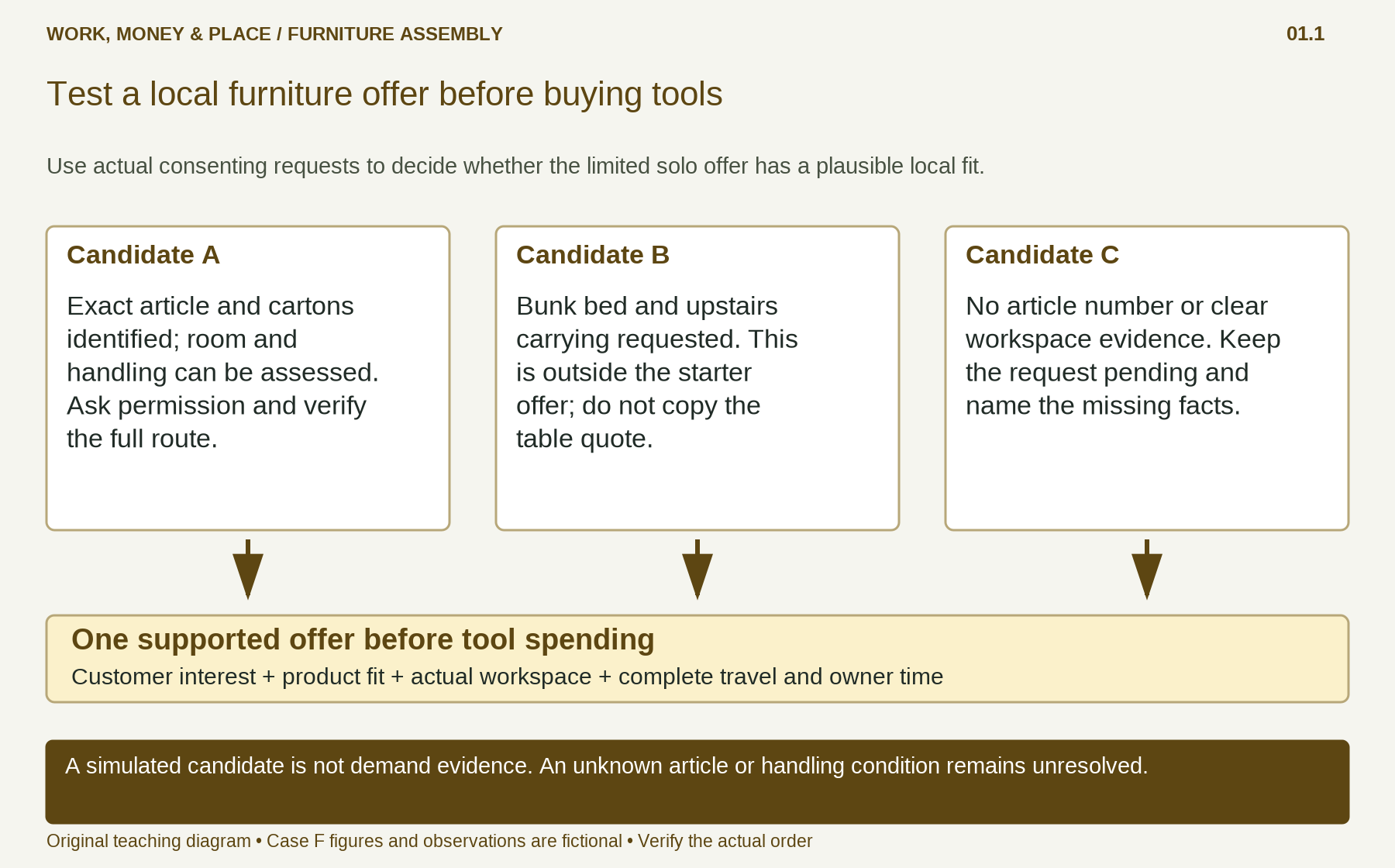
Open the full-size diagram
Example and working records
- F01 working form
- F04 working form
- Case F 01 · Service model and exact products
- Case F 02 · Intake access and prepared workspace
- Case F 04 · Solo handling and owner appointment time
- Case F 12 · One first order readiness decision
Relevant worksheet tabs: Launch, Time and costs. Keep the fictional Case F examples intact. Use a separate own-job row or copy, retain the accepted baseline and enter actual evidence only when it exists.
Describe the complete result you would sell
Begin with customer-purchased factory-made furniture and its exact current instructions. The customer buys the agreed product assembled, inspected and placed in its supported final position, with the stated cleanup and handover. An apparently inexpensive tool kit does not establish that you can reach the room, handle the components, complete the installation requirements or charge enough for the whole appointment. Test those conditions before committing equipment money.
The course works through one identified table and two identified chairs. That narrow example lets you trace actual component and joint decisions. It does not qualify you to assemble every product carrying the same brand. Keep cribs, bunk beds, unfamiliar complex mechanisms, electrical work, structural alterations, custom cabinetry, repairs and unplanned moving outside the starter offer. A different product needs its own assessment and, where necessary, further training.
Investigate several real requests with permission
Use F01 for several actual candidate requests in the area you could serve. Three contrasting requests make a useful small pilot: for example, a supported dining set, a product with an unresolved installation requirement and a booking with difficult access. The number is a planning choice, not evidence that demand exists. Use lawful contact methods and obtain consent before entering a property, measuring or taking photographs. A research conversation is not an accepted assembly order.
Ask what the customer owns or intends to buy, the exact article and quantity, the proposed room and the result they expect. Record whether they are willing to discuss the complete price, preparation duties and conditions of service. Separate observed facts, customer statements and unanswered questions. If you have no consenting request yet, retain an honest pending pilot rather than creating a fictional customer.
Screen the property and the whole route
Use the early F04 record to identify the manual, packages, destination room, possible assembly space, access and supported individual handling. These are feasibility questions; Lesson 03.1 later teaches the detailed product/manual assessment. Check travel, parking, building access and whether the finished item can remain in the intended room. This solo starter scenario has customer flat cartons already at the assembly point; carrying furniture upstairs, relocating assembled items and other moving services are outside the order. Ask who will clear and protect the work area and how children, pets and other occupants will stay outside it.
Include the owner's inquiry, document review, preparation, travel, setup, assembly, inspection, cleanup and administration. Choose tasks you can perform with supported individual control. If the actual product or handling assessment requires assistance beyond the available plan, stop and reassess that task rather than treating the customer as free labor. If required wall securing or installation is outside your competence or authorization, resolve a supported arrangement before acceptance or decline that product; a waiver cannot make the incomplete item ready for use.
This written course teaches the identified assembly sequence but does not teach or validate a complete solo table-turn method. Before independent table practice or accepting a solo table order, obtain product- and site-appropriate hands-on instruction from a competent person, then complete permitted observed practice showing that you can support, turn and place this exact table alone without relying on a leg, dragging it, losing control or trapping fingers. If the observer must take the load, solo capability remains unproved: keep the table work on HOLD. Diagrams and written answers cannot supply this evidence. Include any required instruction, practice furniture and suitable workspace in your own preparation budget. If assistance is needed, assess and agree that different arrangement instead of assuming customer labor or adding an automatic charge.
Turn the pilot into a spending decision
Compare the requests in F01. Identify which combinations of product, property, customer expectations and route could support your offer, what evidence is missing and what would close each gap. Several unsuitable requests may justify changing the accepted product range or service area before acquiring tools. A general interest in furniture assembly is weaker evidence than a specific customer accepting the service conditions at a workable property.
Finish with a bounded offer and a dated decision: continue preparation, investigate named gaps, HOLD or decline. Keep any prices discussed as research notes until the complete quote and agreement are prepared. This first decision concerns whether a local service is worth preparing. The later practical rehearsal establishes physical evidence, and the final readiness map links that evidence to one proposed order.
Put it into practice
Your assignment
Build a consent-based local-fit pilot before making an equipment commitment.
Inputs
- Record several actual consenting candidate requests, or keep unanswered requests explicitly pending.
- Compare exact products, access/workspace, supported individual handling, complete route time and willingness to discuss the full service.
- For a fictional comparison, one customer requests the selected dining set, another an unknown bunk bed, and another will not clear the only working area. These are sample inputs, not observed demand.
Your deliverable
F01 pilot and bounded offer, linked to F04 evidence and a spending/HOLD decision.
Saved only in this browser when storage is available. Export this page separately and use fictional identifiers in practice.
Show the worked answer
- Keep the selected dining set conditional on exact manuals, actual site fit and later practical evidence.
- Exclude the unknown bunk bed from this starter offer; hold the obstructed-space request until a supported arrangement exists.
- Record actual consent and findings separately from the fictional comparison; identify the next action before spending.
Show the self-check criteria
- Each request identifies a product and a complete appointment route.
- Customer statements and verified observations are distinguished.
- Missing permission, access, handling or skill evidence remains visible.
- The exact-table external instruction and observed solo-control prerequisite remains a named HOLD until actual evidence exists.