Assess the actual workspace and handling route, and keep the solo table order on HOLD until mandatory external hands-on instruction and observed practice establish safe individual control.

Open the full-size diagram
Example and working records
- F04 working form
- F08 working form
- Case F 02 · Intake access and prepared workspace
- Case F 04 · Solo handling and owner appointment time
Relevant worksheet tabs: Time and costs, Your order. Keep the fictional Case F examples unchanged. Read its time and cost assumptions beside the example, then use Your order for your own supported plan and actual observations. A numerical result does not clear a physical HOLD. Add help only when the applicable instructions or actual assessed task require it.
Assemble where the item will stay
Walk the proposed work area with permission before opening cartons. Confirm the final positions, available floor space, lighting, protected surfaces, exits and a place for packaging and small parts. A finished tabletop must fit both the room and its actual turning path. Avoid building an item in a room it cannot leave safely. Exclude moving other household furniture unless separately assessed and agreed.
Case F assumes a level ground-floor room with the customer’s unopened packages already flat at the assembly location, final placement in that room and a clear working route. Its 12-by-10-foot clear area is a fictional case input, not a universal minimum or a measured site. Actual carton spread, supported working positions and handling must fit. Stairs, elevator transfers, carrying purchases from a vehicle and transport of assembled furniture are outside this case. New access demands change the job assessment and estimate.
Protect the work and control entry
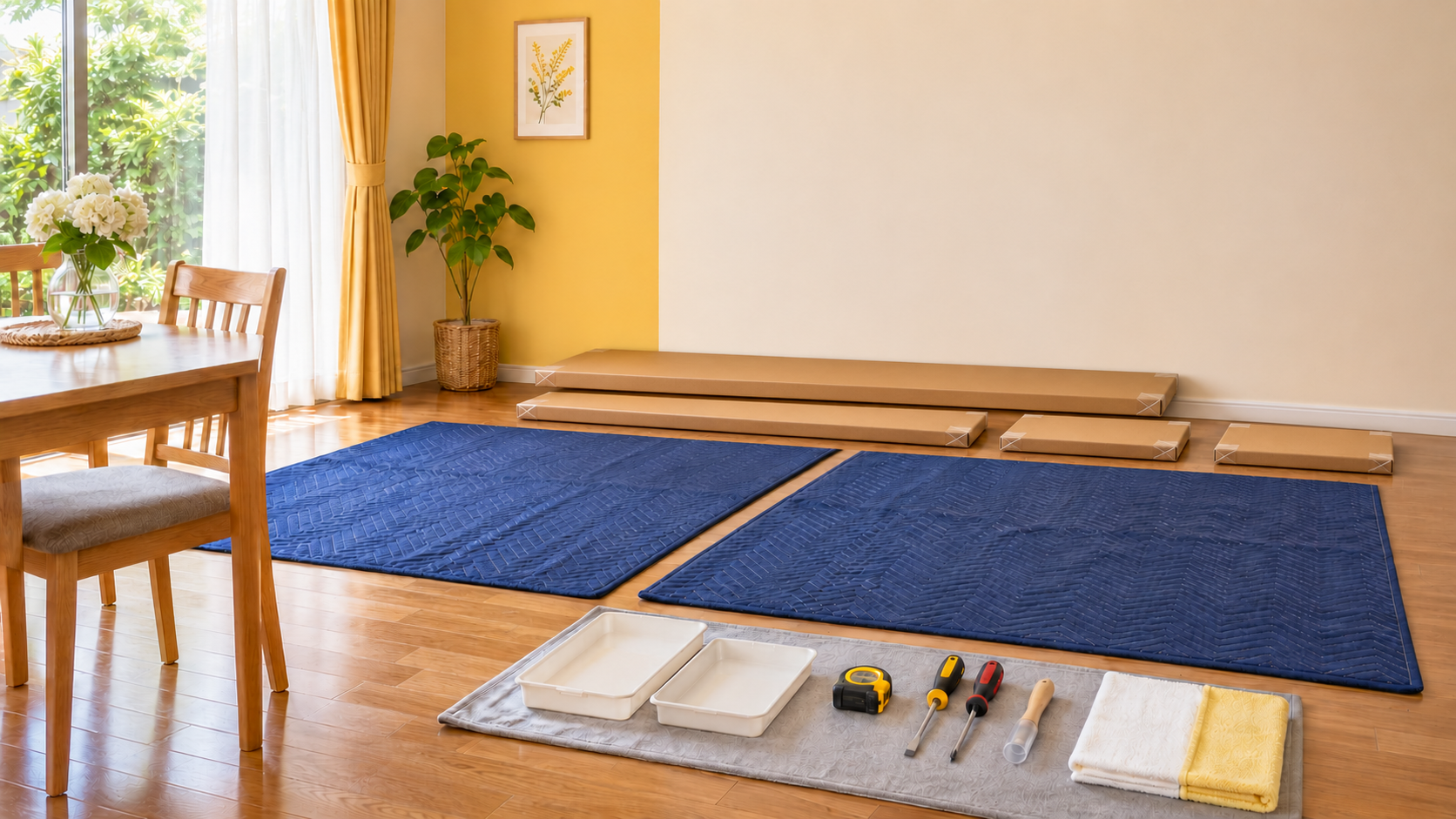
Lay clean protective blankets or suitable mats across the component contact area, keeping their edges flat and outside the walking route. Grit trapped beneath a blanket can still scratch a finish, so inspect both the floor and covering. The selected manuals show assembly beside supported components on a protective surface, with body weight kept off the furniture. Do not kneel or stand on a frame to hold it still.
Create distinct T01, C01 and C02 staging areas and covered or stable part trays. Keep sharp tools and small fittings inaccessible to children and pets. Agree how household members will pass without entering the assembly or turning area. Keep the exit usable; a stack of empty cartons is not allowed to narrow it. Assess footwear, grip, hand and eye protection for the actual tasks, rather than assuming gloves remove puncture or pinch risk.
Open the full-size illustration
Illustration sources: FT01, FT02, FT03, FT04, FT08.
Plan the awkward movement before making it necessary
Review the size, balance, grip points, supported resting positions and route for the tabletop, assembled table and chair frames. Reduce unnecessary moves and work at the final placement wherever feasible. Establish the next stable set-down point before moving a component. If you cannot see the path, maintain grip or control a transition, stop before lifting. A compact package or familiar product name does not establish safe handling.
This written course does not teach or validate a complete method for turning the assembled table alone. Before accepting the solo table order, obtain external hands-on instruction from a competent person for this exact product and suitable setting. Then complete a permitted, observed rehearsal demonstrating that you can support, turn and place it safely alone. The instructor must assess the actual person, furniture and route; this course supplies no universal grip, lifting sequence or safe-weight threshold. Do not discover your limit by improvising an unsupported full-table turn.
The observer records what you actually control, including stable transitions, clear fingers and the final supported placement. If another person must take the load, that attempt has not demonstrated solo capability. Keep the order on HOLD and revise the task design or agree an appropriate assisted service only after its requirements and costs are resolved. Neither a signed checklist nor a finished-table photograph replaces the observed movement. This is a course prerequisite, not a claim that the manufacturer requires two assemblers.
Keep the solo plan conditional on actual control
Case F models one assembler with these practical skills already established before its customer inquiry. Neither selected manual imposes a two-person requirement. The customer places the unopened cartons flat at the assembly point before arrival; the base service includes no heavy transport, stairs or moving assembled furniture between rooms. No external instruction or successful physical demonstration was performed for this course. Add the actual cost and time of any instruction, practice products, space and transport needed for your own preparation to your launch plan.
Keep supported components stable until ready to move them. Do not lever the table over a leg, drag its legs or lift it by an unsupported rail. Stop for fatigue, pain, poor grip, unexpected resistance or a blocked route. Reassess changed conditions at arrival even after a prior successful rehearsal. A customer or child is not an automatic worker; suitable help is an assessed exception, not a default surcharge.
Record a conditional working plan
F04 records workspace, permission, protection, entry control, final placement and the handling decision. F06/F09 retain the external instructor or observer, date, actual product/site conditions, demonstrated movements and unresolved actions; F14 links that evidence. Use F08 for the complete owner time and any separately needed help cost. A photo can show a route but cannot prove clearance or grip. Lesson 04.4 joins this prerequisite to one complete practice appointment; it does not create a second identical handling test.
Put it into practice
Your assignment
Decide whether the proposed appointment can use the assessed table-handling plan.
Inputs
- Packages are already flat at the final ground-floor assembly point; the clear turning space has not been checked.
- The assembler has read the course but has not obtained external hands-on table-turn instruction or demonstrated the actual solo movement.
- The customer offers a child to hold the table if it becomes difficult.
Your deliverable
A dated F04/F08 record with item IDs, evidence, decisions, unresolved actions and the next review.
Saved only in this browser when storage is available. Export this page separately and use fictional identifiers in practice.
Show the worked answer
- Keep F04/F14 at HOLD. Arrange competent external hands-on instruction and permitted observed practice for the actual table, setting and assembler before accepting solo work.
- Do not substitute the child or infer safe handling from package weight.
- If the observer must take the load or safe individual control is not established, keep solo work on HOLD; separately reassess any assisted scope and actual costs without an automatic surcharge.
Show the self-check criteria
- The base service has one assembler; any assistance is conditional on the applicable instructions and actual task.
- The protected work zone, route, exits and placement are assessed.
- No unsafe movement is authorized by the written exercise or target duration.
- The record distinguishes mandatory external practical instruction and observed solo performance from a written course exercise.