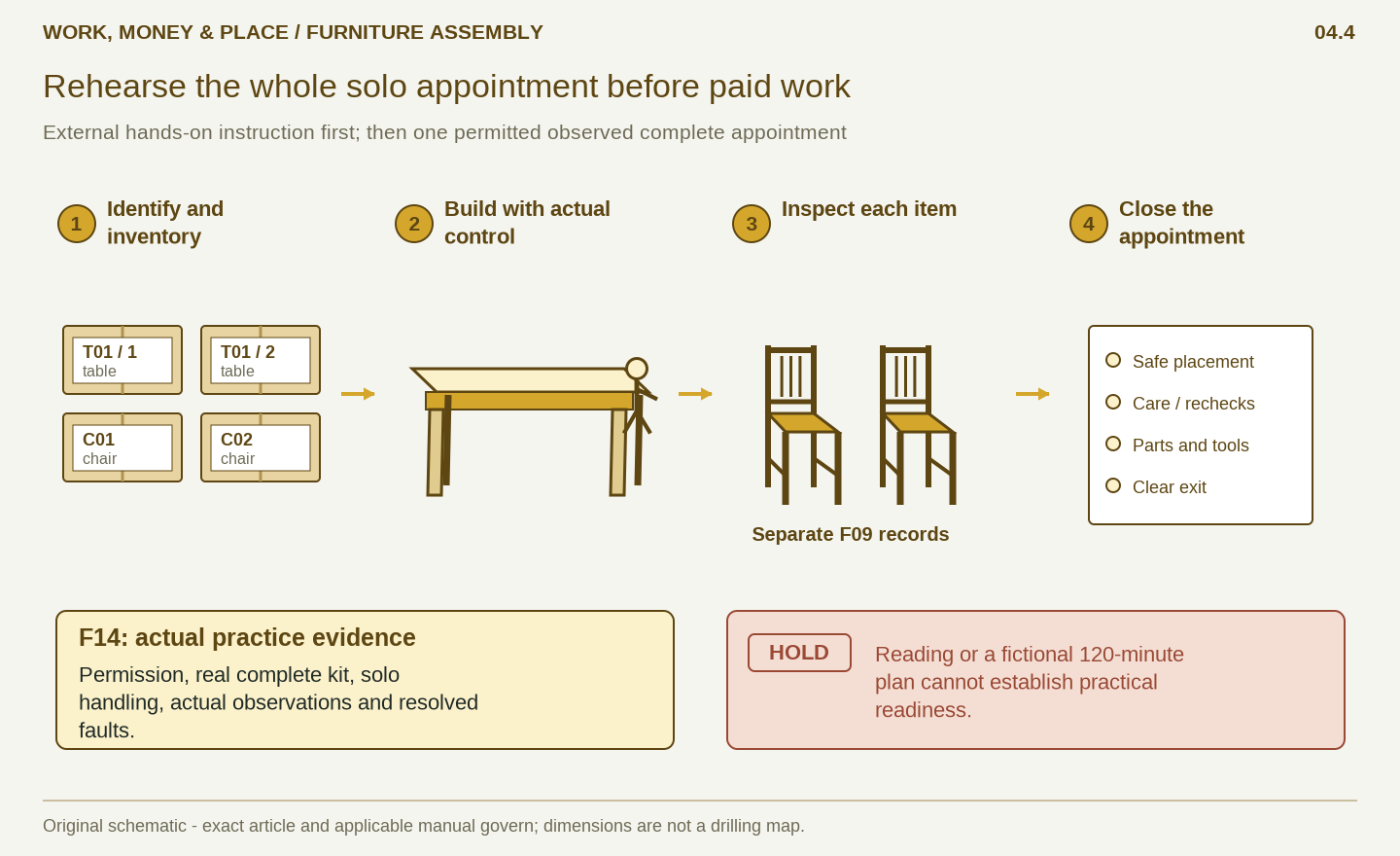
Join mandatory external table-handling instruction and observed solo movement to one complete permitted table-and-two-chair practice appointment before claiming paid-work readiness.
Open the full-size diagram
Example and working records
- F05 working form
- F06 working form
- F09 working form
- F14 working form
- Case F 02 · Intake access and prepared workspace
- Case F 04 · Solo handling and owner appointment time
- Case F 05 · Applied assembly and completion checks
- Case F 12 · One first order readiness decision
Relevant worksheet tabs: Time and costs, Your order. Keep the fictional Case F examples unchanged. Read its time and cost assumptions beside the example, then use Your order for your own supported plan and actual observations. A numerical result does not clear a physical HOLD. Add help only when the applicable instructions or actual assessed task require it.
Set a real practice appointment
Obtain permission to use the exact selected furniture, a suitable space and a complete kit for genuine first assembly. Confirm ownership of the practice materials and whether the furniture will remain there. Do not repeatedly dismantle factory joints or intentionally weaken a finished item merely to rehearse; any later disassembly follows manufacturer guidance.
Make this one complete appointment the observed practice required by Lesson 03.2, after competent external hands-on instruction has established an appropriate method. Arrange the instructor or observer and confirm the actual support, route and stop conditions before work begins. Do not attempt the full-table turn alone for the first time from this written course. If the observer must help carry the load, record that fact: the session has not established solo capability.
Keep F14 at HOLD until the real work and any needed corrections are observed. Reading, watching an animation or copying a fictional form cannot show that you can control the tabletop, align a barrel nut or attach the seats. This course has performed no physical build, solo-turn demonstration or timed practical trial. External instruction and practice may require additional preparation costs in your own launch plan; Case F assumes prior competence.
Rehearse the decision before the first joint
Start as if arriving at the customer: confirm the order, scope, four packages, final placement, protected workspace, entry control and solo handling plan. Inventory T01, C01 and C02 separately in F05. Name each tool and its purpose. Explain why the table’s long and short screws are separated and why one chair’s fourteen dowels cannot be pooled with the other’s.
Include one brief written or separately labelled shortage-card interruption before the first joint. Explain the near-action stop and point to Lesson 05.3/F11 for the customer’s storage and return agreement. Keep that simulation separate from the real complete kit; never remove a required part from a live build or record a staged shortage as an actual supplier defect.
Perform the actual supported work and record it honestly
Complete the table and both chairs through Lessons 04.2 and 04.3 with their exact manuals open. Record stage times, actual handling, interruptions and part questions in F09. The competent observer must be able to describe the actual solo turn and stable placement, not infer them from the finished table. Stop if the route, grip, posture or support defeats the method established during external instruction. Do not finish a movement to protect the schedule; record any assistance honestly and reassess the solo offer.
Observe the tabletop frame’s bracket and screw assignment, locator engagement, barrel-nut alignment, handed legs and specified washer/nut connections. For each chair observe the dowel sequence, six frame screws, seated joints, seat positioning and four controlled hand-awl and seat-screw operations. Describe what the observer actually saw. Do not backfill inaccessible details from a clean finished photograph or call a correction a first-attempt success.
Close the appointment rather than stopping at the last screw
Carry out the item-level inspection in Lesson 05.4, record any fault and keep affected items unavailable for use. Check stable placement in the agreed room, collect loose fasteners and sharp packaging, return tools to storage and leave the exit clear. Reconcile counted hardware with prescribed consumption; an unexplained extra or missing item requires review before acceptance. Give the applicable instructions and care/recheck information to the owner.
Practice explaining a workmanship issue and the remaining agreed work without an automatic extra-charge claim. Use the fault response already taught in Lesson 05.3 instead of retelling the complete missing-part case. Do not invent a customer signature, invoice, replacement receipt or successful physical return as rehearsal evidence.
Replace planning assumptions with your own evidence
The fictional base appointment assigns 15 minutes to inventory/setup, 40 to the table, 40 to two chairs and 25 to final checks and packing, totaling 120 onsite minutes. Those numbers organize a teaching estimate; they are not a manufacturer benchmark. Use actual permitted practice to establish whether your tasks, pauses, handling and total appointment fit a viable supported offer. Keep additional time visible instead of shortening inspections or handling controls.
Complete F14 with evidence, unresolved actions and a repeat-practice or training decision where needed. Passing this one bounded appointment does not qualify you for beds, wardrobes, glass furniture, wall anchoring or another article’s mechanisms. Assess each new product and its full instructions separately. F14 can support a readiness decision only after the real work and corrective actions are observed; until then the learner’s practical status remains HOLD.
Put it into practice
Your assignment
Prepare the practice evidence and distinguish a written decision from a completed physical rehearsal.
Inputs
- The learner has read every lesson but has not received external hands-on instruction or demonstrated the actual solo table turn.
- The Case F schedule totals 120 onsite minutes.
- A separate shortage card is available; the actual assembly kit remains complete.
Your deliverable
A dated F06 complete practice record linked to F05 item inventories, F09 actual assembly observations and F14 readiness actions.
Working forms: F05, F06, F09, F14.
Saved only in this browser when storage is available. Export this page separately and use fictional identifiers in practice.
Show the worked answer
- Record practical F14 status HOLD; no physical result or 120-minute capability is claimed.
- Use one labelled shortage-card interruption to point to the near-action stop and Lesson 05.3/F11 response; keep the real complete kit separate.
- Arrange competent external hands-on instruction, then one permitted observed complete-kit appointment. Record whether the assembler actually controls the table turn alone; any person taking the load means solo capability remains unproved.
Show the self-check criteria
- Permission, external hands-on instruction, a complete real kit and observed solo performance are separately evidenced; the written simulation supplies none of them.
- The shortage rehearsal cannot remove required support from a live build.
- All table, chair, handling and closeout actions receive evidence before practical readiness is recorded.