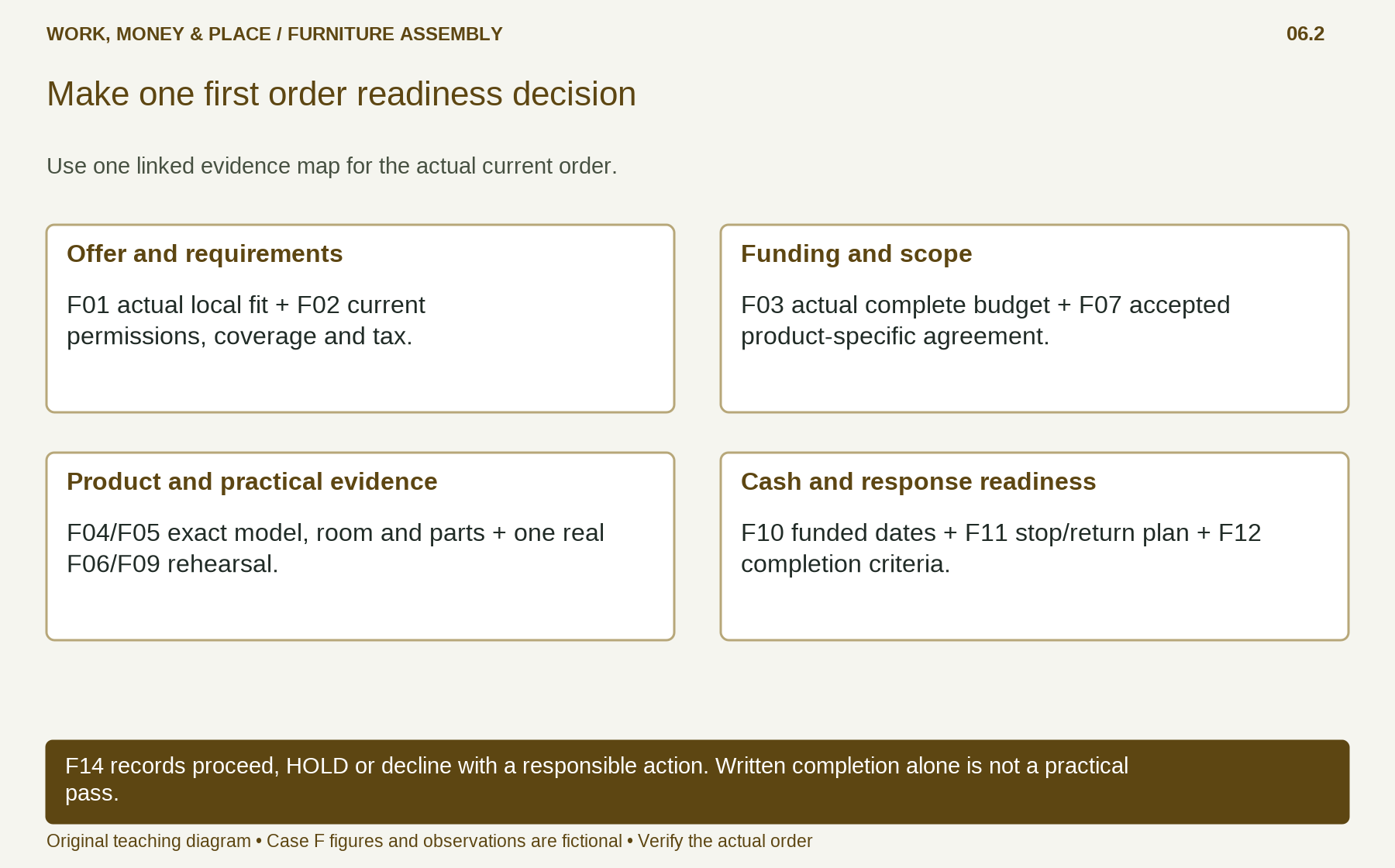
Use one linked evidence map to accept a supported first order, hold named gaps or decline the request.
Open the full-size diagram
Example and working records
- F02 working form
- F06 working form
- F14 working form
- Case F 01 · Service model and exact products
- Case F 02 · Intake access and prepared workspace
- Case F 04 · Solo handling and owner appointment time
- Case F 05 · Applied assembly and completion checks
- Case F 06 · Accepted scope and dated formation history
- Case F 07 · Complete price stock and use allocation
- Case F 08 · Launch funding receipts and held cash
- Case F 09 · Missing dowel whole order stop and return
- Case F 12 · One first order readiness decision
Relevant worksheet tabs: Your order, Time and costs, Launch, Cash example. Keep the fictional Case F examples intact. Use a separate own-job row or copy, retain the accepted baseline and enter actual evidence only when it exists.
Center the map on one proposed order
Use F14 for one identified customer request rather than a general declaration that the business is ready. Link the current offer, exact products, manuals, property assessment, supported solo handling, tool and parts records, controlled practice, price, agreement and dated funding. Record versions and dates so the map describes the same scope throughout. An assessment for a small table cannot release an unrelated storage-unit booking.
Use supported, pending, HOLD or decline with evidence and a responsible next action. A checked reading box establishes that you marked a lesson; it does not establish customer consent, a physical trial or an agency response. Keep the fictional Case F example separate from actual documents and observations. No date in a proposed launch plan overrides a critical unresolved condition.
Close product and property dependencies
Confirm exact article/manual identity, all packages and components, known prior attempts or damage, working area and the route to the agreed final position. Use the technical records rather than copying their tests onto another blank checklist. Verify any required installation and the actual handling arrangement. An excluded anchoring service cannot justify handing over a product whose mandatory securing requirement remains unmet.
Confirm the owner’s demonstrated method and individual control for the actual products and site. Before independent table practice or accepting solo table work, obtain suitable hands-on instruction from a competent person and permitted observed practice of supporting, turning and placing this exact table alone. This course does not teach or validate a complete solo table-turn method. If an observer must take the load, capability remains unproved; keep the table task on HOLD. Case F assumes prior competence, ground-floor cartons already at the assembly point and no moving service. Assistance is a separately assessed and agreed alternative, not an assumed customer duty.
Link one complete practical rehearsal
Use the evidence produced in Lesson 04.4: actual permitted preparation, component reconciliation, supported tool use, assembly, handling, interruption, inspection and reset. Review whether its products and conditions support the proposed job and what changed afterward. This is the point to close a real gap, not to perform a second identical readiness exercise simply to fill another form.
A written calculation or diagram cannot prove that you can hold a component, coordinate a turn, recognize a failed joint or maintain the work area. Keep unperformed practical items pending. If an actual attempt stopped, preserve that result and the evidence required for a supported retry. Do not average a failed control into a passing score.
Check the operating promise and funded cycle
Use F02 to close the service's actual permission, coverage and tax requirements. Confirm the accepted F07 version, formation history, mandatory customer rights, preparation duties and change process. Check that the complete owner cycle, travel, supplies and settlement timing agree with the funding record. Household protection remains a separate decision rather than another name for money already committed to the job.
Check a credible interruption against the agreed stop, return and funding terms. Use the full fault decision in Lesson 05.3 and its actual-versus-plan review in 06.1 rather than retelling the scenario here. Name the action that would close an unfunded return or unsupported stage. A positive plan does not authorize an extra customer charge or release a missing practical prerequisite.
Issue and maintain one decision
Accept only the supported scope once all critical dependencies are closed. Otherwise identify the affected requirement, next action, responsible person and review trigger, or decline the request. After acceptance, a new product, damaged package, changed route or failed control reopens the relevant decision. Keep the accepted baseline and later evidence so the file explains why the work proceeded, stopped or changed.
Put it into practice
Your assignment
Make the final decision from a mixed evidence file.
Inputs
- The quote has a positive planned result and a date is available.
- The exact product/manual assessment is complete, but suitable external solo table-turn instruction and observed individual-control practice have not been completed.
- A request to substitute an unfamiliar tall unit arrives after the original dining-set offer.
Your deliverable
F14 linked decision with each critical dependency, evidence, owner and next action.
Saved only in this browser when storage is available. Export this page separately and use fictional identifiers in practice.
Show the worked answer
- Keep the table order on HOLD until the external instruction and actual observed solo-control evidence are complete; profit and an available calendar slot do not release it.
- Assess the new unit separately, including its installation requirements; retain the original accepted version.
- Issue one supported decision after the actual gaps close, or decline; do not invent a rehearsal, customer acceptance or activity permission.
Show the self-check criteria
- Every critical decision points to actual current evidence.
- The single practical rehearsal is linked, not duplicated as another paper gate.
- A written exercise, customer waiver or positive calculation cannot override an unresolved physical or legal requirement.
- Table readiness includes external hands-on instruction and observed solo control, not self-authorization from a diagram.
Sources: FB01, FB02, FB03, FB04, FB06, FB08, FT02, FT04, FT07, FT08.