Execute the validated small-load plan using actual anchors and matched restraints, then independently check containment and all pre-road limits.

Open the full-size illustration
Illustration sources: JT08, JT10, JT11, JT14.
Example and working records
- J05 working record
- J08 working record
- Case J 05 · Vehicle capacity and the restraint decision
- Case J 09 · The applied pickup loading and receiving visit
Relevant worksheet tabs: Case J, Your order, Your cash. Keep fictional Case J figures separate from your actual item, route, scale, receiving and rehearsal evidence. Count the entire cycle from preparation through reset; a positive spreadsheet result cannot clear a physical or legal HOLD.
Start with the approved arrangement and empty bed
Lay out J05 beside the stationary pickup and identify the actual loading position, anchor points, restraint assemblies and unload order. Inspect the bed for holes, damage, sharp contact, loose objects and slippery contamination. Keep the tailgate movement zone clear. All items and attachments must remain reachable from stable ground within the assessed method; if the arrangement needs someone to climb into the bed, stop and change it.
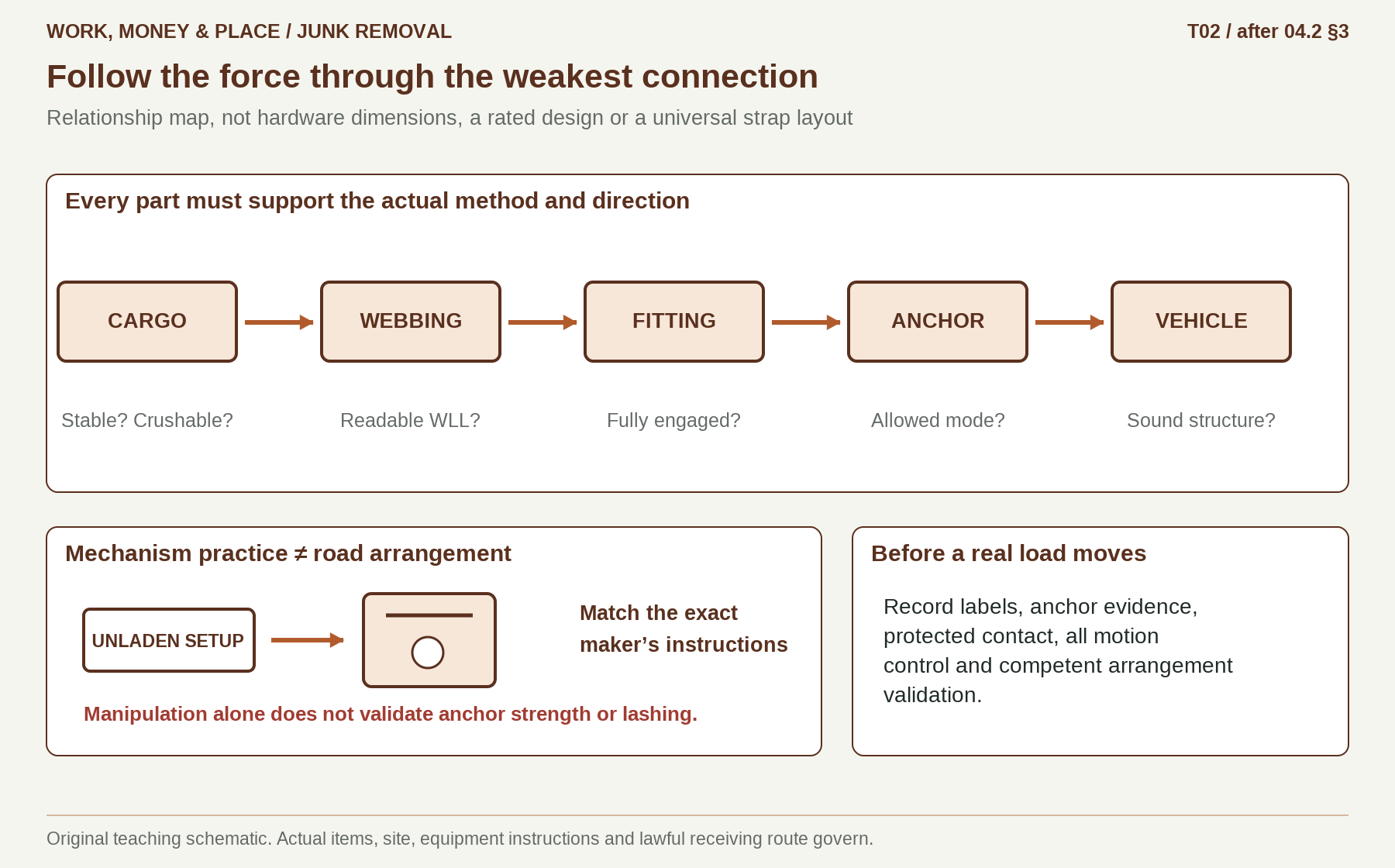
This lesson teaches execution of a validated arrangement for the accepted small load. It does not turn an original diagram into an engineered restraint plan. Before a learner’s road rehearsal, an appropriately competent person must verify the actual load, anchor evidence, restraint directions, limits, geometry and release method. Record what was checked and why. A generic signature saying looks good is insufficient.
Return to the positive Case J section 05/J05 example from lesson 03.2 before installing the actual system. Its mass PASS and filled fictional HYP-R-J01 evidence ledger are different records. The paper conditional release exists only under its stipulated compatible anchors, working-load/mode/weakest-component and force findings, noncrushing contact, tire/lateral suitability, ground access and stable release. Do not apply its hypothetical limits or direct-capture arrangement to the CamJam mechanism exercise or a real Ford bed. Record the actual verified method in J05 and its installation/final checks in J08; the single complete physical rehearsal remains J14 in lesson 04.4.
Place items for stability and unloading access
Hand-place the first accepted item into its assigned position without tossing, forcing or standing in the bed. Use the inspected support/protection specified by the plan. Keep the arrangement low and stable and follow its axle-distribution plan. Protect retained objects and the cab. A pile that happens to sit below the bed sides is not immobilized.
Add one item at a time. Capture loose removable parts in the separately approved arrangement; do not trust a drawer catch or elastic cord to hold a part in a crash. Do not stack a fragile hollow object under a tensioned strap or put a heavy item on something that can collapse. If an item can roll, tip, slide sideways or move into its neighbor, the plan needs effective restraint for that motion before departure.
Inspect and trace the entire restraint path
Run the full webbing through your hands and eyes only while un-tensioned and safe to inspect. The matched maker’s removal criteria apply. For the Keeper inspection example, missing identification, cuts, damaged stitching, knots, heat damage, wear, corrosion or doubt about strength require removal from service. Do not repair a damaged tie-down with tape or a knot.
Locate each anchor physically and compare it with the applicable instructions. Inspect fitting engagement and load direction; do not use a bumper, tailgate cable, decorative rail or grab handle as a substitute. Trace where the force enters the cargo, what stops it sliding out from under the webbing, and what prevents abrasion. Compatible edge protection must resist the contact forces. The working load limit of a complete assembly cannot exceed its weakest applicable component; a hand tug is not a strength test.
Open the full-size illustration
Illustration sources: JT08, JT11, JT13, JT14.
Learn the exact mechanism on a stationary practice setup
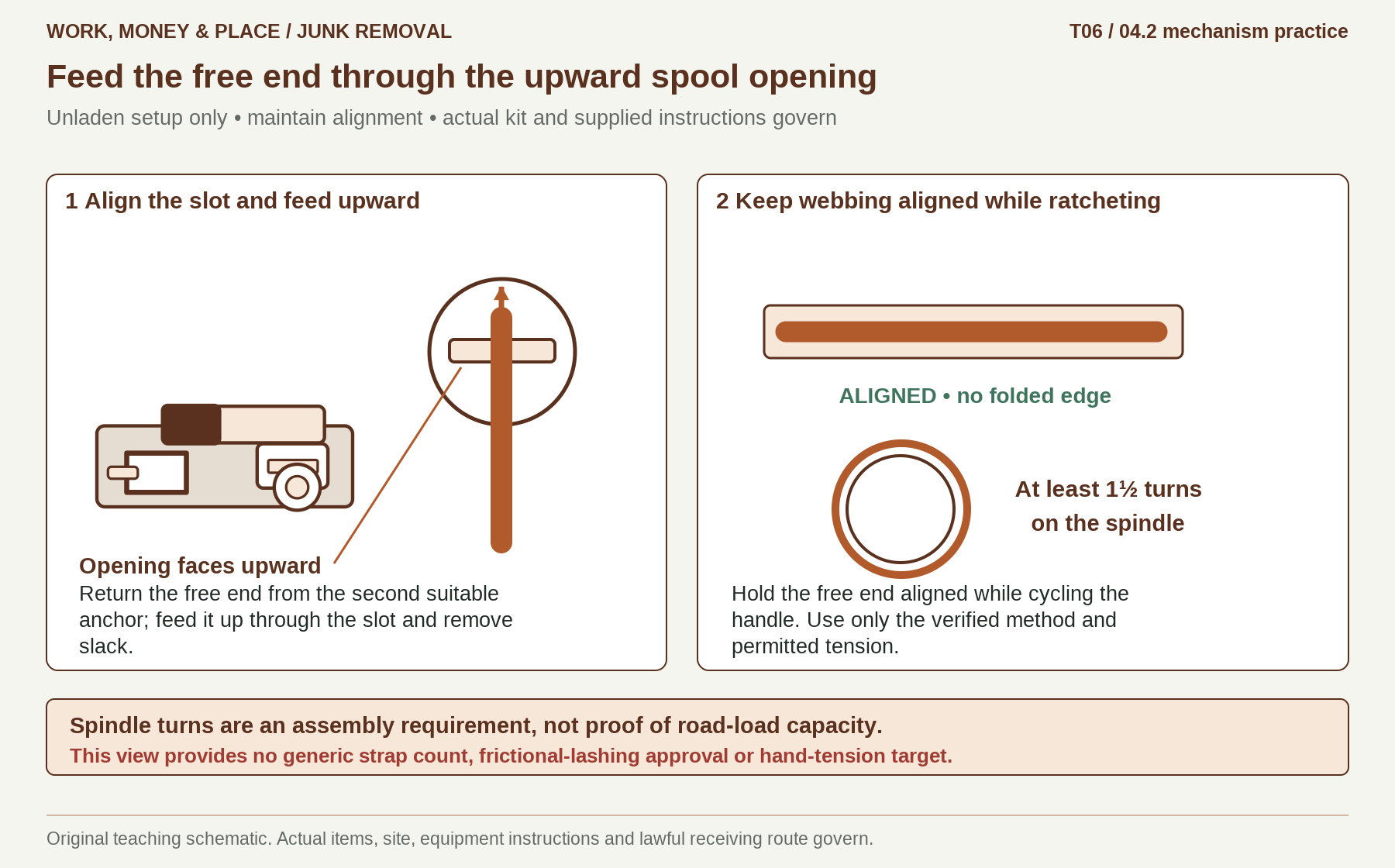
The mechanism example is the Nite Ize CamJam Ratchet Large with its original single-loop webbing, using the maker’s inline instructions. It is not a purchase recommendation or a substitute for other ratchet manuals. On an unladen stationary practice setup, pass the stitched loop through a suitable first anchor and pass the free end through that loop. Open the handle, raise the capture frame using its tab, feed a pinched webbing loop through the passage with the open end toward the first anchor, and place the loop over the frame. Lower the frame, pull it away from the center to lock, and close the handle.
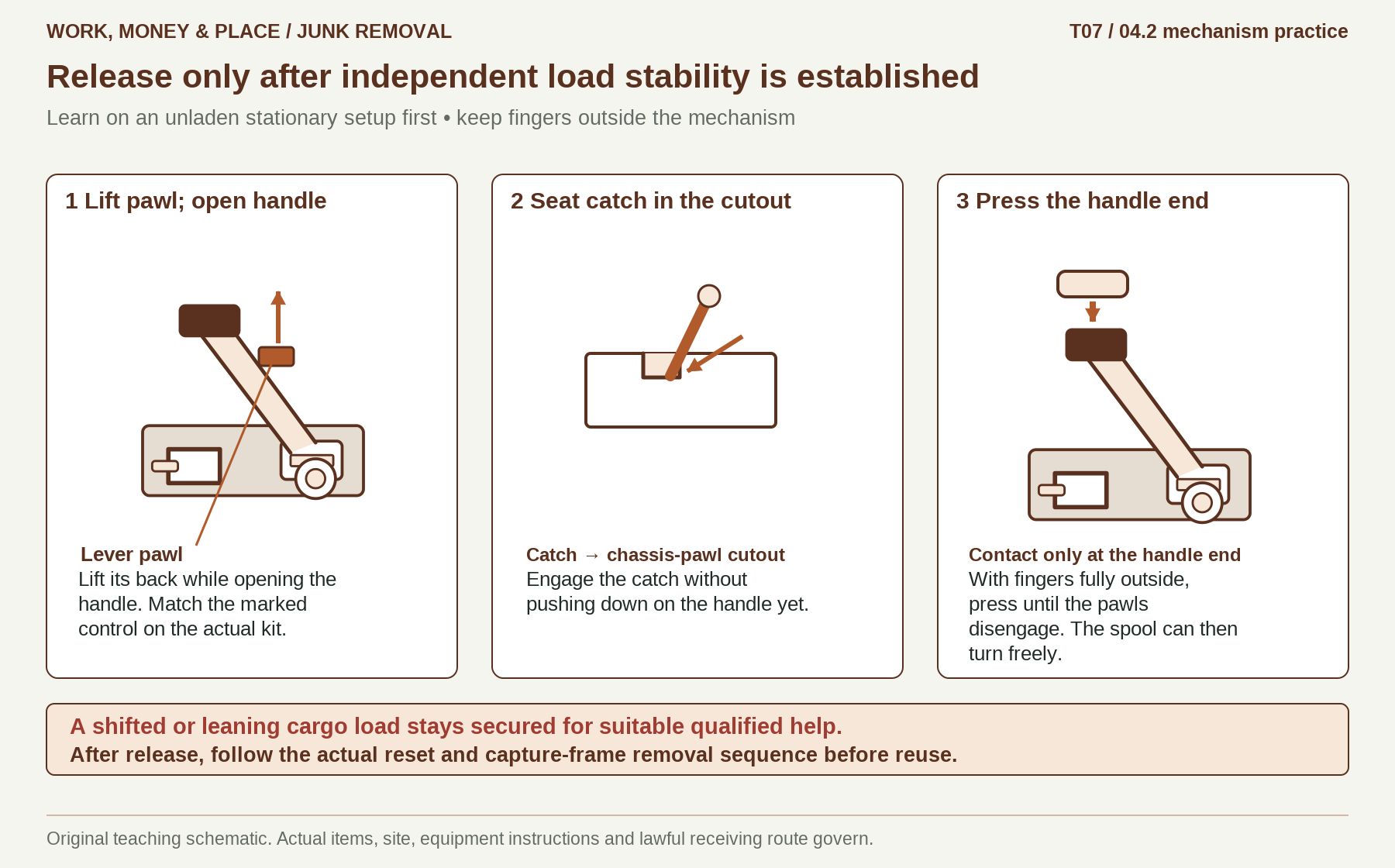
Take the free end around the second suitable anchor and back to the ratchet. Align the spool opening upward, feed the end up through it and pull out slack. Keep the webbing aligned while ratcheting; meet the manual’s minimum one-and-a-half spindle turns. Use only the validated tension and arrangement. To release, lift the lever pawl while opening the handle, engage its catch in the chassis cutout, then press the handle end with fingers completely outside the mechanism. Follow the manual’s reset sequence before reuse. Practice manipulation without a tensioned cargo load first.

Open the full-size illustration
Illustration sources: JT14.
Open the full-size illustration
Illustration sources: JT14.
Open the full-size illustration
Illustration sources: JT14.
Restrain the load; then add separate containment
Use the actual arrangement and manufacturer instructions to install every restraint; keep people out of the potential release path. Check that releasing a strap will not cause an item to fall. The CamJam instructions specify paired restraint arrangements and permit frictional lashing only for appropriately labeled products; do not substitute the federal minimum count for a stricter manufacturer instruction. If the planned lashing method cannot be supported by the label or instructions, change equipment or method before the load moves.
Texas Chapter 725 treats refuse as loose material and gives its own commercial-vehicle definition. For a vehicle used primarily in the business of transporting property, loose material must be covered with the covering firmly secured at front and back, or completely enclosed in the load compartment. Its low-load exception is not the commercial exception. Keep the tailgate securely closed and remove loose material from non-load-carrying parts. A cover contains loose material; it does not replace the cargo-restraint system.
Perform a departure check that can fail
Inspect each attachment, locking mechanism, edge contact and free webbing end from a safe accessible position. Check movement control in every direction required by the verified plan. Do not pull violently, stand in a tension line or claim a shake proves crash performance. Record a context photograph only after the check, with permission. A tight strap can still be attached to the wrong point or crush a failing object.
Compare the actual load and placement with J05’s documented predeparture capacity basis, confirm tire and vehicle condition, and record the final item count. Distinguish calculated axle/gross values from actual readings and complete loaded weighing when the instructions or assessment require it. Check closed tailgate, cover fastenings, lights, plate visibility, mirrors and the driver’s unobstructed controls and exit. If any limit, anchor evidence, receiver gate, restraint or road condition is unresolved, unload or hold on the permitted site. A supported calculation is not the same thing as a measured result; neither can be invented to clear departure.
Put it into practice
Your assignment
Find the unsafe substitutions in a proposed load.
Inputs
- Operator has copied a cargo-anchor number from another Ford model.
- A cover is tight, but a rigid crate can slide forward under it.
- The CamJam manual’s required labeling for a proposed frictional method is absent.
- Final rear axle scale reading is over the actual rating.
Your deliverable
J05/J08 corrected plan and a departure decision.
Saved only in this browser when storage is available. Export a separate copy using fictional identifiers for practice.
Show the worked answer
- Reject the unrelated anchor number; resolve the actual F-150 anchor evidence. The model name and the strap’s WLL do not supply it.
- Hold: independently restrain the crate under a supported full arrangement; covering alone does not restrain it.
- Do not use that method; obtain compatible labeled equipment and verified instruction or revise the supported plan.
- Do not enter public roads. Remove/revise safely on site, then obtain fresh evidence for all limits.
Show the self-check criteria
- Mechanism practice is distinguished from road-load validation.
- Cover, restraint, payload and each axle can fail independently.
- No numerical strap count or tension is declared universally sufficient.