Document coverage questions, transaction classification, tax duties and records for the actual service.
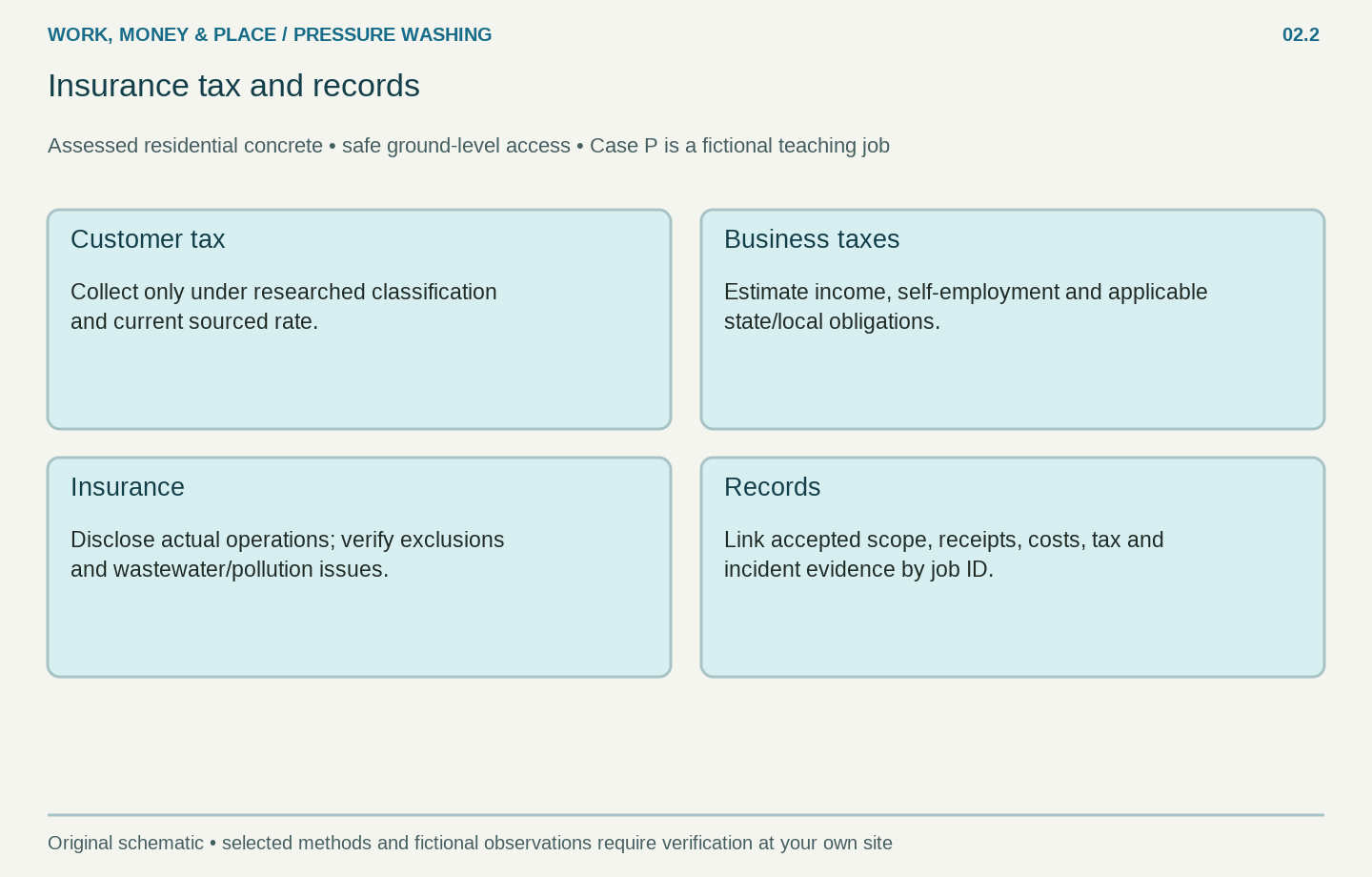
Open the full-size diagram
Example and worksheet
- P04 working form
- P05 working form
- Case P 02 · Complete accepted scope and contract formation
- Case P 06 · Price and owner labor calculation
- Case P 10 · Chronological cash and tax reserve
- Case P 11 · Launch funding and operating alternatives
Study the filled First plan tab. Enter your own work in the separate blank Your estimate tab. Select the tab inside the downloaded file; this link downloads the whole workbook.
Describe the operations to the insurer
Give the licensed insurance professional a concrete description of what you plan to do: residential concrete cleaning, machine and attachments, water-only work or named products, recovery and disposal, work near customer property, transport and any employees. Ask how the policy treats damage to the surface being worked on, overspray, water intrusion, pollution or wastewater allegations, tools in transit, borrowed or rented equipment and business vehicle use. These are questions to resolve, not a statement that a generic liability policy covers them.
Read the actual policy and endorsements, not only a certificate. Record limits, deductibles, exclusions, conditions, covered entities and operations, claim-notice instructions and renewal dates in P04. NAIC explains that a business owners package typically does not include commercial auto or workers' compensation. The appropriate arrangement depends on your circumstances. A low premium cannot be judged useful without knowing the coverage and obligations attached to it.
Keep tax classifications separate
Determine whether your specific service is subject to customer sales tax, which location controls the rate, whether a business receipts tax applies, and what federal and state filings apply to your entity. Customer tax collected is distinct from net service revenue. It should not be treated as spare operating money merely because it arrives in the same payment. P05 records the exact transaction description, authority, rate basis, effective date and unresolved questions.
Washington's DOR business-tax workbook lists pressure washing among activities subject to retailing B&O and retail sales tax; its cleaning guide distinguishes specialized cleaning from ordinary janitorial services. Use the current DOR guidance and actual facts to establish classification and sourcing. Case P's ten-percent customer-tax input is fictional arithmetic; it is not a current Vancouver rate determination. The case's jurisdictional wastewater illustration does not establish its assumed tax rate.
Plan for business and personal tax obligations
The planner's owner labor value is a management input used to judge whether a job supports the owner's time. It is not a payroll calculation or automatic tax deduction. Equipment allocations are also management assumptions, not tax depreciation instructions. Do not transfer the course's management result directly to a tax return. Preserve the source records and obtain the accounting treatment appropriate to the entity, transaction and year.
Establish a record trail
Use a job identifier to connect the inquiry, survey, accepted scope, compatibility evidence, disposal authorization, invoice, payment and actual-cost comparison. Keep purchase receipts, equipment information, mileage or other transport records as appropriate, stock movements and disposal records. Record corrections without silently overwriting the accepted version. The IRS emphasizes records that clearly show income and expenses and support reported tax items; retention depends on the record and its purpose.
Resolve hiring before adding help
A helper changes legal, safety, scheduling and cost assumptions. Federal employment-tax classification considers control, financial arrangements and the relationship as a whole; a contractor label or tax form does not decide it. Washington workers' compensation applies its own tests and explicitly warns that a 1099 alone does not establish exemption. Other wage and labor rules also need current jurisdiction-specific review before hiring.
Record the intended arrangement, agency guidance, payroll and insurance actions, training duties and total employment cost before booking work that depends on help. Do not let an urgent customer date force an unresearched staffing decision. If you remain a solo operator, state that in the estimate and assess whether the site can be controlled by one competent person. Maintain P04 and P05 when activities, staffing or locations change, rather than renewing a policy or tax assumption without reviewing the underlying work.
Check that the policy review describes the business that will actually invoice the customer. If the legal name, operator, vehicle or service changes, tell the appropriate professional and retain the updated response. A question asked about a different business arrangement cannot safely be reused as a conclusion for the new one.
Put it into practice
Your assignment
Audit an incomplete protection and tax packet.
Inputs
- A certificate says general liability.
- The owner assumes all cleaning is sales-tax exempt.
- A friend will be paid cash and called a contractor.
Your deliverable
P04 and P05 questions and HOLD actions.
Saved only in this browser when storage is available. Export this page separately and use fictional identifiers in practice.
Show the worked answer
- Request policy and endorsement review for the described work, wastewater, equipment and vehicle use.
- Research the precise service classification and current rate; keep Case P tax fictional.
- Resolve classification, required coverage and payroll before using the friend as planned labor.
Show the self-check criteria
- No certificate is represented as a coverage ruling.
- Tax collected remains separate.
- Cash payment does not determine worker status.