Use one evidence-and-dependency map to accept a supported first pressure-washing order, HOLD unresolved requirements or decline an unsuitable request.
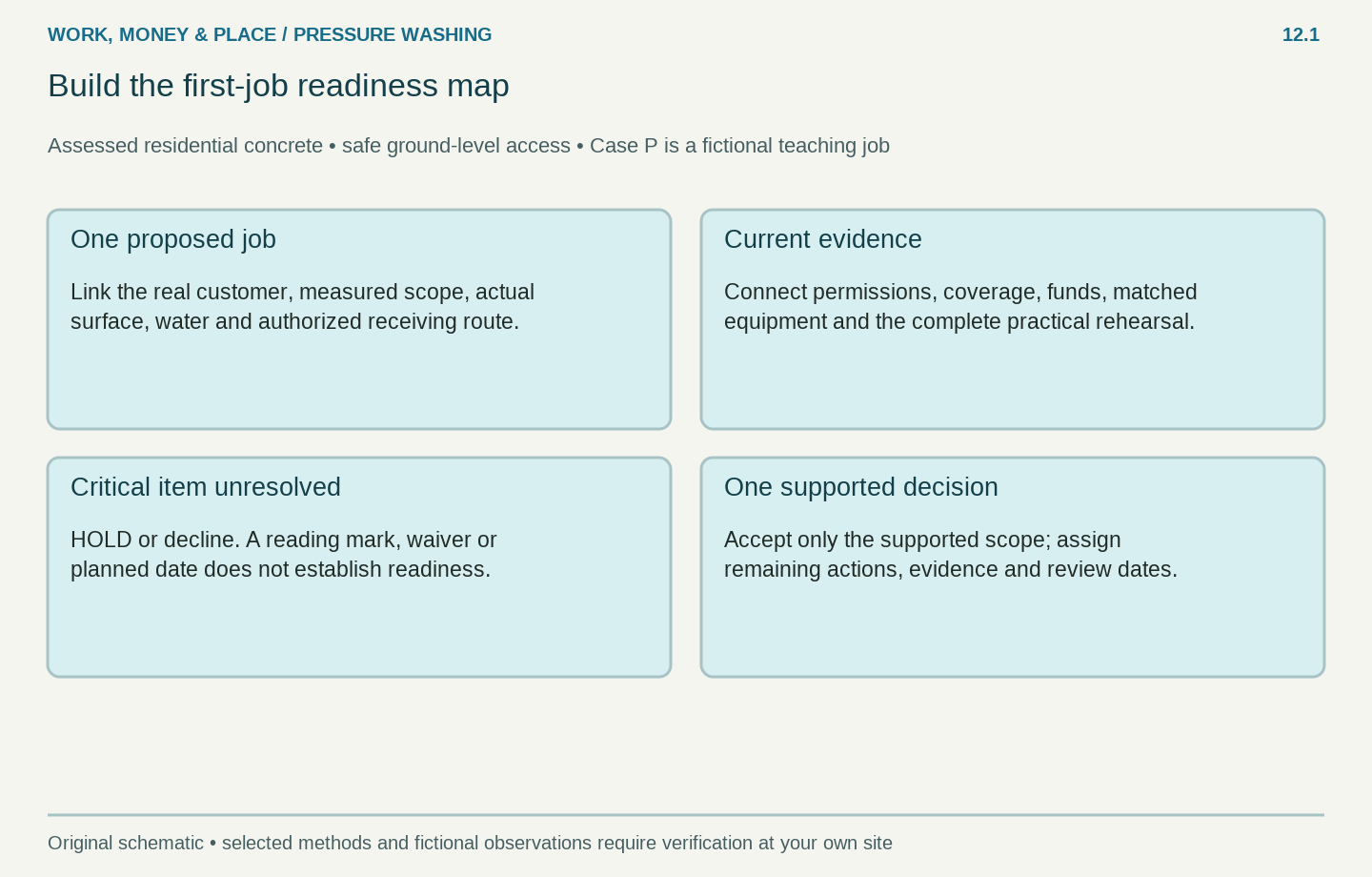
Open the full-size diagram
Example and worksheet
- P01 working form
- P02 working form
- P21 working form
- P24 working form
- Case P 01 · Survey and measured site
- Case P 02 · Complete accepted scope and contract formation
- Case P 03 · Equipment and surface compatibility
- Case P 04 · Water supply and lawful wash water handling
- Case P 05 · Safety and stop work decisions
- Case P 06 · Price and owner labor calculation
- Case P 07 · Purchases stock and complete work schedule
- Case P 10 · Chronological cash and tax reserve
- Case P 11 · Launch funding and operating alternatives
- Case P 12 · Complete the case audit and your own job
Study the filled First plan tab. Enter your own work in the separate blank Your estimate tab. Select the tab inside the downloaded file; this link downloads the whole workbook.
Follow one proposed job through the file
Center P24 on one identified candidate order. Link the P01 offer, customer/property assessment, business and activity requirements, actual policy/tax review, exact equipment/compatibility record, wastewater authorization and physical-route evidence, completed rehearsal, estimate and funding plan. Record each version and date reviewed. The map should show that these records describe the same surfaces, method and conditions rather than a collection of completed but unrelated forms.
Give every open item an owner, next action, required evidence and review date. Separate verified facts from assumptions and planned applications. Case P shows fictional complete assumptions; it supplies no permission, practical pass or utility response for your property. A useful map can be understood by another competent person without relying on your memory or a conclusion that everything looks fine.
Decide whether the property and the promise fit
Use the early screening from Lesson 01.1. Confirm actual customer authority/consent, included sound mature uncoated poured concrete, ordinary-soil result, access, supply, engine placement, public controls and the complete route. The selected engine’s outdoor, carbon-monoxide, combustion and fueling requirements remain part of site fit. A constrained patio does not become suitable because its square footage is small or the owner accepts the risk.
Compare the proposed promise with the supported method. Roofs, ladder spraying, unknown coatings, repairs, hazardous contamination and unsupported special stain treatment remain outside the starter offer. Do not add an attractive request to repair weak demand without developing the separate method and obligations. Preserve the sales history and current acceptance conditions so a new onsite proposal is reviewed honestly rather than backdated into a remote agreement.
Require both lawful discharge and a workable transfer
Identify the actual authority, named approved receptor, written limits, contaminants, receiving conditions and records before generating wash water. A property owner’s sink or a paid disposal budget is not authorization. Case P’s dated AUTH-P-01 is an invented teaching condition, not a permit you may reuse or an agency turnaround promise. Storm drains, lawns, septic and sanitary fixtures are not interchangeable general disposal options.
Then check the physical route independently. The case drum and stationary low tray stay floor-supported while small handled portions bridge the height to the sink. A legal destination does not prove safe lifting, clearances, capacity, receiving rate or complete time. Your permitted preparation must demonstrate the actual route and individual handling limits. A plan requiring a loaded-drum lift, unassessed pan, stairs or an unsuitable reach remains HOLD until redesigned and verified.
Link the rehearsal instead of repeating a paper pass
Use Lesson 06.3 and P02 for the complete practical evidence: selected setup, adequate supply, public separation, inconspicuous surface test, supported washing, containment/recovery, stop response, shutdown and lawful disposal. Obtain appropriate instruction and correction. Written answers, a course completion mark or ownership of the named machine do not establish competence or capacity. Keep the actual observed limits with the equipment and site to which they apply.
The revised Case P budget is 7.5 owner hours, including 100 minutes for 100 small-jug transfer cycles and 39 minutes for thirteen drain/reset cycles. These are paper planning allowances, not demonstrated speed. If your supported complete process takes longer, reduce scope, change the supported arrangement or revise the time and price before acceptance. Do not rush disposal or omit controls to achieve the fictional schedule.
Check the water budget in that same rehearsal: the unverified 94-gallon total includes only four gallons beyond modeled washing for every required flush, purge, warm-up, rinse and restart flow. Mandatory controls cannot be shortened to preserve the allowance. Actual extra flow, batch restarts, cooling or receiving limits can invalidate the 255-minute task and 7.5-hour owner plan; revise capacity, batches, time and cost from the full permitted check.
Check the legal, customer and funding commitments together
Confirm current applicable entity/activity/local permissions, coverage review, tax classification, any worker arrangement and consumer-rights workflow for the actual sale. General background is in the optional WMP Business Reference; the required decision here is whether this business and job satisfy the relevant conditions. An unanswered classification question, pending authorization or expired document has an owner and action, not a presumed pass.
The customer retains the complete surface schedule, preparation, limitations, price/tax, receipt timing, inspection, cancellation and change process. Check the estimate against that promise and preserve its accepted baseline. P21 must show available startup/bridge funding; the dated cash plan must preserve held customer tax and the chosen unrestricted cushion. Keep household needs separate. A positive end balance cannot compensate for a payment that cannot be funded when due.
Record one decision and the next review
Record accept, HOLD or decline in P24. Accept only the assessed supported service, subject to conditions that must remain true. HOLD identifies a missing or failed requirement and prevents the affected commitment until evidence resolves it. Decline is appropriate when the request is outside the supported offer or the property cannot fit the selected system. Never average several completed administrative tasks against one unresolved legal or safety gate.
Use a calendar to sequence research, funding, supported system selection, practical preparation, customer qualification and acceptance; it cannot promise readiness within thirty days. Before departure, reconfirm current conditions. After genuine work, use technical shutdown/recovery, the customer handoff and actual-cost review to close or reopen actions. Another customer is a fresh assessment, not a subscription guaranteed by the first completed form. End with a defensible next action and the evidence required to take it.
Put it into practice
Your assignment
Make one first-job readiness decision from a linked evidence map, rather than a calendar score.
Inputs
- Offer, policy questions and estimate are documented, and a launch message is drafted for Day 15.
- No actual utility authorization exists for the proposed receptor. The customer offers a waiver.
- The supported shutdown/recovery rehearsal is incomplete; the proposed transfer would require handling a loaded drum over a step.
Your deliverable
P24 HOLD/decline decision linked to P01/P02/P21, with the responsible authority, physical-route redesign, evidence needed, funding dependencies and next review dates.
Working forms: P01, P02, P21, P24.
Saved only in this browser when storage is available. Export this page separately and use fictional identifiers in practice.
Show the worked answer
- HOLD performance until the actual lawful route and its conditions are established. A customer waiver does not authorize discharge.
- Independently redesign and demonstrate a supported recovery/transfer arrangement; a legal destination would not prove a loaded-drum lift or step route safe.
- Complete the permitted full-cycle rehearsal and revise capacity, time, cost or scope from real evidence. The fictional 7.5-hour plan is not a productivity target.
- Keep the message as an unsent draft or revise the date while critical gates remain unresolved. Preserve completed research without claiming an overall pass or invented first customer.
Show the self-check criteria
- Every required gate is supported by the actual service, site and evidence, or has an explicit blocking action.
- Legal destination and practical handling/capacity are checked separately.
- A date, waiver, written exercise or positive calculation cannot override an unresolved critical requirement.