Watch our Window Cleaning business episode on YouTube ↗
Start with the business overview, then use the lessons and worksheets for the detailed launch plan. The video opens in a new tab.
Define an initial residential service with a measurable result, clear boundaries, and a complete owner-operated job cycle.
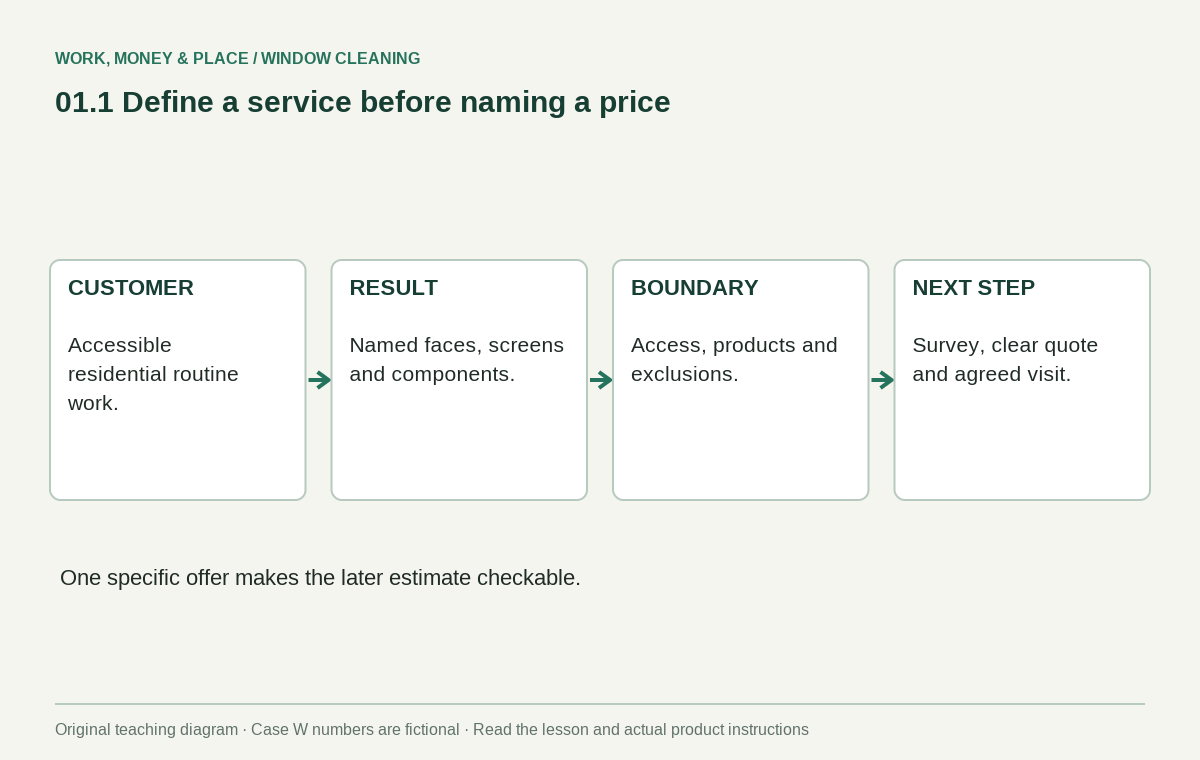
Open the full-size diagram ↗
Example and worksheet
Read the numbered Case W sections for the related fictional records. Apply the method to your own conditions.
Start With a Result You Can Describe
A window-cleaning business sells an agreed result at a property, not a bucket of supplies or a promise to make every surface look new. Your starting offer needs a customer, an accessible type of property, included surfaces, exclusions, and a way to inspect the work. Write those decisions before choosing a company slogan or buying a large equipment package.
The course model is a solo owner providing routine cleaning of accessible residential windows. Ground-level exterior access and suitable interior access keep this first operating model focused. You will learn to assess each property, select a compatible method, practice it, price the defined scope, and manage the visit. Owning a tool does not establish that every window is reachable with it.
Our recurring teaching property is fictional. Its schedule contains 12 window units, 20 glazing sections, and 40 cleaning faces, plus the separately agreed screen, track, and wipe tasks. Those counts describe different things; they are not interchangeable billing units. The $320 first-visit package is an invented training price. It does not tell you what customers in your city will accept.
Choose the Initial Customer and Service
Describe a customer situation precisely enough to recognize a suitable inquiry. For example, a homeowner wants routine cleaning of accessible glass, has ordinary accumulated dirt, can provide the agreed access, and wants the work completed during a confirmed appointment window. This description is more useful than “anyone with dirty windows,” which includes jobs needing different preparation, equipment, or expertise.
Separate the basic glass service from component tasks. Exterior and interior faces, removable screens, accessible frames and sills, and routine track cleaning can take different methods and time. Include them only when defined. Saying that screens are included without counting them leaves a broken frame, an inaccessible clip, and an ordinary removable screen hidden under the same vague promise.
A usable first service sentence is: “We provide assessed routine cleaning of agreed accessible residential glass and the components listed in the accepted quote.” Follow it with the service area and a short explanation of assessment. This is sample service copy. Your final wording must fit your own ability, insurance, local requirements, and the work you actually choose to accept.
Define the Limits Before They Become a Surprise
This edition does not teach ladder, roof, suspended, or rope-access work, construction-debris removal, glass restoration, or a universal scraping or chemical method. These activities are outside the initial offer. A request involving them is a decision to decline or refer the affected work, rather than a reason to improvise during an otherwise ordinary visit.
An exclusion should tell the customer what happens next. If a marked coating, damaged screen, difficult access, or persistent deposit prevents the quoted routine method, identify the affected item, pause that work, and discuss a revised scope or a suitable referral. Do not hide a newly excluded item until the final invoice. Record what remains included and any accepted price or schedule change.
Boundaries also apply to quantity. The training package includes 8 suitable screens, 8 routine track sets, and 12 defined wipe areas in addition to the glass faces. It does not include any item a customer later points to merely because it is nearby. A clear boundary supports a reliable quote and makes your inspection criteria possible to explain.
See the Entire Owner Operated Cycle
The owner is responsible for more than the time a squeegee touches glass. An inquiry may require a reply, a photo review or site assessment, a quote, customer preparation, packing, travel, access checks, cleaning, inspection, correction, handoff, payment reconciliation, restocking, and records. Those activities consume capacity even when they are not separate customer invoice lines.
The first teaching visit uses a fictional five-hour full cycle. That is an input for practicing business arithmetic, not a beginner productivity promise. Later lessons connect it to phase records. Your own time study should identify where each activity belongs and prevent a trip or an administrative task from being counted twice under different names.
Keep the operating model small enough to control. A second worker changes coordination, pay, classification, insurance, training, and supervision. A larger service area changes travel and appointment risk. A second method changes kit and preparation. Start with a coherent model, then expand a specific constraint using evidence from actual completed work instead of assuming every extra service improves the business.
Create the First Version of Your Offer
Complete W01 as a decision record. Name your customer, proposed service area, method boundary, included and excluded tasks, assessment process, who performs the work, and the next action before selling. Add a version and date so later changes to your offer can be connected to the quotes and inquiries they produced.
Use the teaching case to test the clarity of your sentence. Could a reader tell that the quote covers both agreed glass faces and only the listed component tasks? Could the same reader identify an upstairs exterior request or construction paint removal as outside this initial service? If not, revise the offer rather than adding a long disclaimer after a broad promise.
Your first offer is a hypothesis you will test in Module 02. It is not proof of demand or a commitment to accept every inquiry. By the end of this lesson, you should be able to explain one suitable job, one unsuitable job, and what you must check before issuing a real quote. Keep the answer specific enough that another person could use it consistently.
Put it into practice
Your assignment
Write W01 for a focused routine residential service and classify three sample inquiries.
Inputs
- Teaching case: 12 units, 20 glazing sections, 40 cleaning faces, 8 screens, 8 track sets, 12 wipe areas.
- Inquiry A matches accessible routine work; inquiry B asks for roof access; inquiry C adds construction-paint removal.
Your deliverable
A dated service profile, inclusion/exclusion list, and a next action for each inquiry.
Working forms: W01.
Saved only in this browser when storage is available. Export this page separately and use fictional identifiers in practice.
Show the worked answer
- Accept A only after property assessment confirms the stated access and condition.
- B is outside the initial access model; do not promise roof work.
- C needs a separate specialist decision; do not include paint removal under routine cleaning.
- State both glass faces and the counted component tasks separately; the training $320 is not your price list.
Show the self-check criteria
- The offer identifies a customer and property type.
- A named boundary changes the acceptance decision.
- No fictional job, price, or experience is presented as a real customer result.
Sources: BIZ-SBA-PLAN, BIZ-SBA-LAUNCH.