Run a bounded offer test and revise the service area using the full cost and quality of the resulting opportunities.
Open the full-size diagram ↗
Example and worksheet
Read the numbered Case W sections for the related fictional records. Apply the method to your own conditions.
Define What Counts Before You Start
An offer test needs a clear question and a measurement rule. Decide which service, customer group, area, and channel you will test, how much time or money you can commit, and what evidence you will record. Without that boundary, it is easy to keep spending after poor results or to claim success from activity that did not produce suitable work.
Distinguish a contact, an inquiry, a qualified inquiry, a quote, an accepted appointment, and a completed paid job. A contact can be any response. A qualified inquiry fits the proposed area and routine-service scope and can proceed to assessment. A quote is a defined offer, not a generic price range. Acceptance and completion are later events and need their own records.
Use W04 to declare the test and W01 to lock the version of the offer being tested. If you change the headline, included components, area, and price at the same time, the results will not tell you which change mattered. Where a change is necessary, note its date and version so the earlier and later observations are not silently merged.
Use a Small Test That You Can Fulfill
Your test capacity must match your readiness and calendar. Do not publish a broad service promise merely to discover how many people respond. Offer only work you can assess and deliver within the boundaries already defined. Keep time for replying, assessment, quoting, and preparation; an inquiry that you cannot answer until days later does not test only customer demand.
A fictional test might use one approved channel and a fixed effort limit in a small area. Its purpose could be to learn whether customers understand the difference between glass cleaning and screen/track tasks. You would record their questions, the properties that qualify, the time spent assessing them, and the reasons a quote does or does not proceed.
Advertising is only one possible way to collect evidence and is not required for the course exercise. A draft message and a simulated inquiry log are sufficient for private practice. Any real advertisement, listing, outreach, or booking should use truthful claims and comply with the applicable platform, solicitation, privacy, and consumer rules. The worksheet does not publish or contact anyone automatically.
Measure the Funnel Without Changing Denominators
Acquisition Test A is the linked fictional example used again in lesson 07.2, form W14 and its funnel diagram. It produces 10 inquiries. Six fit the area and routine-service boundaries, four receive a complete quote, and two accept. The acceptance rate from quoted opportunities is 2 divided by 4, or 50%. The acceptance rate from all inquiries is 2 divided by 10, or 20%. Both calculations can be correct when their denominator is named.
Neither percentage proves a stable conversion rate. The test is small, the offer is specific, and the outcomes may not yet include completion, collection, or quality. Record the result as two accepted appointments from that test, then continue tracking whether the work was performed as promised, paid, and completed without avoidable return visits.
If the test used $40 of cash spending and 3 owner hours, the cash spend per accepted appointment is $20. That is not the full acquisition cost: the owner time remains separate and needs a stated management value if you use it in a cost comparison. If one accepted appointment later cancels, update the completion-based measure without rewriting the original acceptance event.
Check the Service Area Against the Full Cycle
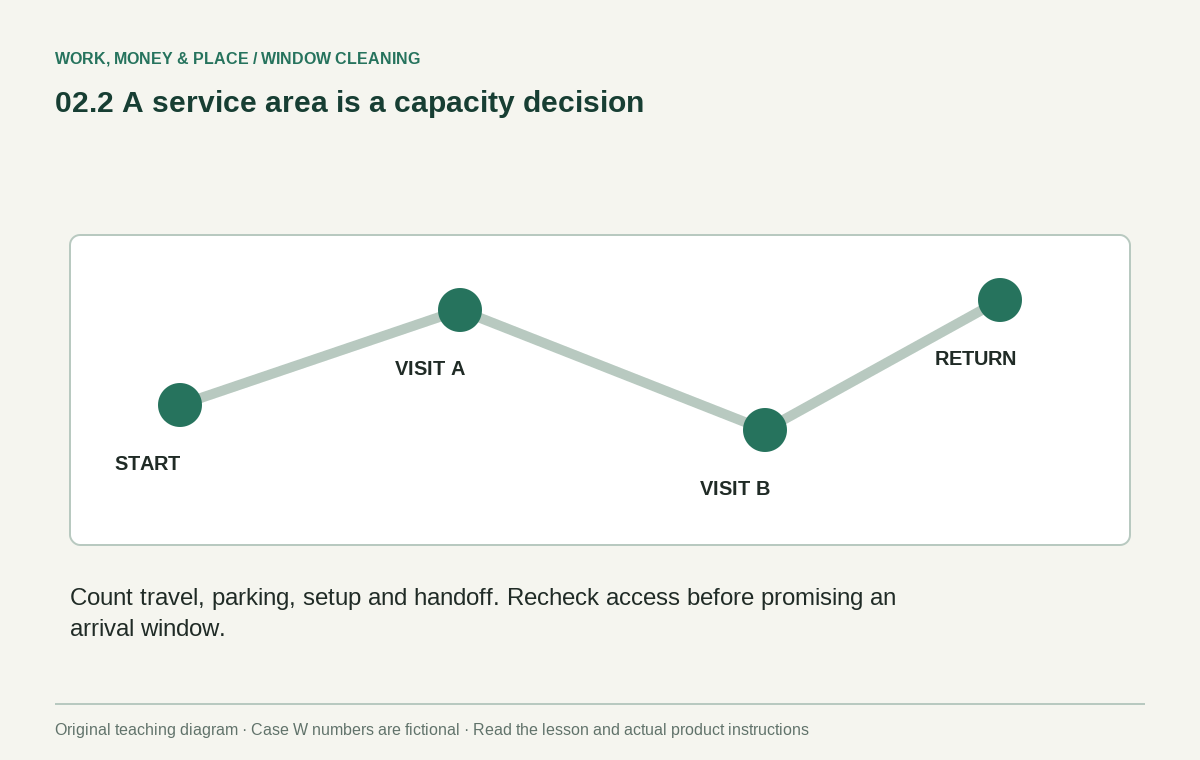
A distant appointment may add revenue and still use more capacity than the price can support. Compare the actual journey, parking, access process, setup, cleaning, handoff, and record time. Do not reduce a travel estimate merely because the next job appears close on a map. The calendar needs an achievable sequence, not the shortest-looking line between addresses.
The teaching case later compares a first visit with a repeat visit, but it does not claim that every repeat is faster or every nearby route is more profitable. A repeat customer may have a changed scope or new conditions. A nearby appointment may have restricted access. Recheck those factors before using a shorter cycle in a quote or weekly capacity plan.
After a test, inspect where the unsuitable inquiries came from and why they failed to qualify. You might adjust the area description, make an exclusion clearer, or change how assessment photos are requested. Do not conclude that a neighborhood is “bad” from one difficult interaction. Improve the specific matching rule you can support with the observations.
Choose Continue Revise or Stop
End the test at its declared review point. Compare the results with the question you set, not with a success story you read elsewhere. Continue when the offer is understandable, suitable opportunities appear, and the delivery economics warrant another bounded test. Revise when an identifiable ambiguity or process issue prevents a useful conclusion. Stop an offer you cannot deliver within its promised boundaries.
Write the next action in a measurable way. “Improve marketing” is vague. “Change the service copy to list exterior faces and separately counted screens, then run the same inquiry process for the next defined test” is a decision another person can follow. Preserve the original results so you can compare the revised version without pretending the first test never occurred.
Use W01 and W04 together. W01 says what you offer; W04 says what evidence led you to that version and what you will test next. A well-run small test can produce a useful correction even without a sale. It should not produce invented reviews, unsupported experience claims, or commitments you cannot fulfill just to make the numbers look encouraging.
Put it into practice
Your assignment
Interpret the fictional funnel and write a bounded next test without launching an advertisement.
Inputs
- Acquisition Test A: 10 inquiries, 6 qualified, 4 complete quotes, 2 accepted appointments.
- $40 test cash spend and 3 owner hours.
- One proposed change to component wording, with service area and channel held constant.
Your deliverable
W01 revision and W04 test decision with named conversion and acquisition-cost denominators.
Saved only in this browser when storage is available. Export this page separately and use fictional identifiers in practice.
Show the worked answer
- Quote acceptance is 2/4 = 50%; inquiry-to-acceptance is 2/10 = 20%.
- Cash spending per accepted appointment is $40/2 = $20; the 3 owner hours are not included in that cash ratio.
- Keep completion, collection, cancellations, and return visits as later events.
- Example next test: clarify the included faces and separately counted component tasks, retain the same area/channel, and review after the declared effort limit.
Show the self-check criteria
- Every rate names its numerator and denominator.
- Cash spending and owner time are separate.
- A small sample is not presented as a stable market statistic.
- No real publishing or outreach is required by the exercise.
Sources: BIZ-SBA-PLAN, BIZ-FTC-REVIEWS.