Compile the complete cost of a defined visit while keeping stock purchases, consumption, owner time, reusable equipment, and overhead distinct.
Open the full-size diagram ↗
Example and worksheet
Use the worked Case W records, then prepare a separate file for your own job.
- Case W 05 · Separate stock purchases from stock used
- Case W 06 · Calculate the first visit and actual result
- Case W 07 · Count every owner hour once
- Case W 10 · Reconcile equipment overhead and launch cash
Download the formula planner ↓
Example tab: First plan. Your blank tab: Your estimate.
Read the filled example, then enter your own measured scope, dated costs, actual payment timing, and full-cycle hours in the blank Your worksheets.
Start with the service you actually agreed to perform
Build the cost from an accepted scope, not from an attractive amount you hope to earn. Case W contains twelve window assemblies, twenty individual glazing sections, and forty cleaned glass faces. It also includes eight removable screens, eight routine track sets, and twelve accessible frame and sill wipe areas. Those counts describe different work. A face price cannot silently include every screen, channel, restoration task, or difficult approach that might be found at another house.
For your own estimate, connect each activity to a quantity, a method, an expected duration, and a cost source. Identify which preparation and travel tasks are already included. If the supplier delivers supplies, do not also charge the same delivery as a second unexplained trip. If a helper is necessary for your selected method, include the full verified cost and working arrangement. The teaching case has one owner and no helper; zero help cost is a known case input, not a rule for every job.
Keep unknowns visible. An empty material-price or time field means the estimate is incomplete. A deliberate zero means you checked the category and found that it does not apply. A supplier price, a measured quantity, an actual receipt, and a fictional exercise assumption are different kinds of evidence. Record their dates and origins so you can replace an assumption without losing the reason behind the original estimate.
Count the supplies used without charging the purchase twice
Before the first job, the fictional business buys a sixty-dollar consumable lot. That cash purchase provides stock. The first visit is expected to use twelve dollars of it, leaving forty-eight dollars in inventory. The twelve-dollar usage belongs in the first job cost. The sixty-dollar payment belongs on its actual date in the cash calendar. Deducting both as separate job expenses would charge the same supplies twice.
The example usage consists of four dollars of compatible glass-cleaning consumables, three dollars of laundry consumables, two dollars of compatible screen-cleaning consumables, and three dollars of disposable protection, liners, and labels. These are fictional all-in cost allocations, not mixing directions or verified retail packages. Actual product instructions determine a compatible method and dilution; the estimate then records the cost of what that method consumes.
Use W10’s Consumable Stock Movement Log at Cost to record each opening, purchase, use, and loss event, with a dated running balance and its source or job ID. Opening stock plus purchases minus use and total losses equals closing stock. The repeat plan uses nine dollars from the remaining forty-eight, leaving thirty-nine, without a new purchase on that date. Record the total loss separately from the portion attributable to the current job: all loss reduces inventory, but only the supported job-related portion belongs in that job’s cost. A supplier return or unusual adjustment needs its own documented treatment rather than a guessed consumption entry.
Value the complete work cycle and shared resources
The owner plans five hours for the first visit, including inquiry, site inventory, quote, stock preparation, all travel, service work, quality checks, invoice, and records. Five hours is a fictional full-cycle budget, not a promise about a beginner. At a chosen management value of thirty dollars per hour, owner labor is one hundred fifty dollars. It is shown separately from cash paid to a helper.
Reusable equipment also supports the job. The case uses a four-hundred-twenty-dollar starter package and a six-dollar allocation per visit, based on a fictional seventy-service planning use. That is not a tested tool life, a manufacturer warranty, or a tax depreciation rule. Actual repairs, replacement needs, utilization, and product choices can change the allocation. A new cash purchase and the allocated management cost answer different questions.
The eighteen-dollar overhead allocation comes from a fictional three-hundred-sixty-dollar monthly budget divided by twenty completed visits. The budget includes insurance, communications, marketing, bookkeeping, and fixed vehicle/business-use costs. Twenty visits is a workload assumption, not a demand forecast. If fewer visits carry the same monthly costs, each must cover more overhead. Keep the complete overhead budget and the allocation basis beside the estimate.
Reconcile the direct cost and management result
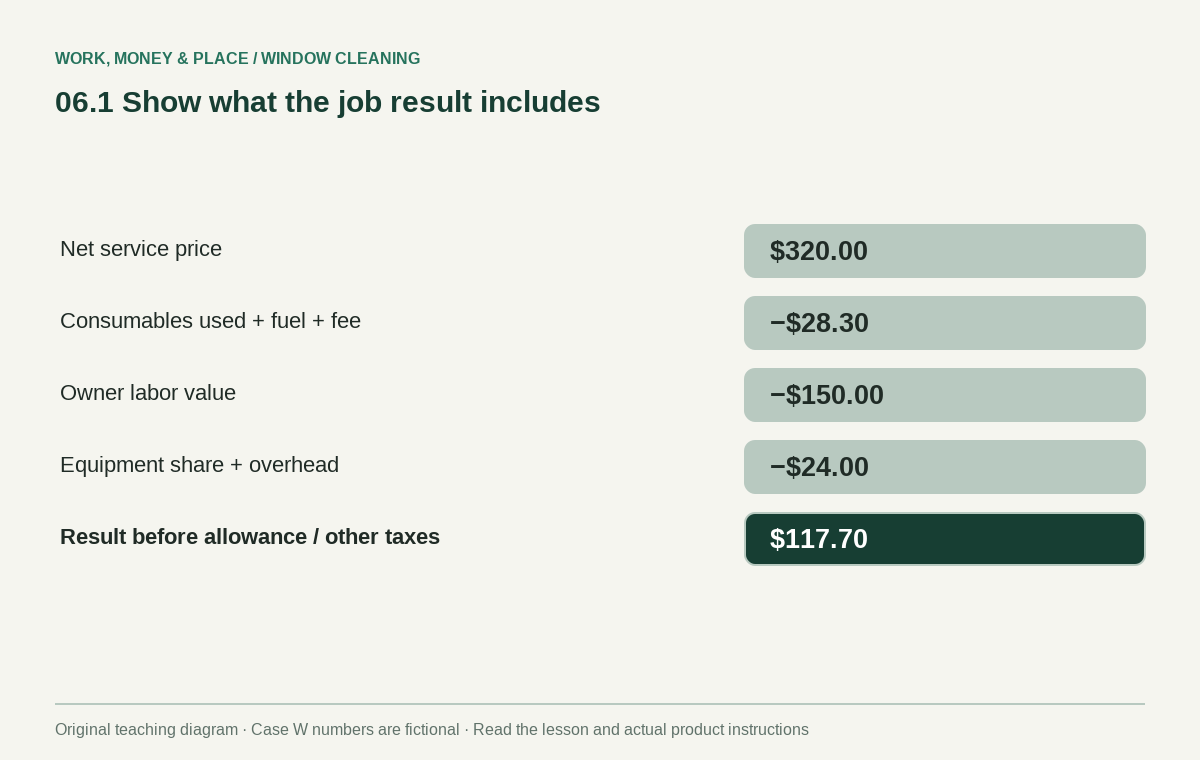
Case W uses twelve dollars of consumed stock, eight dollars of fuel, and one payment-processing fee of eight dollars and thirty cents. Those direct costs total twenty-eight dollars and thirty cents. The fee is calculated on the three-hundred-twenty-dollar gross receipt at a fictional two-and-a-half percent plus thirty cents. It is already included once; do not subtract it again after arriving at the direct-cost subtotal.
Subtract direct cost, owner labor value, equipment allocation, and overhead from the three-hundred-twenty-dollar service price. The result is one hundred seventeen dollars and seventy cents before a planning allowance and other applicable business taxes. A separate twenty-dollar planning allowance leaves ninety-seven dollars and seventy cents after that provision. The allowance is a plan for uncertainty, not proof that a bill has already been incurred.
Finish by testing the record as the person who has to perform the service. Does it cover stock usage, supported job-related loss, all travel, cleanup, laundry, payment costs, and follow-up administration? Does every purchased item appear in use, a separately explained loss, or remaining stock? Complete W10’s stock-log section and W11, then save the accepted dated version. A total you can explain and update is more useful than a percentage that conceals which work and resources it must cover.
Put it into practice
Your assignment
Build the first-visit cost from the case stock record and full-cycle time. Explain the difference between the sixty-dollar purchase and twelve-dollar consumption.
Inputs
- Case W scope and stock record
- First visit: $12 consumables used; $8 fuel; $8.30 processing
- 5 owner hours at $30; $6 equipment; $18 overhead; $20 allowance
Your deliverable
W10 Consumable Stock Movement Log at Cost and W11 estimate, with cost sources, owner labor, equipment, overhead, and an explained remainder.
Saved only in this browser when storage is available. Export this page separately and use fictional identifiers in practice.
Show the worked answer
- Stock: opening $0 + purchase $60 − job use $12 − confirmed losses $0 = closing inventory $48. The next opening is $48; it is not a refund to the bank.
- Direct cost: $12 + $8 + $8.30 = $28.30.
- Management result before allowance: $320 − $28.30 − $150 − $6 − $18 = $117.70.
- After the $20 planning allowance: $97.70 before other applicable business taxes.
Show the self-check criteria
- The full stock purchase is not also deducted as a second consumed-supplies cost.
- Owner hours include travel and administration once.
- Equipment purchase, allocation, overhead, and allowance are distinguished.
- Use and total loss are recorded separately; only the supported job-attributable loss is added to the job cost.
Sources: CASE-WC-01, BIZ-IRS-RECORDS.