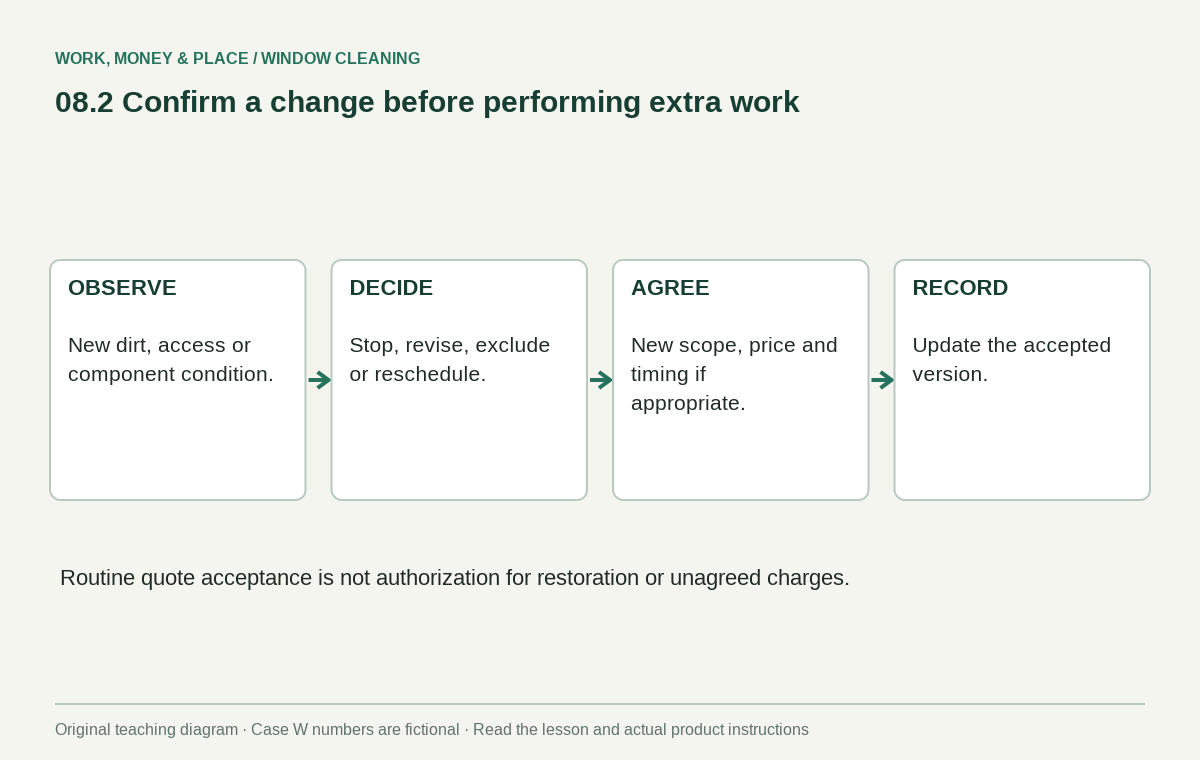
Use a documented decision process for changed access, unsuitable conditions, scope additions, and payment delays without quietly changing the accepted result.
Open the full-size diagram ↗
Example and worksheet
Read the numbered Case W sections for the related fictional records. Apply the method to your own conditions.
Pause the Affected Work and Identify What Changed
A change is easier to manage when you can compare it with a recorded baseline. Open the accepted scope, count schedule, appointment arrangement, and relevant assessment notes. Identify the actual difference: an extra cleaning face, a screen not listed, a blocked area, a different condition, unavailable access, or a customer request for a task outside the routine offer.
Do not treat every difficulty as a billable change. An item you forgot to include in your own estimate may still be part of the accepted customer scope. An agreed task that takes longer than expected is not automatically additional work the customer must pay for. Separate an estimating or execution error from a genuine customer-approved change in the result.
Pause the affected operation before committing to a different method or price. Explain which identifier or component is involved and what you observed. The rest of the job can continue only when it is independent and suitable. A clear partial pause protects the decision process without making an unnecessary claim that every unexpected condition cancels the whole appointment.
Write the Options and Their Consequences
Use W16 to describe the requested or required change, the reason, the affected quantity and method, the price and tax implications, time and access effects, and who must confirm it. A customer should be able to understand the choice before the changed work occurs. A vague message saying “a little extra” does not define a new result or a new amount.
For an added routine component, you may quote the extra accepted work after assessment. For a blocked item, options may include the customer restoring agreed access, omitting a specifically identified part under an agreed revision, or rescheduling the affected work. For an out-of-scope condition, declining or arranging a suitable referral may be the appropriate option rather than trying a more aggressive method.
Record the selected option and confirmation, then revise the documents that depend on it. Update W08’s scope, W15’s customer amount or appointment terms, W11’s costs when needed, W12’s cash dates, and the work plan. Do not rewrite the original version as though the change had always been included. Preserve the chain so the final invoice and actual review can be explained.
Use a Practical Access and Weather Process
Agree who can provide access and how you will communicate before arrival. If the customer is absent or a necessary area is blocked, follow that process. Do not enter an occupied home or use private access information beyond the agreed permission. Record the attempt and outcome factually, without putting unnecessary personal details into public messages or calendar entries.
The selected method also depends on suitable conditions. Weather, footing, surrounding activity, or changed access can make an operation unsuitable. Use the relevant technical checks and stop criteria rather than a universal rule such as “we always work in rain” or “wind never matters at ground level.” A service boundary still needs a site-specific decision on the day.
Explain any rescheduling or cancellation charge before the original booking and ensure it fits applicable requirements. The course prescribes no universal fee. Do not invent a penalty after discovering a problem or use a charge to pressure the customer into accepting an unsuitable operation. Document a revised appointment or resolution and keep the original event for the later time and cost review.
Track Payment Timing Without Calling an Invoice Cash
The teaching first visit uses one payment after completion, but an issued invoice and a cleared bank receipt are different events. If payment is delayed, W12 must keep the receipt on its actual or explicitly assumed clearing date. Costs already paid remain on their dates. A positive eventual management result does not finance an earlier fuel or supplies payment.
Use the agreed invoice and follow-up process to investigate a missing payment. Verify the invoice reference, customer amount, method, due event, and any documented dispute or processing issue. Do not add an unauthorized late fee or take a repeat charge merely because a spreadsheet shows a shortfall. Payment-provider references and the actual account record are needed to reconcile what occurred.
Separate customer tax from the business’s own reserve decisions. For the main Washington routine example, the service invoice has no customer retail sales-tax addition. A different transaction may require another treatment. Whatever the case, protect applicable obligations and never let an unsupported negative reserve create imaginary available money. Resolve incomplete calendar events before using the funding total.
Close the Change and Learn From Its Cause
At handoff, reconcile the accepted original scope and all approved revisions to the completed work and final invoice. Name any item left open and the agreed next action. A customer should not have to infer that an uncleaned window was omitted, rescheduled, excluded after assessment, or simply missed. Use the same identifiers throughout the record.
Then classify the business lesson. A repeated access problem may call for a better preparation message or confirmation step. A repeated scope ambiguity may require clearer component wording. An estimating error needs a revised time or cost model, while a newly requested service may need separate training, insurance, and classification checks. The same extra hour can have different causes and therefore different remedies.
W16 is complete when the decision, acceptance, work, money, and follow-up agree. It is not a way to move every business risk onto a customer or to make a flawed original estimate disappear. Use the record to deliver the result honestly and to make the next comparable quote more informed. Clear changes support both customer understanding and a useful plan-versus-actual review.
Put it into practice
Your assignment
Apply W16 to an added component, blocked access, and a delayed-clearing payment in private practice.
Inputs
- The original routine-service scope and $320 first-visit teaching package.
- Scenario A: customer requests an unlisted screen; B: an agreed window is blocked; C: the post-completion receipt clears three days later than assumed.
Your deliverable
Three decision records with actions, required confirmation, affected documents, and a corrected cash-timing entry.
Saved only in this browser when storage is available. Export this page separately and use fictional identifiers in practice.
Show the worked answer
- A: assess the added screen, quote any accepted change before work, and revise scope/customer amount and internal plan consistently.
- B: pause that item, discuss restored access or an agreed revision/reschedule, and identify what remains deliverable.
- C: keep actual expenses on their dates and move the receipt to its actual or stated test clearing date; an invoice is not cash.
- A task omitted from your private estimate but included in the accepted scope is not automatically a customer-paid change.
Show the self-check criteria
- Genuine scope changes are separated from estimating errors.
- No altered operation or price is assumed accepted without the defined confirmation.
- Access, weather, fees, and payment actions follow disclosed applicable terms.
- The original version and subsequent decisions remain reconstructable.
Sources: BIZ-FTC-CANCEL, BIZ-FTC-PRIVACY, BIZ-IRS-RECORDS, WC-WA-DOR-JANITORIAL.