Choose and verify a surface-specific cleaning method before applying it throughout a property.
Open the full-size diagram ↗
Example and worksheet
Read the numbered Case W sections for the related fictional records. Apply the method to your own conditions.
Create a method card with a real decision
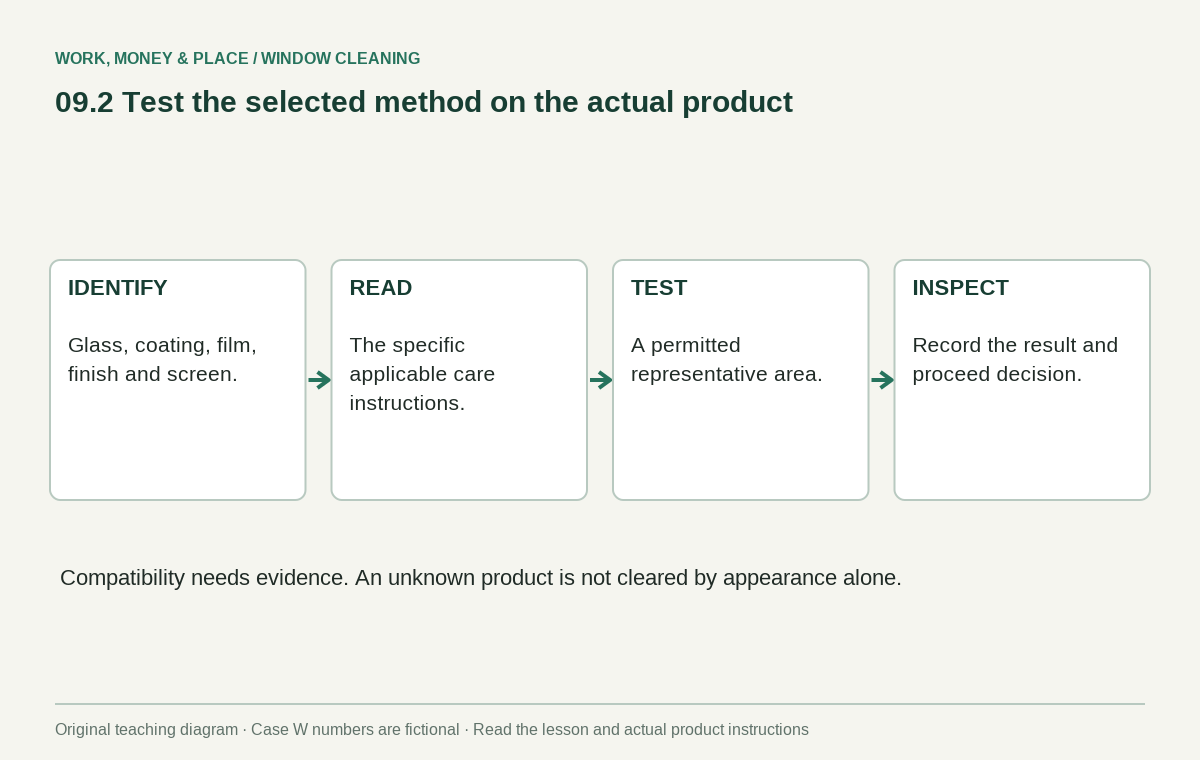
Before a paid visit, connect the proposed method to the actual window and cleaning product. On W18 record the unit or surface group, window maker or available identification, exposed coating or applied-film information, frame finish, selected cleaner, tool contact materials, instruction source, and date checked. Record any unresolved field rather than filling it with a reassuring guess.
Read the relevant care section and the cleaner label together. The window instructions establish what the surface can tolerate. The cleaner label and safety data sheet establish intended product use, handling, and protection. Neither alone answers every question. Screen or frame work may require a separate product choice or simply a different controlled-water method.
The method card should end in one of three decisions: compatible routine method ready for a test; information still needed; or outside the service offered. A test is the next step only in the first case. Trying an unapproved chemical on a tiny corner does not turn missing compatibility information into a sound operating method.
Handle manufacturer differences without inventing a universal mix
Imagine two surfaces that look similar. One identified product's instructions permit a listed general cleaner. Another carries an exposed coating with a more restrictive care path. You do not choose the first instruction because it is easier. Follow the specific instruction for each identified surface or select a common permitted method only if both instruction sets actually support it.
Andersen's HeatLock exception is a concrete illustration of this reasoning, not a claim that every property contains that product. Marvin's no-scraper glass guidance also shows why a scraper sold by a tool maker cannot establish permission on a particular window. For this course's starter service, blades and scrapers remain outside the method regardless of whether they appear in a tool catalog.
If a chosen concentrate calls for measured dilution, write the actual instruction and prepare it accordingly using dedicated measures. Do not copy a ratio from another brand, increase it to solve a stain, or add a second cleaner. A hypothetical arithmetic exercise can teach measurement, but the solution used on a customer's glass must come from the selected product's current directions and the surface compatibility check.
Read two completed method decisions
W18 includes two fully completed fictional records, separate from Case W. In Example A, a fictional owner order record and matching glass identification establish an Andersen 400 Series Tilt-Wash window with factory Low-E glass, no HeatLock, and no added film. This identification is a teaching premise, not a claim that a glance at glass reveals its coating. The room-side glass is accessible from the floor; finished wood and the sill are protected and are outside this product test.
Andersen’s applicable general glass instruction lists Windex Original Glass Cleaner for that identified non-HeatLock surface. The chosen US ready-to-use trigger product’s directions call for spray application and a dry low-lint wiping material. The example therefore selects a cloth method. It does not dilute the product or claim that a spray-and-wipe direction authorizes a bucket solution. W18 records the exact SDS identity, revision, contact, controls, test location, starting condition, after-drying observations, and decision.
The invented test result is clean-looking glass with no new mark observed under the recorded daylight and viewing conditions, plus a dry edge and sill. The filled record states the limits: a routine cleanliness check does not establish that fine scratches are absent. It is neither evidence of a real test nor permission for other coatings. Example B has an applied film whose identity and care instructions are missing. Its product selection is pending, no chemical test is performed, and the affected face remains on hold until the instructions and a compatible method are established.
Test one representative window deliberately
Choose an accessible opening representative of the surface, soil, and method you intend to repeat. Record its starting condition and the daylight, background, and safe viewing positions used for the check. Prepare the protected work zone, inspect clean contact tools, and apply the compatible routine process to a controlled small area or the agreed representative opening. Keep solution and tool contact within the intended surface.
Recover the solution and dry the edges and surrounding components. Check the dry result in suitable daylight from several safe viewing positions, including oblique views where practicable, with attention to different backgrounds. Look for streaks, drips, haze, marks, finish transfer, or an unexpected change. Compare with the starting record rather than assuming a visible defect was created or removed by cleaning.
Clean-looking glass is not proof that the surface is undamaged. NGA explains that fine-scratch visibility changes with daylight, sun angle, and background; a gray sky can conceal marks that become clearer in other light. Record visibility limits. If the available light or view prevents a meaningful damage check, hold wider use of the method until reassessed. Several views improve observation but do not certify the absence of scratches. Inspection visibility does not override product instructions about cleaning in direct sun or on hot glass.
If you see a routine execution problem such as a water line from a dirty rubber edge, correct that cause on the practice/test area and inspect again. If you see unexplained marking, coating response, finish change, or a condition that requires aggressive removal, stop that method. Preserve the record and resolve the issue before touching more openings. An unexpected result is information to act on, not a challenge to increase force.
Use a repeatable practice gate
For self-directed practice, choose an opening you own or have explicit permission to use and whose care requirements you can establish. Begin with accessible ordinary soil rather than an unknown stain. Practice the complete cycle until you can control the applicator, recover solution, keep surrounding materials dry, and produce an acceptable finish consistently. Record all time, including correction and reset.
A good practice result is not just clear glass. The surface and components show no unexpected change, the floor and sill are dry, the tool path stays controlled, and you can explain which instruction supports the method. A poor result includes repeated drips, uncontrolled overreaching, unexplained scratches or haze, or a method you cannot justify beyond a video recommendation.
Set a personal gate of three consecutive acceptable practice cycles on the selected ordinary configuration before offering that method. This is a course exercise criterion, not an industry certification or proof of competence on different materials. If you cannot achieve the result or cannot judge it reliably, obtain suitable practical instruction and supervised feedback. Change the service boundary rather than using a paying customer's property to discover the basics.
Keep a copy or reliable reference to the instruction you actually used. If a label, product, or surface changes later, reopen the decision instead of treating last month’s method card as permanent approval.
Put it into practice
Your assignment
Complete a method decision and controlled practice record for two different surface groups.
Inputs
- Group A has identifiable routine glass care instructions compatible with the selected product. Compare the decision fields with completed fictional W18 Example A; choose the method supported by the actual directions.
- Group B has an unknown applied film and no current care information.
- In a separate compatible washer-and-squeegee practice, cycle one leaves a streak and wet sill; cycle two corrects both. This execution exercise is distinct from W18 Example A’s cloth method.
- The test area looks clean in flat gray daylight, but the observer cannot meaningfully judge possible light scratches from the available view.
Your deliverable
W18 compatibility entries and a W19 practice result with a clear next step.
Saved only in this browser when storage is available. Export this page separately and use fictional identifiers in practice.
Show the worked answer
- Group A may proceed to a representative controlled test after normal checks. Record the exact surface, named product and matching instructions rather than writing only “glass” or “soap.” The completed cloth-method example is not a bucket-dilution approval.
- Group B stays pending film identification and instructions; a successful Group A test does not approve Group B.
- Cycle one is not acceptable. Investigate rubber/contact cleanliness and water control, repeat the cycle, and document the correction.
- Cycle two is one acceptable result. Complete the exercise gate consistently; do not call a single improved pass professional certification.
- Record the lighting, background, viewing positions, and visibility limit; do not label the surface scratch-free. Hold wider use of the method when a meaningful damage check is not possible, then reassess in suitable daylight without overriding cleaning or access instructions.
Show the self-check criteria
- A missing instruction remains visible and blocks the affected method.
- A test has recorded before/after observations and a proceed/pause decision.
- Practice criteria include property control, not only a photograph of clear glass.
- Surface identity, actual product directions, SDS identity, test observations, and decision are filled; fictional observations are not presented as real evidence.
- The record distinguishes acceptable cleanliness from damage assessment and states lighting/viewing limits; no absence-of-scratches guarantee is inferred.