Deliver the defined frame, sill, and routine-track package without flooding components or drifting into repair.
Open the full-size diagram ↗
Example and worksheet
Read the numbered Case W sections for the related fictional records. Apply the method to your own conditions.
Name the component work the customer purchased
Glass cleaning and surrounding-component cleaning are related but different tasks. A quick wipe of the edge after squeegeeing does not equal detailed track service. Before work, point to the agreed areas on one representative opening and make sure the customer understands the result. This prevents the phrase clean the windows from becoming a promise to restore every groove and stain in the assembly.
The teaching package includes twelve frame wipes and eight routine track sets. A frame wipe means the agreed accessible unit-frame surfaces receive compatible routine wiping and drying. It does not mean stripping paint, polishing oxidation, removing failed sealant, or refinishing wood. A routine track set means loose debris removal and damp wiping of specifically accessible areas of one operable unit, without dismantling the assembly or forcing access.
Use W08 to define any narrower limits, such as an inaccessible channel or finish that must stay dry. Check the actual material and care instructions. Vinyl, coated metal, composite, finished wood, sealant, and adjacent painted trim do not share an automatic cleaner approval. If the frame instruction conflicts with the glass product, separate the methods and protect the other material rather than using one solution everywhere.
Remove loose debris before adding moisture
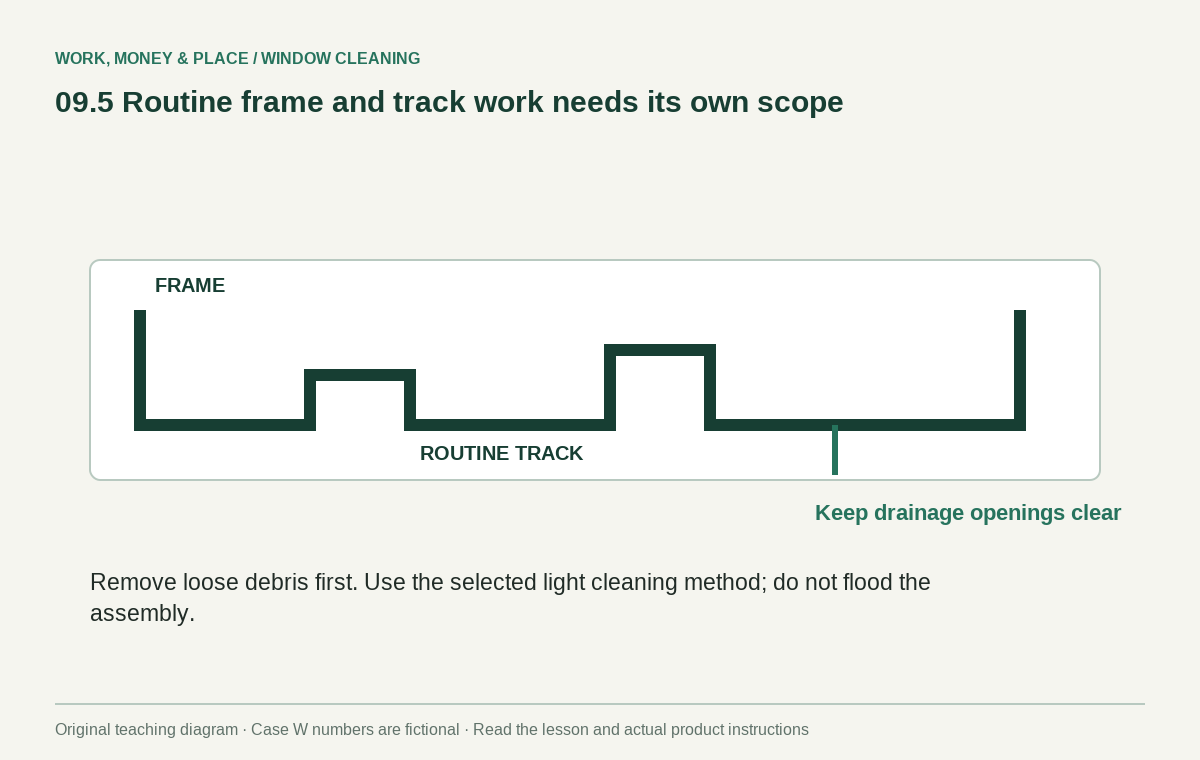
Inspect the accessible track or sill for sharp items, damaged components, and material that does not belong to ordinary loose household debris. Keep the window in its permitted stable position. Use a suitable soft brush and, where appropriate, a small dry vacuum with a non-marking attachment to collect loose dust and grit. Keep the nozzle controlled so it does not strike glass, drag grit over a finish, or pull at seals.
If the debris is wet, unknown, or unsuitable for the selected vacuum, do not use a machine intended only for dry material. Change to an allowed collection method or pause the affected work. Do not disassemble the window to reach hidden deposits. Loose debris removal should make the next wiping step easier; it should not create a repair task or scatter dust over glass that was already finished.
Plan the route so dusty preparation happens before final glass detailing when practical. Collect waste in the designated container and keep the dirty brush and track cloth away from the clean washer and glass cloths. The tool separation is a quality control measure: a single gritty cloth can undo several carefully cleaned faces.
Wipe with controlled moisture and preserve drainage
Apply the compatible product by the controlled method the instructions permit, often through a lightly dampened cloth rather than flooding the channel. Work a small accessible area, lift ordinary residue, change to a clean cloth section, and remove remaining moisture. Protect finished wood and adjoining sensitive surfaces from prolonged wetting. A wet sheen left in a recess is not proof that the recess is clean.
Keep drainage paths functioning as intended. Do not plug weep openings, inject tools into unfamiliar passages, or pack loosened dirt into them. This lesson does not teach drainage repair or leak diagnosis. If standing water, damage, or an uncertain opening suggests a problem beyond ordinary wiping, record the observation and stop the affected component work until the correct instructions or service provider resolve it.
Use gentle repetition only when the material and method permit it. Persistent staining, rust-like marks, mineral deposits, sticky residue, and suspected biological growth are not invitations to add an acid, bleach, abrasive pad, or stronger mix. Describe what remains, show the customer, and apply the existing exclusion or an appropriate separate service decision. The agreed routine result is cleanable loose soil removed, not a factory-new finish.
Verify the result at the component level
Inspect corners, accessible grooves, frame edges, and the protected sill after wiping. Look for loose debris, remaining ordinary residue, water, cloth lint, and solution carried onto adjoining surfaces. Correct in-scope misses with the permitted method, then dry. Check any normal operation you are authorized and competent to perform without forcing the mechanism.
Mark each completed track set and frame wipe against its unit. A fixed unit can have a frame wipe without an operable track set; this is why the teaching quantities are twelve and eight rather than both twelve. If one track cannot be accessed safely, its row must show the reason and the accepted change. Do not compensate for an omitted track by cleaning an unrelated piece of trim and keeping the same completion description.
Before the final glass check, make sure surrounding work has not left smears or dust on a finished face. This small return inspection is faster than discovering the problem at handoff. Capture a representative completion photo only with permission and keep it inside the private job record unless separate public-use permission exists. The record should show what was completed and what remains outside the service.
Put it into practice
Your assignment
Define and sequence a routine track and frame service for one operable and one fixed unit.
Inputs
- U02 has ordinary dry debris in agreed accessible tracks and a compatible finish.
- U10 is fixed and has a frame wipe only.
- A persistent dark stain remains after permitted gentle cleaning at U02.
Your deliverable
W17 component sequence and W19 completion record for both units.
Saved only in this browser when storage is available. Export this page separately and use fictional identifiers in practice.
Show the worked answer
- Prepare U02 by suitable loose-debris removal before damp wiping and drying; preserve drainage and do not dismantle the assembly.
- Record one track set and one frame wipe for U02; record only one frame wipe for U10.
- Describe the persistent stain and retain the routine-service boundary. Do not diagnose it from appearance or introduce bleach, acid, or abrasives.
- Recheck adjacent glass after component work and correct any ordinary new residue by the compatible method.
Show the self-check criteria
- Frame and track quantities are counted separately.
- The process controls moisture and avoids hidden-channel repair.
- Persistent conditions are recorded rather than disguised as incomplete ordinary wiping.