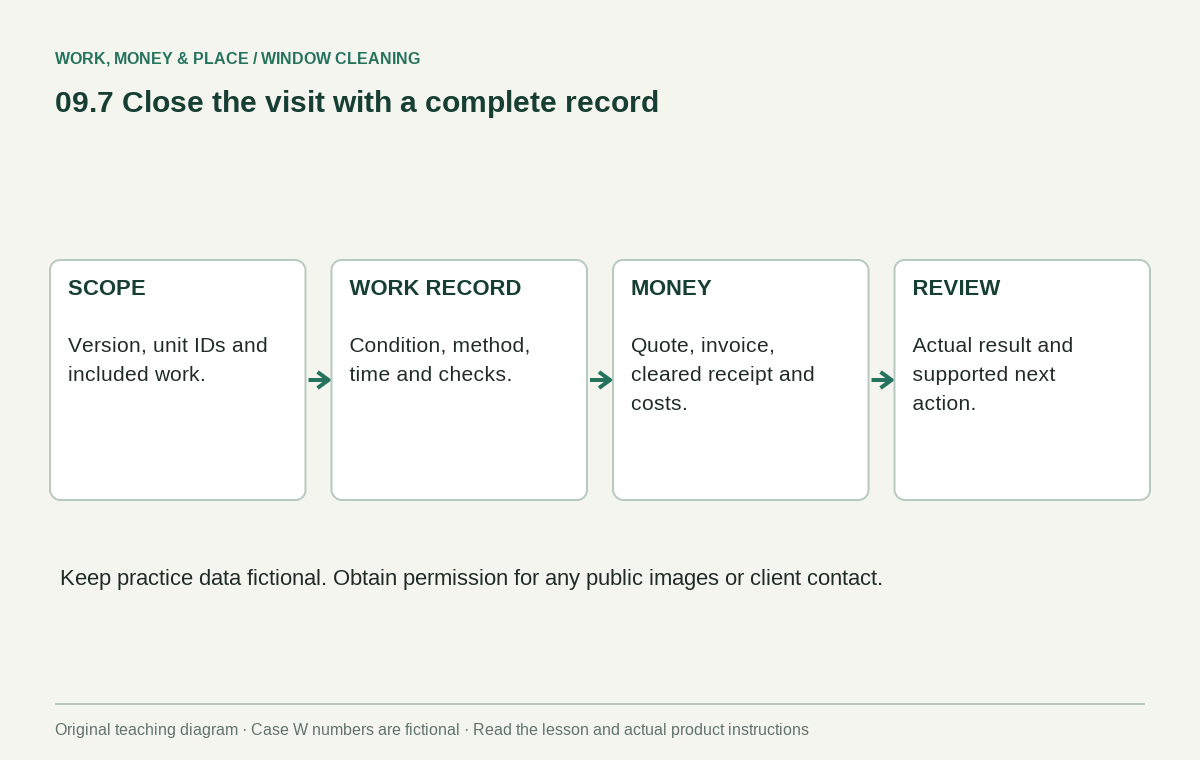
Close the service record with reconciled quantities, restored property, actual resource use, and visible exceptions.
Open the full-size diagram ↗
Example and worksheet
Read the numbered Case W sections for the related fictional records. Apply the method to your own conditions.
Finish the service before packing it away
A visit ends through a planned sequence. First reconcile the work against the window schedule while tools are still available for reasonable corrections. Then reset the property, clean and store the kit, close the actual time and supply record, and prepare the customer handoff. Packing everything before your own final inspection makes a small correction inconvenient and encourages premature completion claims.
The fictional base job should show forty included faces checked, eight suitable screens cleaned and refitted, eight agreed track sets completed, and twelve frame wipes finished. Use each unit row to reach those totals. If the agreed scope changed, reconcile to the accepted revision rather than forcing the original numbers to match. Explain an omitted exterior face or unserviced screen by its ID and reason.
Check doors, gates, windows, screens, moved items, and the travel route according to the actual permissions and site plan. Restore only what you are authorized and competent to handle. Ask the customer to reset items they moved themselves. Keep exits clear and make sure no bucket, cloth, tag, brush, waste, or removed component remains at the property unintentionally.
Reset and inspect the equipment
Collect used cloths separately from clean stock and keep wet equipment away from paperwork and sensitive vehicle surfaces. Clean contact tools according to their instructions, inspect them, and dry them for protected storage. A nicked rubber edge discovered during the visit should not disappear back into the ready kit where it will surprise you next morning.
Account for product containers and any working solution. Follow the product directions and local requirements for disposal; never assume a green or biodegradable claim permits discharge anywhere. Protect the customer's landscaping, drains, and finished surfaces according to the actual site and product requirements. The routine plan should use only the amount needed for controlled service rather than creating avoidable leftover solution.
Secure equipment for transport so a bucket, pole, or loose channel cannot become an uncontrolled load. Restock only what is actually needed and record the order before the next visit. Equipment maintenance and restocking time belong in your full operating cycle, even when performed later at home rather than in front of the customer.
Record actual time and consumed supplies
Close W13 with the full work cycle: preparation, purchasing or stock preparation attributable to the visit, travel, arrival and setup, cleaning, correction, quality check, pack-out, and records. Avoid double counting an activity that overlaps another time block. The sum should represent actual owner time committed, not only minutes holding the squeegee.
In the fictional first order, the planned full-cycle owner time is five hours. The later repeat example uses three and a half hours because the scope is familiar and lighter routine soil is assumed. Round-trip travel remains unchanged. Both numbers are assumptions for learning. If your first practice takes seven hours, record seven and investigate the causes rather than deleting slow periods to reproduce the example.
Record supplies consumed at the method's chosen cost basis. The teaching plan uses $12 of the $60 opening stock, leaving $48 before replenishment or loss. Its actual-results scenario uses $14, leaving $46. Keep the planned and actual columns separate. The $420 reusable kit is not consumed on this single visit. Carry any equipment allocation through the pricing model rather than charging both its full purchase and an allocation as if both were new job cash expenses.
Prepare a clear handoff and the next visit file
Before inviting the customer to inspect, gather a brief factual summary: the package completed, any accepted change, known existing conditions, and any unresolved item. Keep ordinary cleaning corrections distinct from nonroutine exclusions. The next module covers the customer walkthrough, invoice reconciliation, and financial review; this lesson supplies the accurate service record those steps need.
Save only appropriate job evidence in the private customer file. Link photos to units and permission, remove duplicates that add no useful information, and preserve the relevant before/after or incident record. Do not post a customer's interior, identifying details, or review merely because they paid for cleaning. Public-use consent and private job documentation are separate decisions.
Finally, note a practical repeat-service observation without promising a universal interval: whether soil is likely affected by the local setting, what access preparation helped, and which existing conditions should be rechecked. A future visit requires a fresh condition and scope review. Familiarity can reduce administration, but weather, contamination, screens, access, and the customer's needs can change. A well-closed record lets the next visit start with reliable information.
Use the next-day preparation list to separate replenishment, equipment maintenance, and skill practice. Each has a different purpose and cost. This makes the operating record useful for the next customer rather than a collection of completed checkboxes that nobody consults again. Keep the plan usable.
Put it into practice
Your assignment
Complete the operational closeout for the fictional base visit and explain a time variance.
Inputs
- Accepted base scope: 40 faces, 8 screens, 8 track sets, 12 frame wipes; all completed.
- Actual full-cycle time is 5.5 hours instead of planned 5; the phase log attributes the difference across inquiry, travel, service, and quality work.
- Opening consumables $60; planned use $12; actual supplies used $14; no stock loss or replenishment.
Your deliverable
A reconciled W13/W17/W19 record ready for customer handoff and financial review.
Saved only in this browser when storage is available. Export this page separately and use fictional identifiers in practice.
Show the worked answer
- Record actual 5.5 hours and the phase-level reasons for the additional 0.5 hour. Do not report 5 merely to match the plan or label all additional time correction if the phase log shows otherwise.
- Verify all 40 faces and component counts by the schedule and show no unresolved base-scope items.
- Planned stock closes at $60 − $12 = $48. Actual stock closes at $60 − $14 = $46, and actual job supplies consumed are $14. Reusable equipment remains a separate asset/cost-allocation category.
- Record property reset, returned screens, kit inspection, and any next-practice action before marking the operational visit closed.
Show the self-check criteria
- Actual counts and resources reconcile without hidden omissions.
- Property and customer components are restored as agreed.
- An accurate file is ready for the module 10 customer and financial review.