Build a repeat-visit offer and a realistic route that preserve the agreed scope, customer choice, and full-cycle economics.
Open the full-size diagram ↗
Example and worksheet
Read the numbered Case W sections for the related fictional records. Apply the method to your own conditions.
Download the formula planner ↓
Example tab: Repeat plan. Your blank tab: Your estimate.
Open the downloaded workbook and select the named tab. Use the example for reasoning, then enter your own supported inputs in a separate blank Your sheet.
Make the next visit a new, clear agreement
A satisfied customer is a useful starting point for repeat work, but the completed job does not authorize another visit or another charge. At the handoff, ask whether the customer would like a reminder or a future appointment. Record the answer in W21, including the preferred contact method and any date or season the customer actually requests. A reminder is an invitation to confirm, not a booking. An accepted appointment is a service commitment, not permission to enroll someone in a subscription.
Give the customer a simple reason to consider another visit: preserving the appearance they liked and avoiding a new search for a provider. Do not promise that every home needs the same interval. Exposure, weather, household preferences, access, and budget differ. A customer might request exterior work more often than interior work, or decide to book only when needed. Record that preference without turning a hypothetical repeat frequency into expected revenue. Your forecast should distinguish confirmed appointments, requested reminders, and possible work.
Reconfirm the property rather than copying the old quote
Before offering a repeat price, review the previous inventory and ask what changed. Confirm which glass faces, screens, track sets, and wipe areas are included; check access, furniture, pets, recent repairs, and the current condition. A newly enclosed patio, replacement screen, painted surface, or obstruction may change the work. The earlier visit is useful evidence, but it cannot establish that the next visit is identical. Update the scope and obtain agreement before additional work.
The fictional teaching case makes this distinction visible. The repeat plan keeps the same 12 window units, 20 glazing sections, 40 glass faces, 8 screens, 8 track sets, and 12 wipe areas. Its $280 price assumes routine conditions and a full-cycle owner time of 3.5 hours. The first plan used 5 hours at $320. Familiarity reduces some assessment and preparation time; it does not remove travel, protection, inspection, payment, or records. These are instructional assumptions to test, not a repeat discount to advertise or a speed target to impose on yourself.
Recalculate the repeat visit before promising a lower price
At the fictional repeat price, the processing fee is $7.30, using the case assumption of 2.5 percent plus $0.30 for one receipt. Supplies consumed are $9 and fuel is $8, giving $24.30 in direct job costs including processing. Value 3.5 owner hours at $30, then allocate $6 for reusable equipment and $18 for overhead. The result is $126.70 before the $15 planning allowance and other business taxes, or $111.70 after that allowance. This management result is not a guaranteed take-home payment.
Compare the result with actual evidence after the first repeat job. If the visit still takes five hours, keeping the other repeat inputs unchanged reduces the result by $45. If the scope changes, rebuild the estimate rather than treating all changes as a timing variance. Stock purchased earlier can supply this visit, but its $9 consumption still belongs in the cost model. The absence of a new supply-store payment does not make the supplies free. A repeat price is justified by the work and operating costs you can support.
Build a route from time windows and total travel
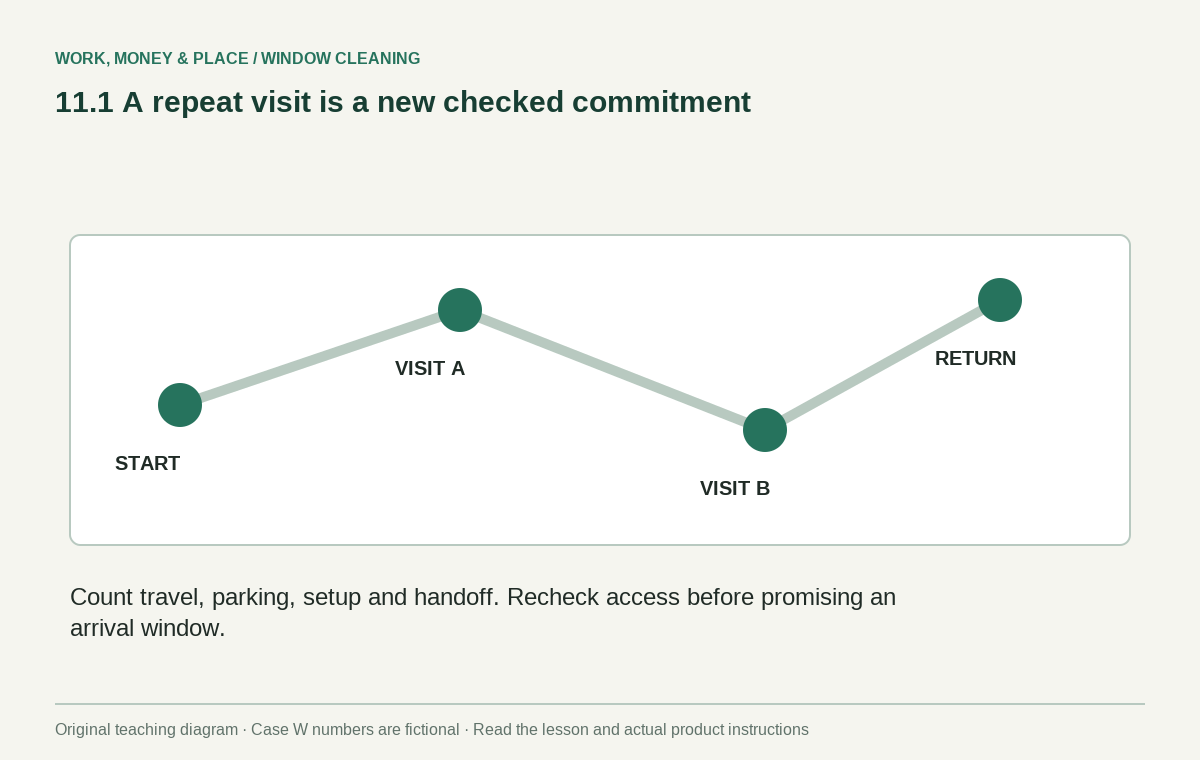
Use W03 to map a possible day before accepting adjacent appointments. Each visit needs its own work time, access window, and finish check. The day also needs breaks, travel between stops, parking, loading, and a modest disruption allowance. Avoid adding separately estimated travel twice. If the original job estimate already includes a complete round trip, replace those travel amounts with the combined route travel when assessing a multi-stop day.
For illustration, two repeat visits at 3.5 hours each include 0.6 hours of travel each. If verified combined travel would be 0.8 hours instead of 1.2, the modeled total becomes 6.6 hours. Add a half-hour break and 0.4 hours of disruption room: 7.5 hours of an eight-hour available day. This example establishes a possible fit, not a promise of two jobs every day. Interior access times, an unexpected defect, or longer driving may break the fit. Do not add a distant third stop merely because its glass-cleaning time appears short.
Keep the repeat list useful and respectful
Confirm the appointment, scope, price, access arrangements, and agreed weather or cancellation procedure in writing. If conditions become unsuitable, explain the problem and offer a new date rather than rushing the work. Do not invent a universal cancellation penalty or assume a customer-requested visit waives any applicable consumer rights. Keep only the information needed to organize the service. The reminder list should not become a collection of unnecessary household details or permanent access codes.
After each visit, record actual time, service differences, corrections, and the customer's next preference. Review repeated overruns before opening additional slots. If a customer declines reminders, stop those reminders; retain transaction evidence according to your legitimate recordkeeping requirements. A healthy repeat route consists of customers who choose the service, work that still fits your access limits, and prices that cover the actual operating model. An empty future slot is more honest than a calendar filled with unconfirmed assumptions.
Put it into practice
Your assignment
Prepare a repeat offer and a two-stop route decision in W21 and W03 using the fictional case.
Inputs
- Same agreed scope; repeat price $280; full-cycle time 3.5 hours including 0.6 hours of travel; supplies $9; fuel $8; processing fee $7.30; owner value $30 per hour; equipment allocation $6; overhead allocation $18; allowance $15.
- Two visits; combined travel 0.8 hours; break 0.5 hours; disruption room 0.4 hours; available day 8 hours.
- The customer requests a reminder but has not accepted another visit.
Your deliverable
A repeat scope confirmation, calculated result, route timeline, and permission/status record.
Saved only in this browser when storage is available. Export this page separately and use fictional identifiers in practice.
Show the worked answer
- Record reminder permission only; do not mark the next visit booked or charge the customer.
- Direct cost is $24.30 and owner time value is $105. The result is $126.70 before the allowance and $111.70 after the allowance, before other business taxes.
- Two standalone estimates total 7 hours. Replace 1.2 hours of travel with 0.8 hours, giving 6.6 hours. With the break and disruption room, the day uses 7.5 hours, leaving 0.5 hours uncommitted.
- A changed scope or access condition requires reassessment and customer agreement before confirming the old repeat price.
Show the self-check criteria
- Reminder permission and appointment confirmation are different statuses.
- Travel is replaced once and not counted twice.
- The offer identifies what remains included and what requires reassessment.
- The repeat price and timing are labeled fictional assumptions rather than market or earnings claims.
Sources: BIZ-SBA-PLAN, BIZ-FTC-PRIVACY, BIZ-FTC-CANCEL, BIZ-IRS-RECORDS.