Define a clear starting business model and check whether you can support it.
Open the full-size illustration ↗
Start With a Job You Can Describe
Consider a real project completed by the course creator in Shoreline, Washington. Work took place November 7–9, 2026. The scope included 96 linear feet of solid Estate Style fence, with a variable height of approximately 5–6 feet, plus two separate walk gates. The gate openings are excluded from those 96 feet. Under the estimate as reported, the fence was priced at $52 per foot and each gate at $600. The total, including sales tax, was $6,192. The owner performed the work himself and provided the original amounts and project stages from his own experience.
A per-foot price explains only part of an estimate. You also need the post design, access conditions, gate specifications, footings, and precise inclusions. This estimate excludes removal of an existing fence unless it is listed separately. On another job, the cost and time for removal could change the calculation. Even the same footage does not make two projects identical.
The first decision for a business owner is which problem to solve and which resources will support the work. In this lesson, you will create a profile of your initial service. By the end, it should be clear who your customer is, exactly what you offer, who performs the work, and what requires a separate decision.
The course creator considers this a typical job in his own practice. He attributes the price to the slower November season and says his usual pricing is higher. This is context from one contractor, not market statistics. For your own estimate, consider seasonal lead volume, available time, and actual costs. This example does not establish a universal summer price or a promised number of jobs per month.
Define the Customer and the Result
This course focuses on a small residential fence installation business in the United States. The owner initially takes part in the field work. Cedar is the main material in the example used throughout the course. The initial customer in the training model is a residential property owner who needs a fence installed or replaced along an agreed line.
Cedar identifies a material, but it does not define the complete design. Posts, rails, infill, fasteners, and the gate must be specified separately. If an estimate says only “cedar fence,” the customer and installer may picture different results.
Write your service in one sentence. For example: “We install a specified residential wood fence design with cedar infill in the listed cities. Removal, hauling, and a standard walk gate are priced separately and included only by written agreement.” This is an example of a service description, not a ready-to-use contract.
Identify the Crew and the Owner’s Responsibilities
There are several ways to organize the work: the owner installs the fence alone, the owner works alongside a crew, or the owner arranges for other contractors to perform it. These models differ in required skills, costs, productivity, and registration requirements.
The main model in this course is an owner who works on site. If help is needed, define the tasks, qualifications, lawful hiring arrangement, and full cost of that help in advance. Saying “I’ll find someone before we start” leaves the schedule and quality of the job without a confirmed person to do the work.
Compare your chosen crew model with the requirements where you work. Installing by yourself, employing workers, and assigning work to another company may require different checks. Module 03 uses Washington as an example and builds a record of applicable requirements. For now, do not assume every way of bringing people onto a job is available simply because someone is willing to do it.
Even an owner who installs fences well still has calls, site measurements, estimates, purchasing, scheduling, paperwork, and final inspections to handle. These responsibilities take time and belong in the plan.
Set Clear Limits for Your Initial Service
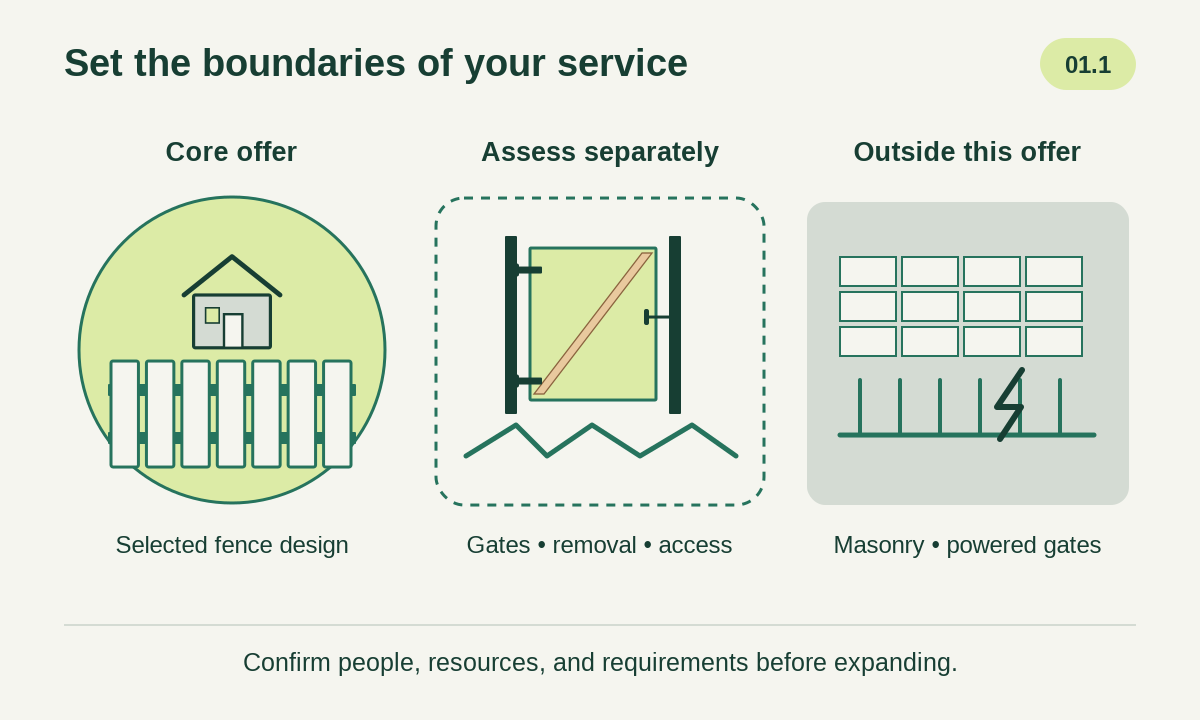
Divide conditions into three groups. First, list what the standard service includes. Second, list work that can be priced separately after a site assessment, such as removal, hauling, an additional gate, or difficult access. Third, identify work that is currently beyond your preparation and chosen business model.
For the initial training example, do not automatically include retaining walls, masonry, powered gates, or work near unresolved utilities. Another service may require different people, documentation, and technical solutions. Establish those needs before making a promise to the customer.
Choose your service area based on your ability to complete jobs there. An hour of driving affects the workday differently from a job near your base. Consider suppliers, disposal trips, return visits, and equipment storage. Do not choose a broad service area solely because you can drive to it.
A useful check is whether someone else can read your description and know which projects to refer to you. If the answer is “any fence, anywhere,” the service is not yet defined clearly enough.
Separate Job Revenue From the Owner’s Earnings
Continue with the Shoreline project. Of the $6,192 total price, the course creator reported $620 as sales tax. Setting that amount aside leaves $5,572. Reported materials were $1,800 and fuel was $50. After those items, $3,722 remains.
The owner worked alone. He reports that the entire job cycle, including preparation and travel, took 21 hours across three partial days. These details help explain the economics of this particular project. They do not mean another person will achieve the same productivity or price.
The $3,722 remainder is after the reported sales tax, materials, and fuel. The owner also confirmed a Square fee of 2.5% on the entire $6,192 payment. That adds $154.80 in cost, leaving $3,567.20 after the listed items. Whether purchase tax is already included in the materials total has not been established separately; do not add it again without checking. This remaining amount still includes the owner’s labor, a share of overhead, and other applicable business expenses.
For management purposes, show the value of all 21 hours of your own labor separately, then allocate overhead using a consistent rule. The owner reported insurance of $120 per month and his own budget estimate of about $200 per year for registration or licensing expenses. These amounts describe his practice, not mandatory charges for every student. The project date is known; the separate sales tax amount still must be checked under the rules for that transaction rather than used to infer a city tax rate.
Valuing your own time helps you decide whether to take a job. It does not automatically create a tax deduction. For example, the IRS explains how a sole proprietor’s own payments and withdrawals are treated. Management calculations and tax accounting must remain distinct [IRS-P334].
Build the First Version of Your Business Profile
Open F01 and complete it for your situation. Identify the customer, result, service area, owner’s role, and people who will perform the work. Add included tasks, separately priced items, and exclusions. If a fact has not been checked, state exactly what you must establish, with whom, and before which decision.
At this stage, you do not need to invent a company name, buy every tool, or set final prices. First, define a service you can research and support with the resources needed to deliver it.
The lesson is complete when your profile makes it clear which business you intend to test. This is a working hypothesis that will change after market research. In the next lesson, compare the model with the skills, time, and resources you actually have.
Put it into practice
Your assignment
Create your initial service profile in F01. Separate facts about yourself and the chosen service area from assumptions about future demand.
Inputs
Your skills and available people to perform the work
One selected residential fence type
Cities served and acceptable travel
Your deliverable
A completed F01 and a one-sentence service description.
Working forms: F01.
Notes are saved only in this browser. Keep a separate copy of important work and avoid entering customer personal information.
Show the worked solution
- Training description: install a specified residential cedar fence design within a defined area; price standard walk gates and removal according to the stated scope.
- Identify who will perform the work. For any unconfirmed skill, state a specific preparation step.
- The Shoreline example’s 96 ft and two gates do not become a standard for every future job.
Show the self-check criteria
- The customer and result are specific.
- The material does not substitute for a complete design.
- Inclusions, additional items, and exclusions are separated.
- The service area and owner’s role have clear limits.
Sources: WA-LNI, IRS-P334, PSE-LOCATE.