Define a clear starting business model and check whether you can support it.
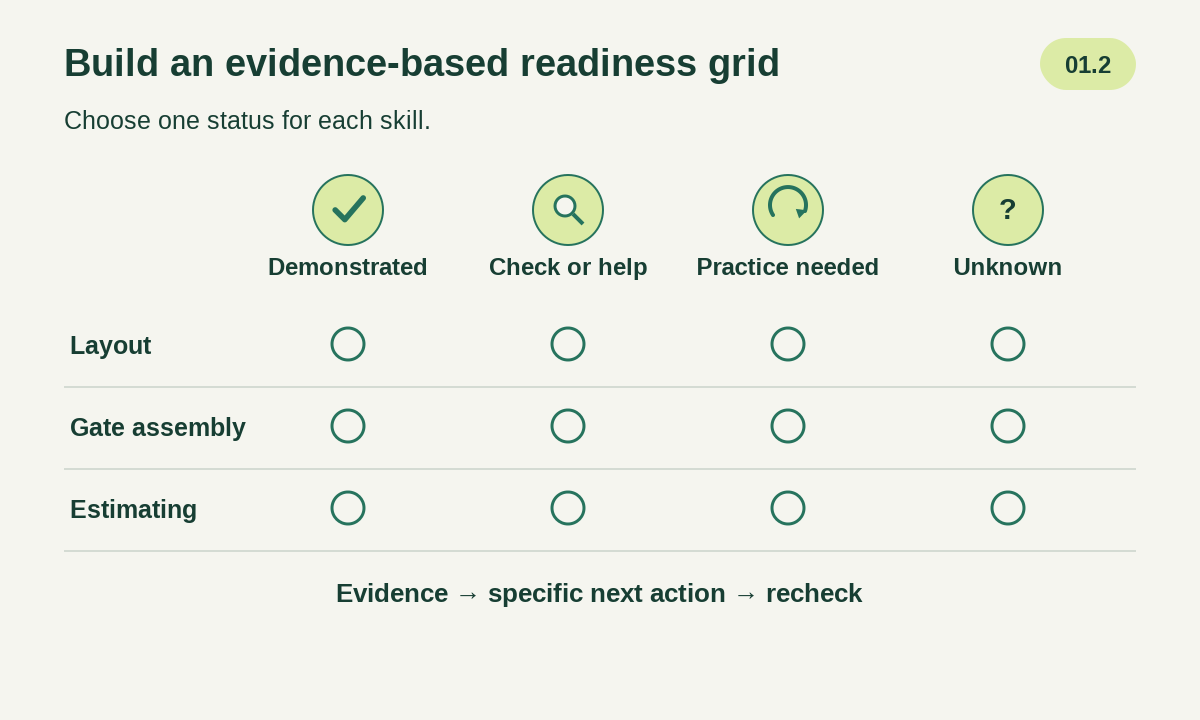
Open the full-size illustration ↗
Check Readiness Through Specific Actions
You now have an initial version of your service. The next question is what already enables you to deliver it and what still needs preparation. Check readiness through specific actions and evidence.
Do not give yourself a single checkmark for “I know how to install fences.” Break the work into site assessment and measurement, design selection and verification, materials, construction, the gate, quality inspection, estimating, customer communication, and records. Someone can handle one part confidently and still make mistakes in another.
Use four status options in F02: I can demonstrate it independently; verification or qualified help is needed; training and practice are needed; or information is not yet available. Record the evidence and next action beside each status. This creates a preparation plan rather than a general feeling of confidence.
Check Technical and Business Preparation Separately
For a cedar project, you need to connect the selected materials to a specific design and site conditions. The written installation module uses illustrations and walkthroughs to explain layout, posts, framing, infill, a standard walk gate, and final inspection. It does not include filmed field demonstrations or supervised practical training. Practical work requires a specification for the chosen design and clear criteria for evaluating the result.
Watching an explanation does not by itself establish that someone can do the work. Evidence might be an exercise completed under qualified supervision, a checked practice assembly, or a previous project evaluated against clear criteria. Saying “that’s how I usually do it” also does not replace checking whether a solution fits a new site.
Check the business side separately. Can you reconstruct a job’s scope from your site notes? Identify all materials? Count the owner’s and helper’s hours? Explain what the price includes? Document a change before performing additional work?
If an answer is unknown, the course should help you close that specific gap. You do not need to hide it behind an attractive portfolio or a more expensive tool.
Calculate a Realistic Workweek
Now use a separate training exercise, not the Shoreline project. Imagine a hypothetical week in which the owner has 30 working hours available. On this fictional project, on-site installation takes 24 hours of the owner’s time. The site visit and on-site coordination add two hours. Handling the inquiry, estimating, and correspondence take three; purchasing and loading, excluding travel, take four; all driving takes four; and closing the records takes one. The total is 38 hours.
Calling this job “three days of work” would erase 14 hours of other tasks from the schedule. With only 30 hours available, the shortfall is at least eight. This example does not yet include weather allowance or other inquiries.
Possible solutions include a different deadline, a smaller scope, confirmed delivery, appropriate help, or a revised weekly plan. Check each option for cost and actual time saved. Renting a tool does not always address the cause of a delay.
Complete F03. Record the owner’s and helper’s time separately. Two people working eight hours create 16 labor-hours; they do not make a calendar day 16 hours long. If the same trips appear in two rows, remove the duplicate.
Check Resources for the Next Project
The starting equipment list depends on the specific service. For your first project, map the sequence: where materials will come from, how they will reach the site, where tools will be stored, who will work, how waste will be removed, and what happens if equipment fails.
For each item, identify how it will be provided: already available, rental confirmed, delivery priced, or still to be determined. Check price and availability for the date needed. Separately flag items required to perform a chosen task and purchases that currently only seem convenient.
Check the cash sequence as well. When must you pay for materials, help, delivery, and rentals? What money will cover these costs before the customer’s payment arrives? A profitable estimate does not guarantee cash will be available on the required date. The finance module will build a calendar and test that gap.
On the reference project, the course creator used tools acquired long before the job and his own van. He estimates roughly $1,000 for a basic tool setup for this kind of start, used across many projects. That amount does not include the vehicle. An experienced contractor owning a vehicle does not make transportation free for a new business. Check vehicle suitability, purchase or access, safe loading, storage, and operating expenses for your situation. Do not buy a complete setup based on someone else’s single figure. First connect each tool to a selected task and decide what is needed immediately.
Identify Conditions That Prevent Taking a Job Yet
Turn uncertainty into a question with a responsible person and a condition for resolving it. For example, a customer points to an old fence line and assumes it is the property boundary. Record which boundary confirmation the project requires, who will obtain it, and when the final fence line can be agreed on. An old fence is not that confirmation by itself.
Another example is underground utilities. Requesting utility marks and checking private lines address different parts of the task. In Washington, PSE explicitly distinguishes its lines from private lines. The absence of a mark therefore does not prove that nothing else is underground [PSE-LOCATE]. The full process for the chosen work location will be covered separately.
A further case is a service for which you lack a suitable person to do the work or confirmed requirements. In Washington, contractor registration must be checked before advertising, bidding, or working [WA-LNI]. Another state requires its own list of applicable requirements. Do not automatically transfer the Washington example to that state.
Your record should end with an action: obtain confirmation, complete practical training, check a requirement, change the scope, or decline an unsuitable part of the work. “We’ll figure it out on site” resolves none of these items.
Choose Your Next Decision
Distinguish readiness to keep learning from readiness to promise a customer an installation. You can finish this module with unresolved questions if they are recorded honestly and have defined next steps. That makes the following lessons useful for practical decisions.
A real commitment requires another check: appropriate people can deliver the selected service, applicable requirements have been established, the scope is clear, time and money have been calculated, and site conditions are confirmed. The final module will bring these results into one package.
Complete three actions now: refine the service profile, fill out the readiness record, and check one workweek. Then proceed to research your local area. The goal is to test where the selected service is needed and what must change before the first sales.
Put it into practice
Your assignment
Complete F02 and F03 for your initial service. Separately solve the fictional 38-hour workweek exercise.
Inputs
24 hours of installation
2 hours of site assessment
3 hours of estimating and correspondence
4 hours of purchasing, excluding travel
4 hours for all driving
1 hour to close the records
30 hours available
Your deliverable
A readiness record with next actions and an owner’s calendar.
Notes are saved only in this browser. Keep a separate copy of important work and avoid entering customer personal information.
Show the worked solution
- Total need: 38 hours; shortfall: eight hours. This is a separate fictional exercise, not the 21-hour Shoreline project.
- A workable decision is to change the deadline or scope, or confirm a way to reduce labor time. Do not promise the same deadline without changing the underlying conditions.
- Assign an action and evidence to an unconfirmed skill. Finishing a lesson does not substitute for readiness to accept a real job.
Show the self-check criteria
- The owner’s and other people’s time are separate.
- Travel is not counted twice.
- A single checkmark for watching a video does not close critical gaps.
- Every unresolved question has a next step.
Sources: WA-LNI, IRS-P334, PSE-LOCATE.