Turn the F08 layout into a verifiable schedule of quantities, specifications, prices, and deliveries.
Example and worksheet
Follow the complete stock count, spare allocation, and cut arithmetic.
Example sheet: B estimate. Your worksheet: Your estimate.
Start with the material takeoff in B estimate. Enter your own material quantities, unit costs, specifications, and quote sources in Your estimate.
Download the file, then select the named worksheet tab. The example sheets are fictional; the Your sheets are for your own project.
Open the full-size illustration ↗
Estimate the Selected Design, Not Just the Footage
A material takeoff starts with an agreed design. Open layout F08 and identify each fence run, corner, end, and gate opening. Then make sure you know exactly what was measured: the entire line including openings, or only the solid fence sections. If an opening has already been excluded from the length, do not subtract it again. That small ambiguity can leave you an entire section short when you buy materials.
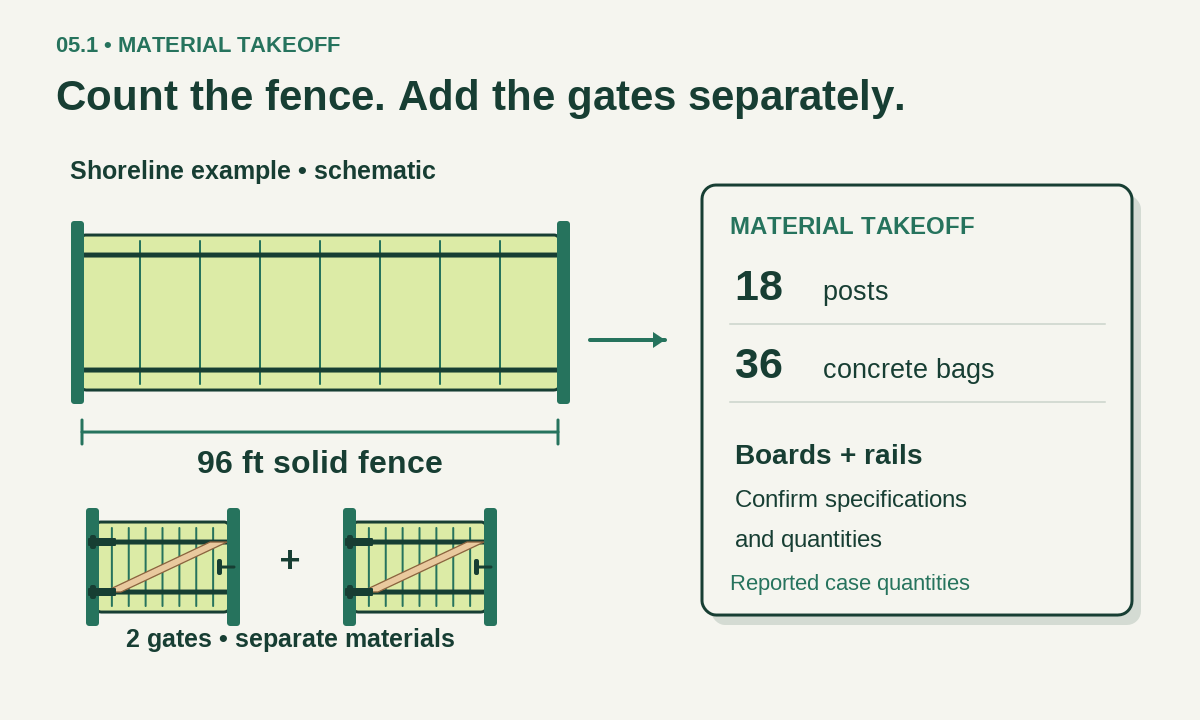
For the Shoreline project, the course author clarified the starting information: ninety-six feet refers to solid fence sections and excludes the openings for both gates. One long run is eighty-six feet; the short solid sections near the gates add up to another ten. Their individual lengths have not yet been specified. Eighteen posts were installed, and each clear gate opening between posts is three and a half feet wide. The No. 1 cedar boards are six feet long and five and a half inches wide, and the rails are two-by-fours. The number of rails per section, rail lengths, and board thickness are still needed for an exact purchase order. Derive component quantities from the layout. Gate openings are excluded from the solid fence footage, but the gates themselves still require material.
Enter each category in F09: posts, framing, fence boards, caps, fasteners, footing materials, gate components, and additional operations. Each line needs more than a quantity and price. Include the specification, unit of measure, and basis for the calculation. “Boards, one hundred pieces” is not enough. The supplier needs to know which product you want, and the installer needs to know where it will be used.
Derive Quantities from the Layout
Consider a separate practice scenario that does not specify a design for a real property. For a straight twenty-four-foot run, the design already permits a maximum section length of six feet. The number of sections is the run length divided by the permitted section length, rounded up: twenty-four divided by six equals four. For one isolated run without gates, that gives us five posts. Six feet is a given condition of this exercise, not a universal standard we are prescribing.
Now connect two runs at a corner. Count the shared corner post only once. Add a gate, and its posts, dimensions, and loads need a separate check. That makes the formula useful for checking a simple run, while the final quantity comes from a layout with numbered post locations. Every post should have a clear purpose.
For a simple, evenly spaced board layout, let w be the effective board width, g the gap between boards, and L the clear width to be filled. Find the smallest whole number N for which N × w + (N − 1) × g covers L. Check end gaps and trimming separately against the layout. First convert everything to the same units. Overlapping boards and variable heights require their own calculation. Count fasteners by connection and the selected specification. Calculate concrete from the confirmed footing geometry and the yield of the actual package, rather than a habitual number of bags.
Separate Useful Allowances from Hidden Overruns
After calculating the net quantities, list the extra allowance separately. It may have a clear purpose: cuts on a slope, appearance selection, possible defects, or packages that cannot be split. Extra stock purchased beyond the takeoff should not silently become a cost consumed by this project. Materials returned to inventory or to the supplier after the job need separate treatment when comparing estimated and actual costs.
The author added post protection using a six-inch-wide roll of self-adhesive tape intended for decks. The exact product and instructions have not yet been identified. In the estimate, it is a separate material and operation. Before choosing it for another project, check the specific tape’s intended use, compatibility with treated lumber, and whether contact with soil and concrete is permitted. The name “deck tape” alone does not establish suitability below ground or a post’s service life.
The author reported these purchase-price reference points before store sales tax: four dollars per board, twenty-one per post, ten per cedar rail, four dollars and fifty cents per bag of concrete, four per cap, and forty-five for one gate’s hardware kit. Screws and nails together were about forty dollars. Eighteen posts at two bags each gives thirty-six bags: the posts cost three hundred seventy-eight dollars, and the concrete costs one hundred sixty-two. If we assume one cap per post and one hardware kit per gate, those items plus the fasteners total seven hundred forty-two dollars before tax. The cap and kit counts are explicit assumptions for this check, not a reconstructed receipt.
Let’s check package quantities with another scenario. The approved takeoff requires thirty-nine identical, suitable parts, and five are in inventory. You need thirty-four more, but the supplier sells packs of ten. You therefore buy forty, leaving six after using the combined stock. You pay for forty at checkout, while the project consumes thirty-nine, including the five already in inventory. Keep both records in F09, along with the cost of the material actually consumed. That prevents leftovers for the next job from appearing as an overrun on this one, and keeps track of cash temporarily tied up in stock.
The author reported total material spending of eighteen hundred dollars. The remaining one thousand fifty-eight dollars after the conditionally assembled lines above does not establish the board and rail counts. It may also include protection, purchase tax, and other items. First clarify what the total includes, then reconcile quantities and leftovers. These prices belong to this example and do not replace a current supplier quote. Do not come up short on materials for the two gates simply because their openings were excluded from the ninety-six feet of fence.
Check the Purchase and Arrival on Site
Before ordering, compare supplier quotes for the same specification. Ask: “Please confirm the product, quantity, availability by the required date, delivery cost, unloading conditions, and return policy.” The cheapest board on a price list does not necessarily produce the lowest-cost, fully supplied project if it is out of stock or requires extra trips.
Decide who will receive the delivery, where the material will be stacked, whether the vehicle can reach that spot, and how a safe walkway will remain open. After delivery, check quantities and damage before the truck leaves. Record any discrepancy and the agreed resolution. A return trip for missing hardware takes the owner’s time and belongs in actual job costs.
For Washington, check the tax treatment of purchases separately. DOR distinguishes materials incorporated into the project from tools and supplies that are consumed. Being a contractor does not by itself establish when a reseller permit applies. Keep the basis for the tax treatment you choose. The result of this lesson is a takeoff another person can use to order the right items and identify what still cannot be purchased until the design is clarified.
Put it into practice
Review this lesson’s Project B sections and worksheet tabs ↑
Your assignment
Complete F09 for one project run and add separate lines for gates and unconfirmed components.
Inputs
Agreed layout F08
Specifications for the selected design
Supplier quotes current on the purchase date
Your deliverable
A quantity and purchasing schedule that identifies the source of every number and includes a delivery plan.
Notes are saved only in this browser. Keep a separate copy of important work and avoid entering customer personal information.
Show the worked solution
- In the 24 ft / 6 ft scenario: 4 sections and 5 posts before accounting for corners and gates.
- Shoreline: 96 ft of net solid fence, two gates listed separately, and 18 posts; 36 bags of concrete as reported by the author. Posts and concrete total 378 + 162 = 540 USD before tax. Clarify the remaining quantities and the tax treatment within the 1800 USD material total instead of adjusting them to force a match.
Show the self-check criteria
- Gates and shared posts are not counted twice.
- Units are consistent; extra allowances and package quantities are separate.
- Availability, delivery, unloading, and returns are confirmed or have a specific outstanding question.
Sources: OWNER-CASE, OWNER-PHOTOS, A-OWNER-PROTECTION, WA-DOR-CUSTOM.