Make equipment decisions based on the operation, expected utilization, and full cost, rather than a desire to build an equipment fleet.
Example and worksheet
Connect purchasing and equipment decisions to cleared funding.
- Project B · Release procurement as a checked package →
- Project B · Plan the cash before the final payment →
Example sheet: B estimate. Your worksheet: Your estimate.
Check the rental and delivery lines in B estimate, then replace them with your own costs in Your estimate. Use Your cash for actual payment dates.
Download the file, then select the named worksheet tab. The example sheets are fictional; the Your sheets are for your own project.
Open the full-size illustration ↗
Compare the example tool basket with what you already own. Check the complete job requirements, then use F10 to decide what to buy, rent, or postpone.
Start with the Work You Need to Support
Choose tools after choosing the service and design. Open F08 and F09 and walk through the project from the site assessment to cleanup. For each operation, ask: What will perform it? Who knows how to use that equipment? How will it reach the work area? What happens if it fails? A purchase does not make up for inadequate preparation, and renting a machine does not make it fit through a narrow passage.
Group equipment into measuring and layout, footing preparation, assembly, gate work, transportation, and cleanup. List the necessary protective equipment and safe-use conditions from the manuals for the equipment you select. This lesson helps you plan equipment needs; it does not replace hands-on training for a specific machine.
F10 offers four decisions: use what you have, buy, rent, or postpone the related service for now. Each needs a deadline and confirmed availability. “I think a friend has one” remains an open question until you agree on the date, included components, condition, and responsibility. Planning for a tool failure at home is better than trying to explain it to the customer after the job starts.
Compare the Full Cost of Equivalent Use
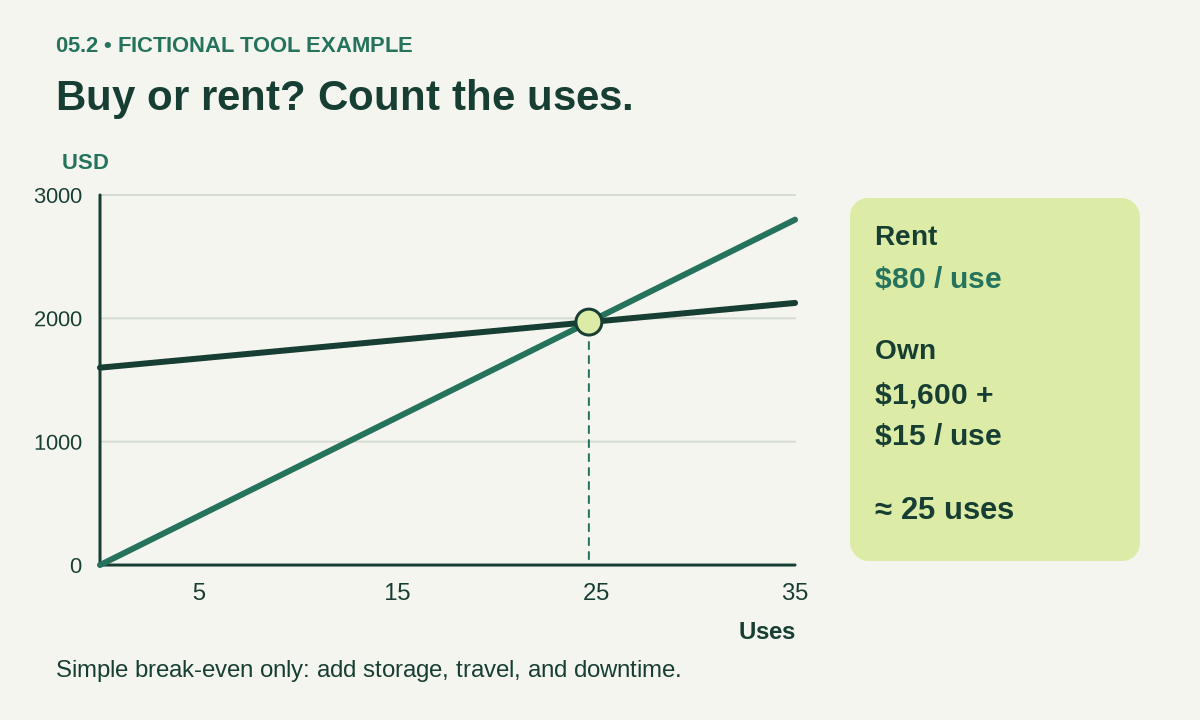
Suppose a tool in a separate practice example costs seventeen hundred dollars to buy, with an expected resale value of one hundred dollars at the end of the chosen period. Each use requires another fifteen dollars in maintenance and consumables. A complete rental for equivalent use costs eighty dollars. All these numbers are fictional. They illustrate the comparison method, not local rental prices.
The purchase price less resale value is sixteen hundred dollars. Each use of the owned tool saves sixty-five dollars compared with renting: eighty minus fifteen. The simple break-even point is sixteen hundred divided by sixty-five, or about twenty-five uses. That is not the final answer, because storage, financing, transportation, downtime, and changes in resale value have not yet been included.
If your plan includes only five confirmed uses, you cannot claim purchase savings based on twenty-five. If each rental requires two one-hour trips, compare those hours too. Do not count consumables and fuel again if they are already included. Compare the same operation, duration, and complete equipment package, rather than a purchase price against an advertised minimum rental rate.
Check Cash Needs, Access, and the Calendar
Even a purchase that pays off over frequent use can consume the money needed for the next job’s materials. Compare two questions: What does the equipment cost over the chosen period, and how much cash does it require before the customer pays? Paying for a purchase today and allocating its cost across projects are different records. Mixing them can make one job appear artificially unprofitable while the others seem to use the equipment for free.
Check weight, dimensions, transportation requirements, loading arrangements, and permitted access to the property. Equipment that cannot reach the work area will not shorten the operation. Confirm pickup and return hours, the deposit, damage terms, consumables, and late fees. A refundable deposit affects available cash but does not automatically become an expense.
On the actual project, the author used tools he had owned for years and his own van. Their earlier purchase was not a new cash payment for this job. For a beginner, he estimates roughly one thousand dollars for basic tools that will serve many projects; that amount excludes the vehicle. Suitable transportation is necessary. His operating model calls for at least a van, and a used vehicle may work after its condition and suitability are checked. Check the tool list, load securement, maintenance, and jobsite access separately. The dollar amount alone is not a complete shopping list.
Check the rental’s calendar duration as well. If the work takes one day but the agreed pickup and return hours require three billable days, a one-day rate is the wrong figure. Update the line and compare again. Equipment you already own is not free to use: maintenance, wear, and transportation remain. At the same time, a past purchase should not automatically push you into unsuitable work just to justify money already spent. Decide based on future additional costs and your ability to deliver the result.
Make a Decision with a Review Trigger
An example F10 decision is: “Rent suitable equipment for the first agreed operation; confirm availability and cost before scheduling the date. Reconsider buying when the log shows enough uses.” This is stronger than a vague plan to “make do for now,” because it has a basis, an owner, and a review point.
It may make sense to buy everyday measuring and assembly tools before an infrequently needed machine. Still, check what you already have, remaining service life, and replacement costs. Do not assume every used tool is a bargain. Inspection, working condition, completeness, and suitability for the job belong in the comparison. A low-priced fault can shift the cost from the purchase to a delayed project.
Finish this lesson with one real decision. Choose an item, obtain comparable purchase and rental terms, and calculate utilization and cash needs. If an operation is still unsupported, change the scope or date before making a commitment to the customer. Your result is the ability to explain calmly why you should spend a particular amount now, which costs it prevents, and what new information would require a different decision.
Put it into practice
Review this lesson’s Project B sections and worksheet tabs ↑
Your assignment
Compare two ways to support one operation over the same period and number of uses.
Inputs
List of operations in F08
Confirmed purchase and rental terms
Realistic utilization and storage plan
Your deliverable
A completed F10 with a decision, the next cash payment, and a review trigger.
Notes are saved only in this browser. Keep a separate copy of important work and avoid entering customer personal information.
Show the worked solution
- In the fictional example, the simple break-even point is 1600 / (80 − 15) ≈ 24.62, or 25 uses.
- If storage and transportation differ, add them before deciding; show the deposit in cash flow separately from expenses.
Show the self-check criteria
- The comparison uses the same operation and complete equipment package.
- Training, access, transportation, maintenance, and downtime are considered.
- The same management result does not count equipment as both a full purchase and an allocated expense.
Sources: OWNER-CASE.