Tie payments to clear milestones and approve changes to price, schedule, and work in writing before performing them.
Example and worksheet
Keep the agreed customer amount and timing consistent with the internal plan.
- Project B · Connect the estimate to the agreed result →
- Project B · Plan the cash before the final payment →
Example sheet: B cash. Your worksheet: Your cash.
Trace B estimate into B cash. Put only your own agreed amounts and actual clearing/payment dates in Your cash.
Download the file, then select the named worksheet tab. The example sheets are fictional; the Your sheets are for your own project.
Open the full-size illustration ↗
Payments Need a Milestone and Verification
A payment term must explain what happens and how both parties know that the milestone has been reached. “The rest later” does not define a date or procedure. Record the agreed amounts or how they will be determined, the basis for each payment, and how you will invoice and confirm receipt. Check that the terms comply with applicable requirements and your ability to perform the job.
Do not choose a deposit solely because a friend or video recommends it. Different locations and situations may have limits and requirements for contracts and notices. F15 helps assemble terms for review but does not establish their legal suitability. Cash calendar F12 shows whether your funds are sufficient under the agreed schedule. It does not authorize shifting every cash shortfall to the customer.
The author reported a Shoreline deposit of thirty percent of the total. Applied to sixty-one hundred ninety-two dollars, that is eighteen hundred fifty-seven dollars and sixty cents, with forty-three hundred thirty-four dollars and forty cents remaining. This is the arithmetic of the reported term, not verification of dates or actual bank receipts. In F12, material-payment, deposit-receipt, and final-payment dates remain separate fields. The fictional fifteen hundred and four thousand from another exercise do not belong to this customer.
A Change Starts with a Difference from the Agreed Scope
A change order is needed when the proposed result or conditions genuinely differ from the accepted version. A customer requests another gate; an agreed process resolves a hidden condition; or the run length changes through a confirmed decision. First identify the difference and its basis, then calculate the consequences. Your own estimating error and a new customer request are different causes. They do not automatically justify the same additional bill.
In F16, record the project and version numbers, what was agreed, the proposed change and reason, the work and materials added or removed, and changes to price, tax, payments, and schedule. If the change replaces an earlier line, show the subtraction as well as the new addition. Otherwise the customer could pay for two versions of the same component.
Obtain clear approval from both parties before performing added work, in a form suitable for the transaction. That may involve an agreed document and an established acceptance process; verify the specific local requirements. Keep the text, version, and approval with the project, rather than only in the memory of the person who took the call.
Have the Conversation Before Adding Costs
Suppose the customer says after accepting the proposal, “Let’s add another gate on the other side.” Reply: “First, let’s confirm its location, dimensions, posts, and hardware. I will prepare a scope change and show the price and schedule before the work is done.” Do not automatically say “another six hundred” because that was the gate price on another project. Access and the design may differ.
Now suppose an agreed inspection reveals an unknown obstruction at a post location. First stop the affected work and arrange an appropriate, safe investigation. State what is known and which decision is still missing. Do not continue on the assumption that a verbal “just make it work” removes technical or mandatory requirements.
After obtaining verified information, present options with clear consequences. These might include an allowable line change with required approvals, or another verified solution from a qualified specialist. Do not invent a technical alternative from a financial table alone. Then calculate its materials, labor, and schedule. If your qualifications are insufficient, first establish a lawful and technically suitable way to perform the work, rather than writing a confident promise into a change order.
Carry the Change into the Estimate and Calendar
An approved change must flow through the entire project. Update layout F08, material takeoff F09, estimate F11, and cash calendar F12. Material already purchased but no longer needed under the new version requires a clear return or reuse decision. Preserve the original estimate so you can later distinguish a customer scope change from an execution overrun.
Before final payment, reconcile the current price: the original agreed scope plus approved additions minus approved deletions. Show earlier payments and the remaining balance. If a quality or scope issue remains open, record it and the resolution process. Managing documents confidently does not mean demanding a signature saying there are no problems while problems are still being discussed.
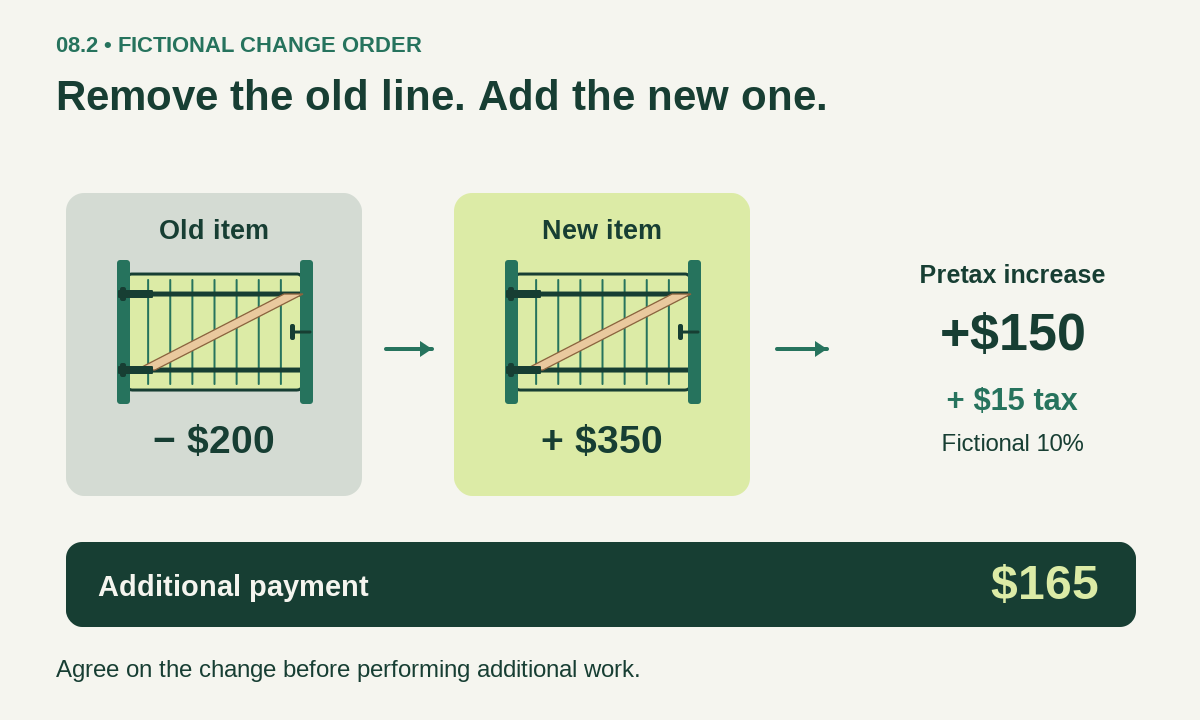
Check the subtraction with a separate math example. The accepted pretax price is five thousand dollars. The parties replace an agreed two hundred-dollar item with an option costing three hundred fifty. The change is an additional one hundred fifty, not three hundred fifty. At a strictly fictional ten percent rate, the tax difference is fifteen dollars and the added payment is one hundred sixty-five. The revised total becomes fifty-six hundred sixty-five instead of fifty-five hundred. For a real transaction, use its verified tax treatment, not the exercise rate.
Finish the lesson by analyzing two situations: an additional customer request and your own underestimated time. The first requires agreement on new scope and its consequences; the second first requires understanding the cause and your obligations. A good change process keeps the result and the relationship clear. It helps both parties see what changed, why, and which document now governs the next actions.
Put it into practice
Review this lesson’s Project B sections and worksheet tabs ↑
Your assignment
Prepare F16 for an added gate on a fictional project, then separately analyze your own estimating error.
Inputs
Accepted F15 version
New request and verified technical feasibility
Calculation of materials, time, price, and date
Your deliverable
A proposed change package with recalculated F11/F12 and the original version preserved.
Working forms: F08, F09, F11, F12, F15, F16.
Notes are saved only in this browser. Keep a separate copy of important work and avoid entering customer personal information.
Show the worked solution
- The added gate receives a specification first; Shoreline’s 600 USD price is not transferred automatically.
- If a new component replaces an old one, show the old line’s subtraction and the new line’s addition.
- Underestimated owner time is not automatically presented as a new customer request.
Show the self-check criteria
- The accepted version is referenced and the difference is clear.
- Amount, tax component, schedule, and payments are agreed before the additional work.
- Unresolved risks are not treated as authorized work merely because the customer signed permission.
Sources: OWNER-CASE.