Video release pageNot public yet
The companion video is optional. Use the lessons and worksheets for the detailed launch plan. The video opens in a new tab.
Define a specific routine house-cleaning offer with an observable result, realistic household conditions and clear limits.
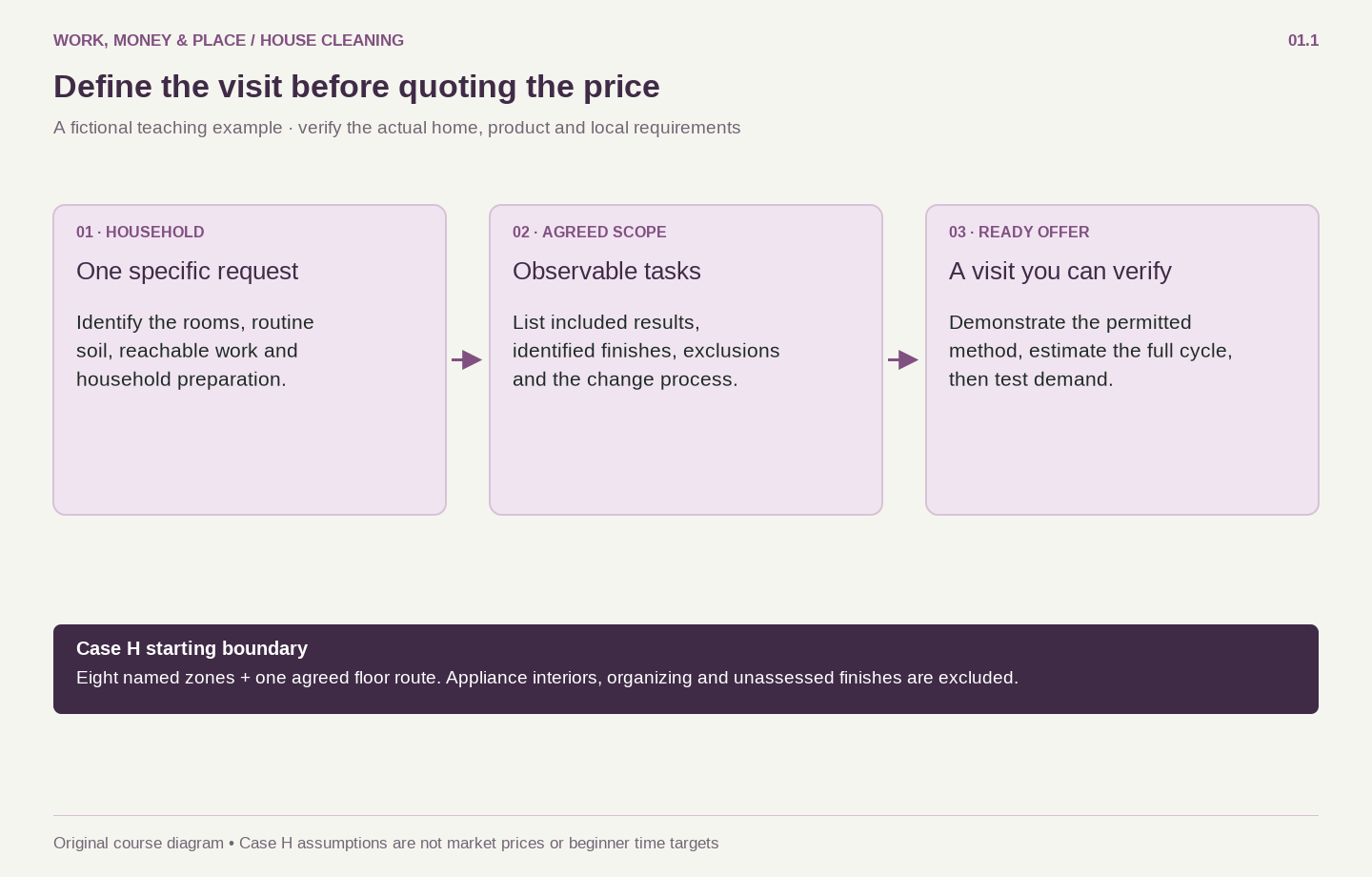
Open the full-size diagram ↗
Example and worksheet
Use the separately labeled Case H teaching records, then create a dated record for your own assessed service. Fictional results do not establish practical readiness or local demand.
Sell a reliable visit with an agreed boundary
A house-cleaning business sells a dependable service inside someone’s living space. The customer needs to know what will be done, which rooms and surfaces are included, how the household prepares, and what happens when the starting condition differs from the description. A promise to clean everything creates uncertainty before you have even priced the work. Begin with a task list that can be inspected at handoff, rather than an impressive name such as premium or complete cleaning.
The starter offer in this course covers assessed routine soil on reachable occupied-home surfaces from stable floor positions. It is not a restoration or hazardous-contamination service. Your first operational decision is whether you can deliver that defined work consistently while protecting people, finishes and access details. Someone who already keeps a personal home tidy still needs to practice the complete commercial visit: setup, approved methods, tool separation, inspection, reset, communication and records.
Describe the home without turning room count into a price
Case H is a fictional Washington home with three bedrooms, two bathrooms, one kitchen, one living/dining zone and one hall/entry zone. Those are eight named task zones. Its 1,600 square feet helps describe the property, but does not by itself state the amount of soil, the number of objects to work around, the finish requirements or the available access. Cleaning the floors across those zones is a route through the inventory, not a ninth room.
For your own offer, pair each room with the tasks you actually accept. A bedroom may have accessible dusting and an agreed floor area, while bedding changes and organizing remain excluded. A kitchen task might cover assessed accessible exterior surfaces without opening an oven or refrigerator. The inventory must distinguish included tasks, confirmed exclusions and questions still awaiting inspection. An unanswered question is not permission to fill the gap with an optimistic assumption.
Separate routine care from a different service
A request to wipe reachable bathroom fixtures does not establish that unknown dark staining, damaged sealant or a severe deposit is ordinary soil. Likewise, a customer’s preferred product is not automatically suitable for an unidentified stone, wood finish or appliance surface. Record the uncertainty, obtain the applicable instructions and decide whether the affected task can be accepted. Do not use a discount or extra effort as a substitute for identifying the work.
This first offer excludes hazardous contamination, mold remediation, hoarding, post-construction cleanup, pest work, restoration, raised access and unassessed specialty finishes. Case H also excludes oven and refrigerator interiors, interior window washing, laundry service, organization and moving heavy furnishings. These limits make the planning exercise coherent. A future expansion needs a separate method, capability check, insurance review and price. The customer’s approval of an ordinary cleaning quote does not expand your competence or remove those boundaries.
Give a first visit its own plan
The fictional first visit is quoted at $340 and uses six complete owner hours, including off-site work. A separately reassessed repeat visit is modeled at $280 and four and a half hours. These are teaching inputs for different conditions, not local rates, a promised beginner speed or an automatic subscription discount. The lower repeat price must still cover its own labor value, supplies, travel, equipment and overhead. Repeat business is useful only when the visit remains deliverable.
A first visit lets you establish the property record, learn the access routine, confirm surfaces and inspect the result. An established customer may later have extra people at home, a blocked room or a changed finish. Your agreement should therefore define how the next visit is confirmed and how changed conditions are handled. Predictability comes from maintaining the record and communicating changes, rather than promising an identical result for an unchanged price regardless of circumstances.
Build the connected service file
Use H01 to write one service offer in ordinary customer language. Then connect it to the H06 survey, H07 room/task inventory, H08 accepted scope, H11 estimate and H15 quote. After work, the H19 quality record and H20 handoff should refer to the same included tasks. This chain turns an attractive description into a business process that can be checked. A vague inclusion at the beginning usually becomes a pricing or quality disagreement at the end.
Your first milestone is a defined practice offer, not a public launch announcement. Complete the practical lessons and controlled practice before accepting customer work. A written course and its illustrations can explain decisions, but cannot observe your hands, certify competence or remove the need to stop when a method is uncertain. Keep any practice results labeled honestly and record the next specific preparation step. You are ready for a particular assessed service only when its essential questions have usable answers.
Put it into practice
Your assignment
Write a starter service offer and classify five household requests before quoting.
Inputs
- Case H: eight task zones in an occupied three-bedroom/two-bathroom home.
- Requests: accessible ordinary bedroom dust; oven interior; unidentified delicate countertop; confirmed reachable floor; suspected hazardous contamination.
Your deliverable
H01 with an offer, named exclusions and an unresolved-task decision.
Working forms: H01.
Saved only in this browser when storage is available. Export this page separately and use fictional identifiers in practice.
Show the worked answer
- Example offer: routine care of specifically surveyed occupied-home rooms and reachable surfaces, using compatible methods, with agreed kitchen/bathroom tasks and floors.
- Ordinary assessed dust and the compatible reachable floor may enter the survey. Oven interior stays outside this offer. The unknown countertop stays on hold until identified; suspected hazardous contamination is outside the starter service.
- Eight zones describe the task inventory; neither eight zones nor 1,600 sqft alone establishes a price.
Show the self-check criteria
- The promise identifies observable included work.
- Unknown surfaces are not marked included.
- First-visit and repeat conditions are separated.
- The file explains what practical evidence is still missing.
Sources: HB01.