Open the full-size tool illustration ↗
Separate reusable tools from consumable stock
Case H uses a fictional $560 reusable-kit allowance and an $80 consumable purchase. The equipment share is $560 divided by 70 modeled uses, or $8 per visit. The first visit consumes $14 of stock and leaves $66; the stock purchase is paid once and is not another $80 job expense. These are teaching inputs, not current supplier quotes. Suitable transport is already owned in this case.
| Reusable-kit element | Fictional amount USD |
|---|---|
| Suitable reusable vacuum package | 180 |
| Buckets and separated caddies | 30 |
| Compatible mop handle and washable heads | 60 |
| Separated reusable cloth rotation | 70 |
| Surface-compatible brushes and nonabrasive tools | 40 |
| Reusable floor and access protection | 30 |
| Measuring, labeling and secure tool storage | 35 |
| Reusable task-appropriate protection | 45 |
| Small reusable detail tools | 35 |
| First-aid package | 35 |
Keep tools assigned to their work zones
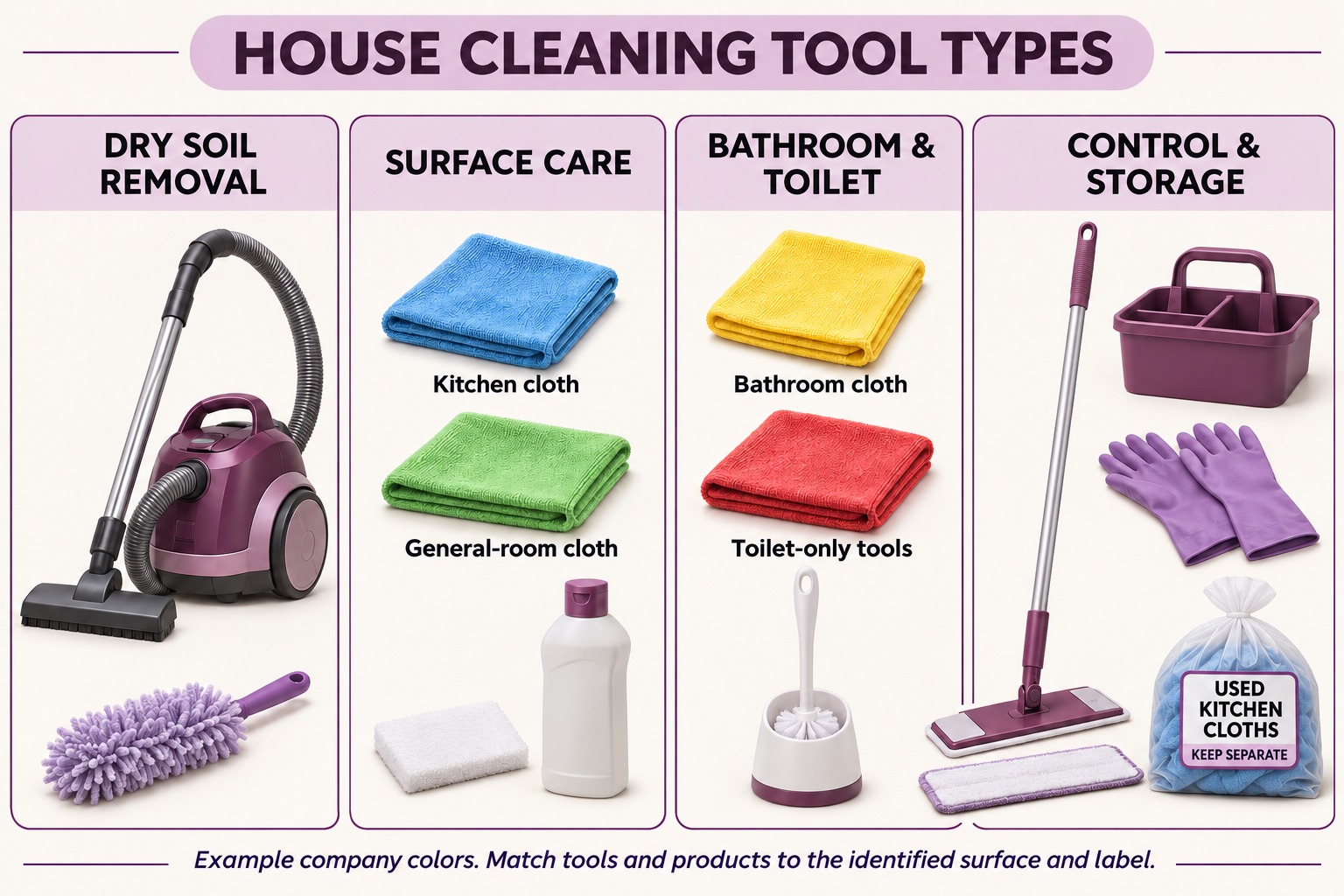
The example company uses blue kitchen cloths, yellow bathroom cloths, red toilet cloths and tools, green general-room cloths and dedicated floor pads. A used cloth goes into its assigned used-tools container, rather than back into the clean kit. Select physically compatible vacuum heads, nonabrasive pads and floor tools under the exact surface instructions.
Verify the actual product and surface
A generic bottle in the illustration is not a recommendation or approval for a finish. Identify the exact surface, finish and product; match the current label, SDS and manufacturer care instructions. Use H18 to document a permitted test and its limitations. An unknown finish is held pending evidence. Complete H17 for the actual site and product before beginning.