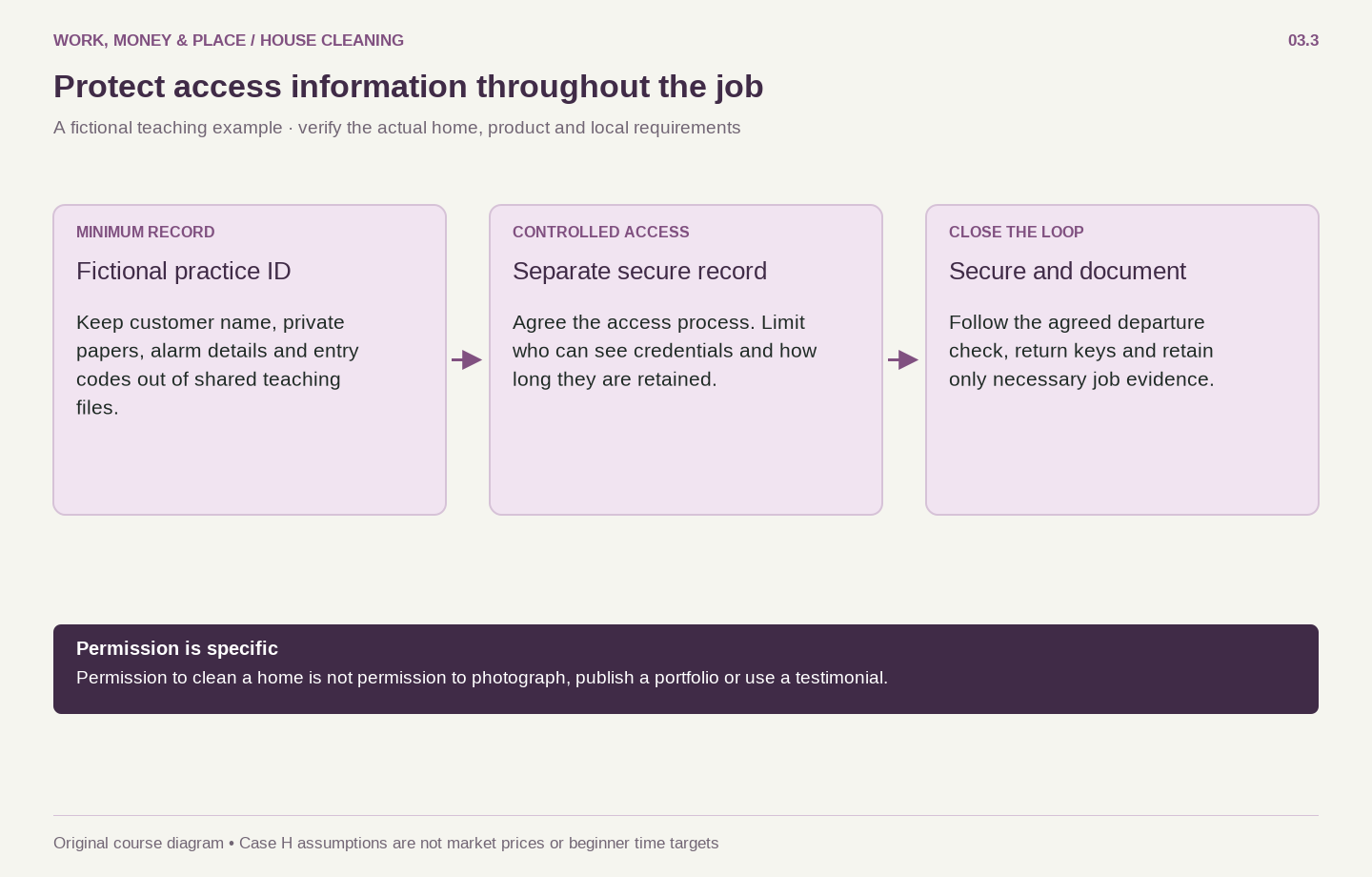
Create a controlled process for household access, private information, photos, and job evidence without putting sensitive customer data into general worksheets.
Open the full-size diagram ↗
Example and worksheet
Use the separately labeled Case H teaching records, then create a dated record for your own assessed service. Fictional results do not establish practical readiness or local demand.
Collect what the next decision actually requires
A cleaning inquiry does not require a complete household biography. Start with a broad service area, requested visit type, approximate rooms, timing, and a safe contact method. Request the precise service address when it is needed to assess travel, access, and the visit. Ask task-specific questions about pets, occupancy, finishes, and restrictions without collecting unrelated medical, financial, or family information. H06 is a survey aid, not a reason to copy every personal detail a customer happens to mention.
Use a job ID to connect the scope, quote, schedule, and invoice. Keep confidential entry instructions in a restricted location rather than reproducing them on every form. Do not put a door code, alarm credential, customer payment-card number, or full identity document into a practice worksheet. Browser-stored course notes and downloadable templates are not a secure client-management system. Use fictional placeholders while learning and establish suitable business storage before handling real records.
Verify authority and the agreed entry procedure
Confirm who may authorize the service and how you will know that entry is permitted on the scheduled day. A message from an unfamiliar person saying that the door is open is not sufficient evidence by itself. Record a verified contact, an agreed arrival window, whether someone will be present, and what to do if the expected arrangement changes. The customer should know which rooms are included and which areas are private or excluded.
If a key is entrusted to the business, track custody, return, and permitted use. Label it with a neutral identifier rather than an address visible to anyone who finds it. Restrict access to people who need it for an authorized task. Never assume that access for one cleaning visit permits a later unscheduled entry, marketing photography, or sharing instructions with an unintroduced helper. If authorization is unclear at arrival, stop outside the disputed area and contact the verified customer.
Separate condition records from marketing permission
Before-work evidence can explain an existing scratch, an inaccessible surface, or an agreed exclusion. Photograph only what is necessary, with the customer's permission and a clear purpose. Avoid faces, children, mail, screens, medicine, security equipment, and personal papers. A close view of a finish concern is usually more useful than a wide image of an entire private room. If a concern cannot be documented safely, write a factual note and agree on the limitation.
Permission to document a job for the customer does not automatically authorize public portfolio use. Obtain separate permission before publishing a household image or testimonial. Keep the permission connected to the actual image and intended use. Remove identifying details when appropriate and do not post a private address as a service example. A customer can decline marketing use without that choice becoming a reason to provide poorer cleaning or a less careful handoff.
Prepare for an access or information incident
Write a short response before a key is lost or a private document is accidentally captured. Stop the activity that could make the problem worse. Secure the remaining keys or records, identify what may have been exposed, and notify the appropriate verified customer promptly with facts you know. Preserve the relevant record. Do not conceal the incident, promise that nothing can happen, or erase the only evidence before understanding the problem.
For an immediate safety emergency, use the appropriate emergency response rather than treating it as an ordinary customer-service message. For a data or access incident, follow applicable requirements and obtain qualified help when necessary. The correct next step depends on the exposure and location. The course supplies a preparation framework, not a universal legal notification deadline. Record who owns the next action and when it will be checked, so an apology does not replace actual follow-through.
Retain useful evidence and remove unnecessary copies
Keep the accepted scope version, change approvals, completion notes, receipts, and required business records for a period appropriate to legal, insurance, and operational needs. Decide that period using your actual obligations; there is no single retention number that fits every record in this course. Delete unnecessary duplicate photos and outdated access instructions using a deliberate process, while preserving material needed for a complaint, claim, or required record. Protect backups and limit who may retrieve them.
At handoff, return a key through the agreed method and confirm receipt. Close the job record with the date, completed and excluded tasks, customer response, and any unresolved item. Do not store payment-card details simply because an invoice was paid. Review access whenever a helper leaves the business or a customer changes an arrangement. This small control process supports trust: the business can explain what was authorized, what happened, and how household information was handled.
When sharing a record with a bookkeeper, insurer, or other appropriate recipient, provide only the information needed for that purpose through a suitable controlled method. Do not attach household access instructions merely because they sit in the same folder.
Put it into practice
Your assignment
Build an access and evidence plan for a practice home without entering any real security credential.
Inputs
- A customer will be away and offers a door code.
- The bathroom has a pre-existing mark near personal medication.
- The customer permits private condition photos but has not agreed to marketing use.
- An unfamiliar text later asks you to give a new helper the code.
Your deliverable
H05/H06 entries identifying secure storage location, verified authorization, photography limits, key/code handling, and the stop-and-contact response.
Saved only in this browser when storage is available. Export this page separately and use fictional identifiers in practice.
Show the worked answer
- Use a neutral job ID and record where authorized access details are securely stored; do not write the code in the workbook.
- Document only the relevant surface condition with permission and avoid medication or identifying items. Keep the image private.
- Do not publish the image without separate marketing permission.
- Do not disclose the code in response to the unfamiliar text. Verify the request through the established customer contact and introduce any authorized helper through the agreed process.
Show the self-check criteria
- No actual secret or private household detail appears in the exercise.
- Authorization, condition evidence, and marketing consent are separate.
- Uncertain entry or disclosure is paused.
- The plan includes return, incident, retention, and access-removal actions.