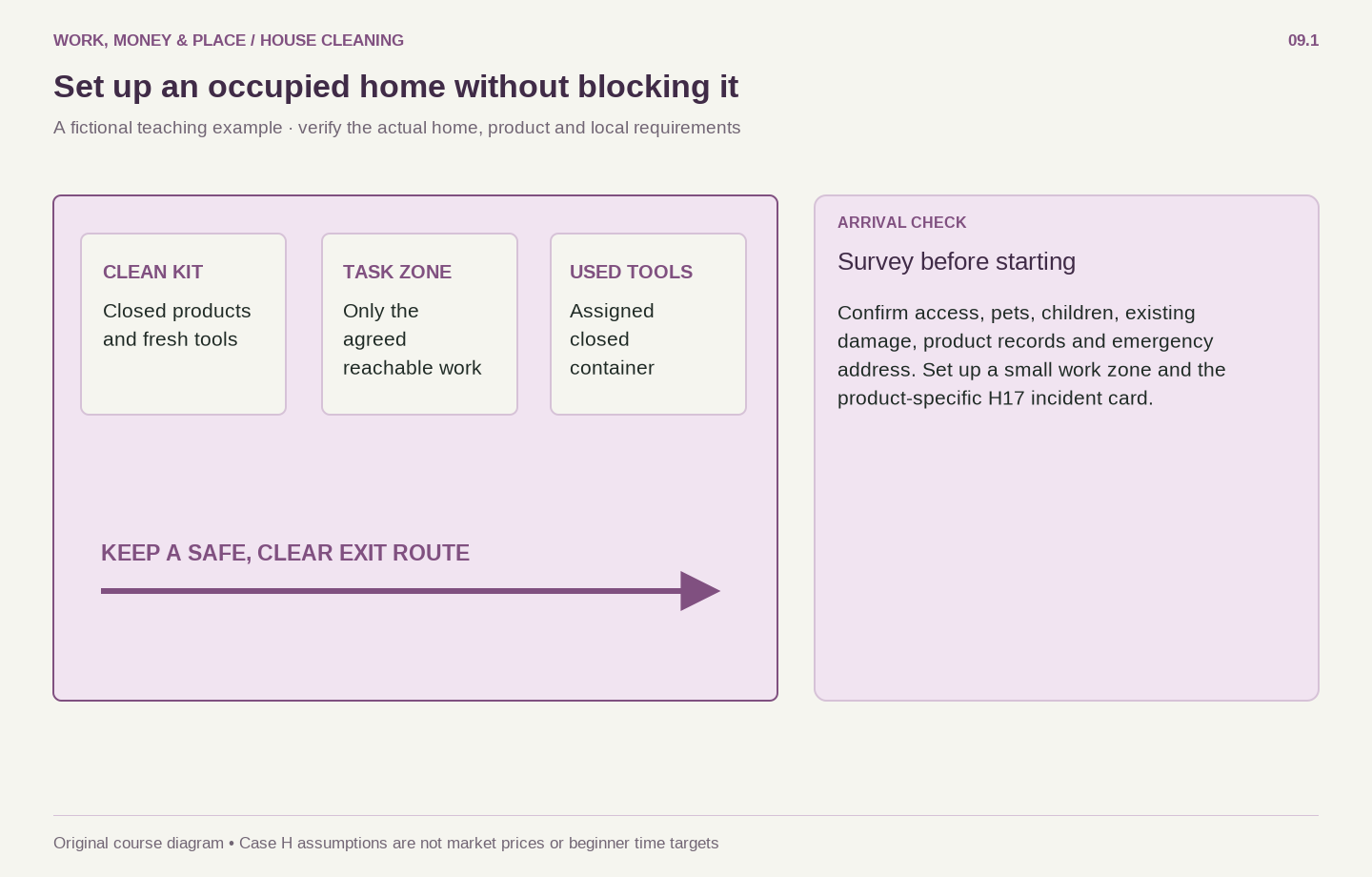
Confirm the accepted home conditions and establish a protected route before beginning the routine visit.
Open the full-size diagram ↗
Example and worksheet
Connect this lesson to the complete Case H records. Keep the fictional example separate from your own project.
Start with the agreed package in your hand
Arrive with the accepted H06 inventory and the current quote, not only an address in your phone. Confirm the household contact, entry method, approved parking, pets, occupied rooms, water access, and any change since the survey. Keep access codes private. Do not announce them in a video or put them in a photograph of your checklist. Case H is an occupied home, so a clear route and cooperation with occupants matter throughout the visit.
Reconfirm that the work remains routine. A newly blocked bedroom, wet floor from a leak, household illness requiring a different service, or unfamiliar spill changes the starting conditions. Describe the observation and pause the affected task. The fifteen-minute first-visit arrival phase is a teaching allowance for these checks, protection, and setup, not a rule that you must stop assessing when the timer ends. If the package no longer fits, obtain a clear decision before proceeding.
Make the first walk-through a condition record
Walk the eight zones in the same order as the survey. Check the particular surfaces you intend to touch and the route the equipment will follow. Note existing chips, loose handles, peeling finishes, unstable objects, cracked seams, or moisture. Record location and appearance without diagnosing causes. A factual note such as loose left cabinet handle is more useful than an unsupported claim that the customer broke it. Photograph only what is necessary and permitted.
Resolve changes before they disappear under tools. If a vanity finish was identified at quotation but a replacement top is now installed, the previous H18 method does not automatically apply. Hold that surface for identification. If a counter is still covered with excluded possessions, ask the customer to clear it or mark the specific task unavailable. Keeping an honest condition record prevents the final checklist from becoming an argument about work that could never be performed.
Establish clean and used-tool stations
Set the clean kit on a suitable protected staging area agreed with the household. Keep labeled products closed and upright when not in use, away from food, children, and pets. Separate clean cloth packs from used containers. Put the blue kitchen, yellow bathroom, red toilet, green room, and identified floor tools where each can be selected without searching through dirty material. These are this course's example colors; written zone labels are the controlling cue.
Plan how you will leave a bathroom without carrying its used tools through a clean kitchen station. A dedicated used-tool carrier and hand hygiene between tasks prevent a careless transfer. Remove gloves appropriately and replace them when the task or contamination requires; a glove that touched the toilet is not a clean hand for a kitchen bottle handle. Do not set a bathroom caddy on a food-preparation counter. Keep toilet tools distinctly contained even during a brief interruption.
Keep the route safe as it changes
Place cords and equipment where they will not block exits or household movement. Inspect the actual cord and plug and use only the electrical arrangement permitted by that machine's manual. Keep dry electrical equipment away from wet work. If a fault is discovered, stop and isolate the equipment rather than attempting an improvised repair. A warning sign is useful communication, but it does not replace controlling access to a damp or obstructed route.
Choose a sequence that lets soil-producing room work finish before the final floor route. Bathrooms may be completed with dedicated tools and then those tools contained before entering another zone. Within each bathroom, keep toilet work last. If the household needs a room midway, agree on timing and reopen it only when the particular work area is ready. Do not trap yourself behind a wet section or require an occupant to walk through an untreated spill to reach an exit.
Check the incident card while conditions are calm
Before opening a product, make H17 usable: actual site address and callback, safe access for help, location of labels and offline SDS copies, and the appropriate contact for the exact product. The six-step card starts by stopping the task and securing the area. For an immediate emergency, call 911 and provide location, callback, and what happened; follow the dispatcher. A routine product inquiry is different from an emergency call.
Locate exposure directions in the matching label and SDS Section 4 and spill information in Section 6. Do not use one cleaner's first-aid steps for another product. Do not neutralize a spill with a second chemical or recover it with a dry vacuum. If the release cannot be managed within the product instructions and your training, withdraw from the affected area and get appropriate help. Record the event and conditions for restart. Practicing this means finding information and rehearsing decisions, never creating an exposure or placing a test emergency call.
Put it into practice
Your assignment
Run a dry arrival rehearsal without using chemicals.
Inputs
- The hall is clear; bathroom one has a newly changed vanity top.
- A child may enter the kitchen; the pet will stay with the owner.
- The selected dry vacuum has a damaged plug.
Your deliverable
H06/H17 with go, hold, and equipment decisions plus an open exit route.
Saved only in this browser when storage is available. Export this page separately and use fictional identifiers in practice.
Show the worked answer
- Hold the new vanity until its finish and care method are identified; other separately safe work can be assessed.
- Agree household control of child and pet access and a protected product station.
- Quarantine the damaged vacuum, obtain a checked suitable replacement, and revise timing if necessary. Never start with a known electrical fault.
Show the self-check criteria
- No actual exposure, spill, or emergency call occurs during rehearsal.
- Every held task is traceable to a zone.
- Labels, SDS, contact information, and exit are available before work.