Build a location-and-activity permissions register without confusing business identity with trade approval.
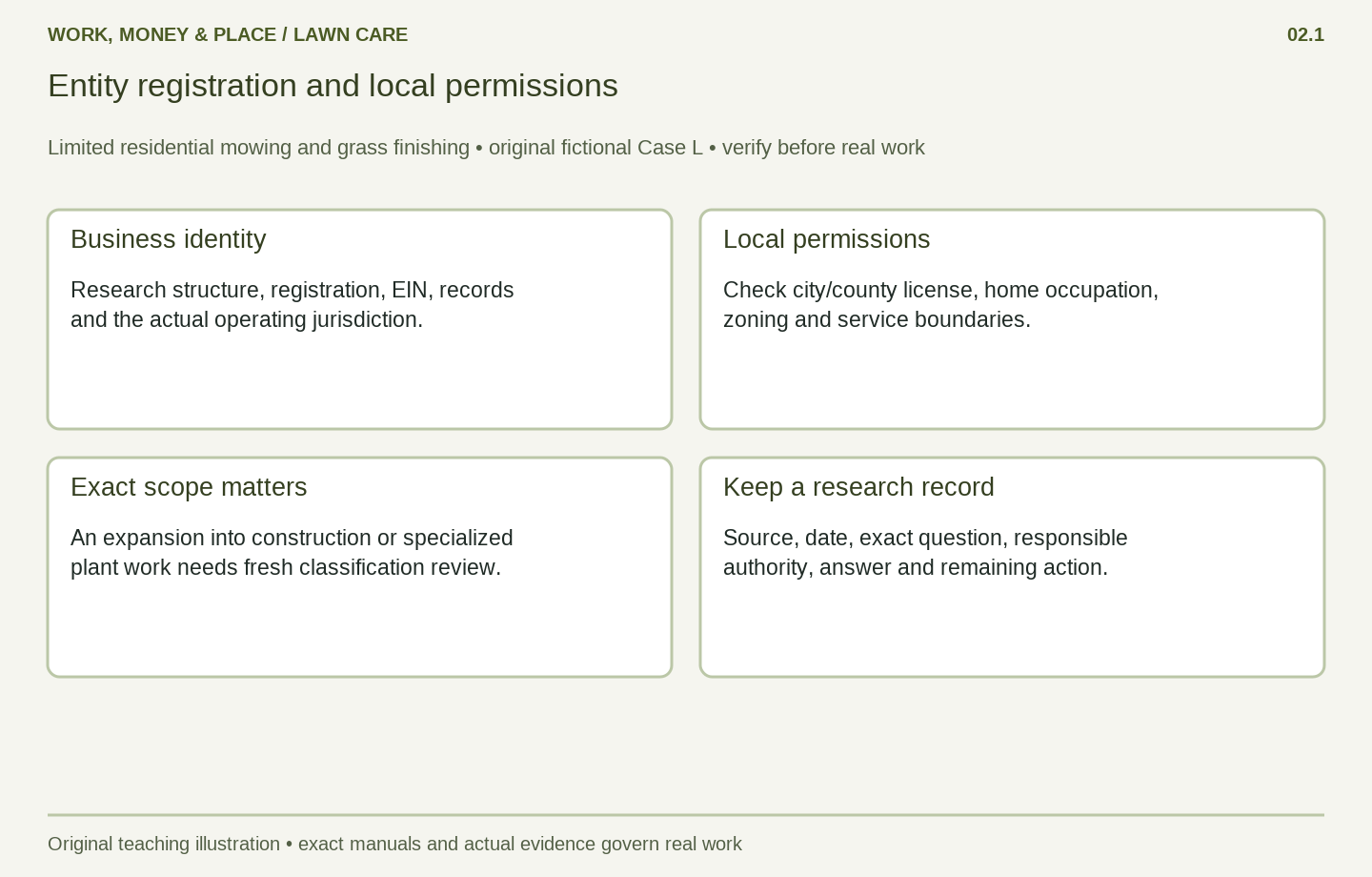
Open the full-size diagram
Example and worksheet
- L03 working form
- Case L 02 · Scope and remote agreement
- Case L 11 · Launch, equipment choices and route sensitivity
- Case L 12 · Audit the case and prepare your own visit
Study the filled First plan tab. Enter your own work in the separate blank Your estimate tab. Select the tab inside the downloaded file; this link downloads the whole workbook.
Describe the business before choosing a form
Start with the real owner, business location, work locations and offered activities. Those facts help determine which registrations and permissions need investigation. A mailing address is not necessarily the place where equipment is stored, batteries are charged or a vehicle is parked. Likewise, doing work across a city boundary can raise requirements even when the business has no office there. Put the activity description from L01 beside L03 so your legal research concerns the service you actually plan to sell.
Use the optional WMP Business Reference for general structure and registration background. The required output here is the permission register for your actual mowing activities, operating base and job locations.
Separate state identity and city permission
Washington is this course's researched example, not a national licensing template. The state business guide connects business licensing, tax accounts and local requirements, while some entity filings involve the Secretary of State. Determine what applies to the actual owner and entity. Keep consistent legal names and identifiers across the registration, bank records, customer documents and coverage discussions. A mismatch can make later verification difficult even if each individual document looks official.
The City of Vancouver explains business-license requirements for businesses located or working within its city limits. Verify the actual jurisdiction rather than inferring it from a postal address containing Vancouver. Check the current city process and any exemption facts directly. A possible exemption from a fee is not permission to assume no license or registration is needed. This course supplies no real business number, activated license or finding that a learner qualifies for an exemption.
Investigate the operating location
Home-based operation needs its own review. Vancouver identifies home-occupation standards and possible permit requirements separately from the city business license. Describe storage, vehicle activity, equipment loading, charging, noise and any customer visits when asking the relevant questions. A quiet office at home is different from outdoor equipment storage or repeated early-morning loading. A license alone does not settle zoning, lease terms, homeowners-association restrictions or safe battery-charging arrangements.
Keep the source, date, exact question, facts supplied and result in the register. If the answer depends on a condition, record that condition instead of reducing the entry to approved. For example, a permission tied to no onsite customer visits must be reopened if you later invite customers to a workshop. Do not invent an agency contact or turn a general webpage into a site-specific approval. Where a required determination is unresolved, the corresponding activity remains on HOLD.
Distinguish maintenance from an expanded trade
Washington's small-business guide warns that lawn businesses can enter contractor specialties through activities such as modifying beds, building paths, planting or powered removal of unwanted plants. The landscaping specialty definition is also relevant to activity review. These sources do not justify a blanket claim that every mowing business is exempt from contractor registration, nor do they authorize this starter business to perform all landscaping tasks. Describe the exact limited offer and resolve applicability before advertising covered work.
Keep tax classification, contractor registration and workers-compensation classification in different entries. They answer different questions and may use similar words differently. A DOR category containing lawn maintenance does not prove an L&I contractor determination. If a customer requests a retaining wall, irrigation repair or tree work, do not treat that as a minor extension of the routine-mowing license check. Refer the request back to the scope decision and investigate separately before any offer.
Make the register usable after launch
For each applicable item, identify the authority, requirement, evidence, responsible person, effective date, renewal or review date and remaining action. Include business and work locations, tax registration, actual activity classification, home operation and relevant local restrictions. Keep a current source link and a retained copy of any actual determination. Do not place passwords, payment-card data or unnecessary personal identifiers into ordinary course worksheets.
Put it into practice
Your assignment
Separate three permission questions.
Inputs
- The owner has formed an LLC and plans to charge mower batteries/store tools at a Vancouver home.
- The proposed work includes routine mowing plus a new paved garden path.
- The owner thinks a low-revenue city fee exemption removes all licensing duties.
Your deliverable
L03 three separate research entries and launch decisions.
Working forms: L03.
Saved only in this browser when storage is available. Export this page separately and use fictional identifiers in practice.
Show the worked answer
- Investigate city license, jurisdiction and home-occupation/zoning/storage conditions in addition to entity filing.
- Remove the path from the starter offer and resolve contractor/trade requirements before offering it.
- Check the precise exemption and process; do not equate an exemption from a fee with permission to omit licensing.
Show the self-check criteria
- Entity and activity permissions remain separate.
- The actual operating location is described.
- No real approval number is invented.