Document the complete formation history and preserve applicable cancellation and customer remedies.
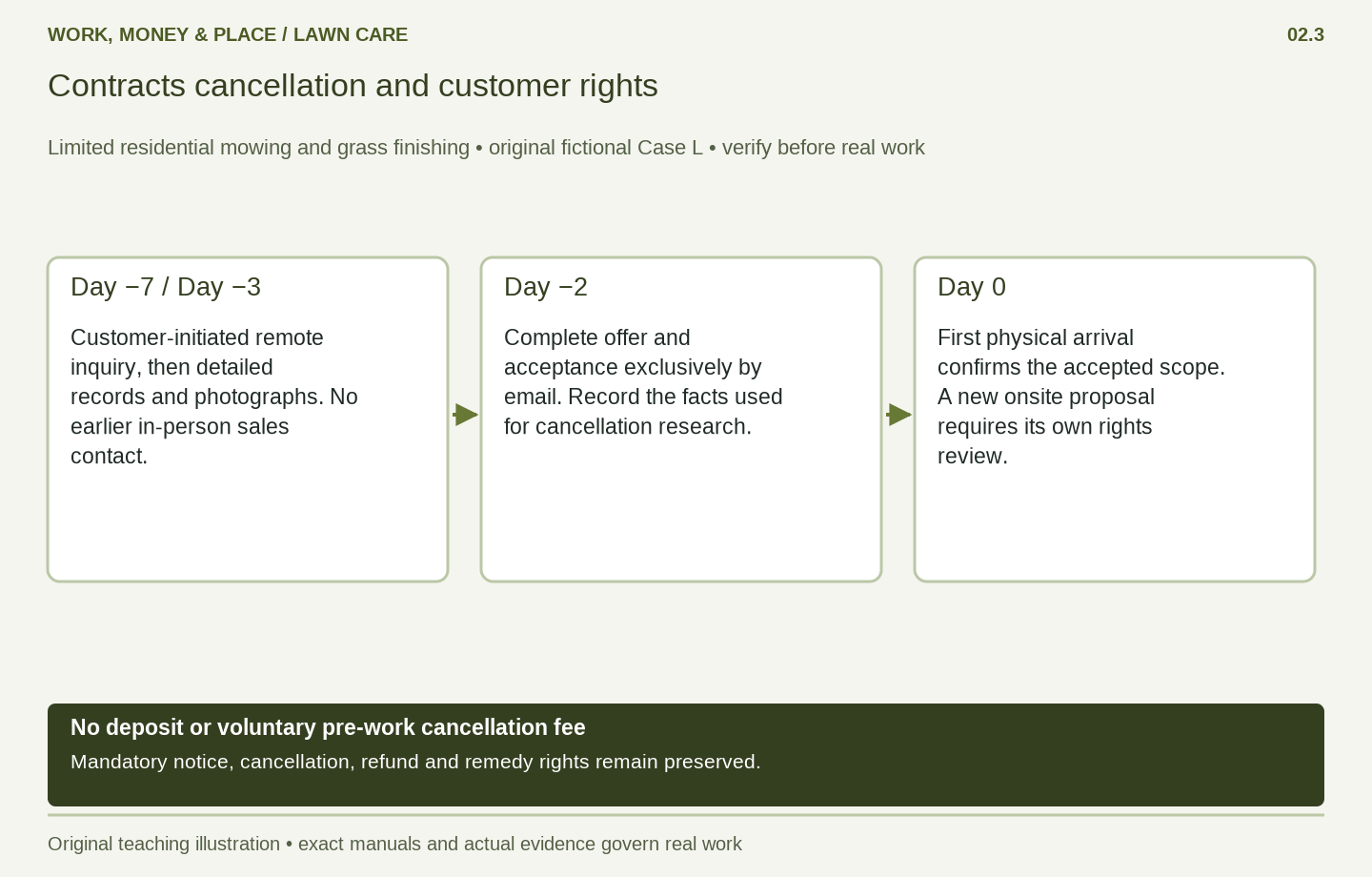
Open the full-size diagram
Example and worksheet
- L06 working form
- Case L 02 · Scope and remote agreement
- Case L 08 · Acceptance, receipts and customer handoff
- Case L 12 · Audit the case and prepare your own visit
Study the filled First plan tab. Enter your own work in the separate blank Your estimate tab. Select the tab inside the downloaded file; this link downloads the whole workbook.
Keep the sales history before deciding the rule
A mowing agreement has a history, not merely a signature date. Record who initiated the contact, how the service was discussed, whether anyone visited in person before acceptance, how the complete offer was delivered and when it was accepted. An electronic signature after a doorstep negotiation does not make every part of the sale online. Keep the original inquiry and material communications with the accepted version so the legal analysis concerns what actually happened.
The FTC Cooling-Off guidance covers certain sales at homes and other temporary locations and identifies sales made entirely online, by mail or telephone among its exclusions. This is a limited federal-rule question. Do not claim a universal exemption because the customer wants lawn maintenance, pays after work or signs on a phone. Review the actual facts, any applicable federal requirements and the relevant state or local consumer rules before relying on an exception.
Distinguish a visit from a continuing commitment
Case L records customer-initiated remote inquiry and photographs on Day −7, detailed confirmation on Day −3 and the complete offer and acceptance entirely by email on Day −2, with no earlier in-person sales contact. First physical arrival is Day 0 for confirmation and performance under the agreement. These are fictional formation facts, not a recommendation to quote every lawn remotely. If confirmation produces a new onsite offer, record it as a new proposal and review its consequences rather than rewriting or backdating the original acceptance.
Identify required information and notices
When a covered rule requires cancellation notices or forms, use the actual required content, format, language, delivery and time calculation. The FTC guidance explains seller disclosures and cancellation forms for covered sales. A sentence saying contact me soon does not necessarily satisfy those duties. Place the required customer copy and evidence of delivery with L06, and establish when performance can lawfully proceed rather than asking the customer to waive everything.
Washington's Attorney General guidance discusses separate door-to-door, retail-installment and commercial telephone-solicitation situations. Those categories are not interchangeable, and a series of separately agreed lawn visits should not be casually labeled an installment purchase. Conversely, calling a contract a maintenance plan does not remove applicable protections. If you cannot establish the required route, keep formation or performance on HOLD as appropriate and obtain a qualified interpretation of the actual arrangement.
Write voluntary terms that match the service
State deposits, payment timing, voluntary cancellation or rescheduling terms before acceptance. The fictional teaching arrangement does not depend on an undisclosed pre-work penalty. Distinguish a customer cancellation from a postponement because wet ground, people, hidden debris or other conditions make work unsupported. Describe the next communication and whether a new date needs acceptance. A safety hold should not create a surprise charge first disclosed after the operator reaches the property.
Also distinguish correcting deficient work from selling extra service. A missed included grass strip is not automatically new billable scope, while a request to clear an excluded bed is not automatically included. Preserve mandatory cancellation, refund and remedy rights in both the written terms and actual response. Clear voluntary terms can help customers understand what to expect, but they do not override a law or make misleading advertising acceptable.
Retain the accepted version and changed sales facts
Before booking, confirm that the offered work matches the assessment, selected equipment and feasible operating envelope. After acceptance, preserve the dated version and make transparent corrections or accepted changes. A customer who asks for an early start, entry inside the required separation or a closer public boundary has introduced a material condition that cannot be resolved by a generic waiver. The useful result of L06 is a documented route for the actual transaction, including unresolved questions, rather than a declaration that electronic paperwork has eliminated customer rights.
Put it into practice
Your assignment
Compare two sales histories and a proposed repeat commitment.
Inputs
- A: customer inquiry, discussions, complete offer and acceptance are entirely by email; no earlier in-person sales contact.
- B: terms are negotiated at the home, followed by a phone signature.
- A later message promises visits all season without stating price changes, cancellation or whether each visit needs acceptance.
Your deliverable
L06 separate histories and missing continuing-service terms.
Working forms: L06.
Saved only in this browser when storage is available. Export this page separately and use fictional identifiers in practice.
Show the worked answer
- A supports only the narrow federal remote-only analysis; preserve mandatory state/local rights and review actual facts.
- B is not entirely online merely because the final signature is electronic; investigate applicable in-home/off-premises requirements.
- Do not treat an undefined season promise as a complete agreement; disclose continuing terms or obtain separate visit acceptance before commitment.
Show the self-check criteria
- All material sales contact is retained.
- Required notices are not replaced by a waiver.
- Repeat visits do not acquire hidden renewal or cancellation terms.