Track whole stock purchases, charging cost and owner labor on distinct management and cash bases.
Open the full-size diagram
Example and worksheet
- L20 working form
- L21 working form
- Case L 06 · Price and full owner value
- Case L 07 · Whole packs, stock and complete schedule
- Case L 09 · Adverse actual branch and variance
- Case L 10 · Chronological cash and customer tax
Study the filled First plan tab. Enter your own work in the separate blank Your estimate tab. Select the tab inside the downloaded file; this link downloads the whole workbook.
Identify what is actually being purchased
A spool, package or carton is the purchased unit; the quantity used on a visit can be much smaller. Record the whole delivered price, usable quantity, actual unit and any opening carrying value. Case L buys 240 feet of approved 0.095-inch trimmer line for $18, twenty litter bags for $12 and forty disposable dry shop cloths for $8. The $38 purchase is original teaching data, not a product quote or an instruction to substitute a different line for the selected manual's requirements.
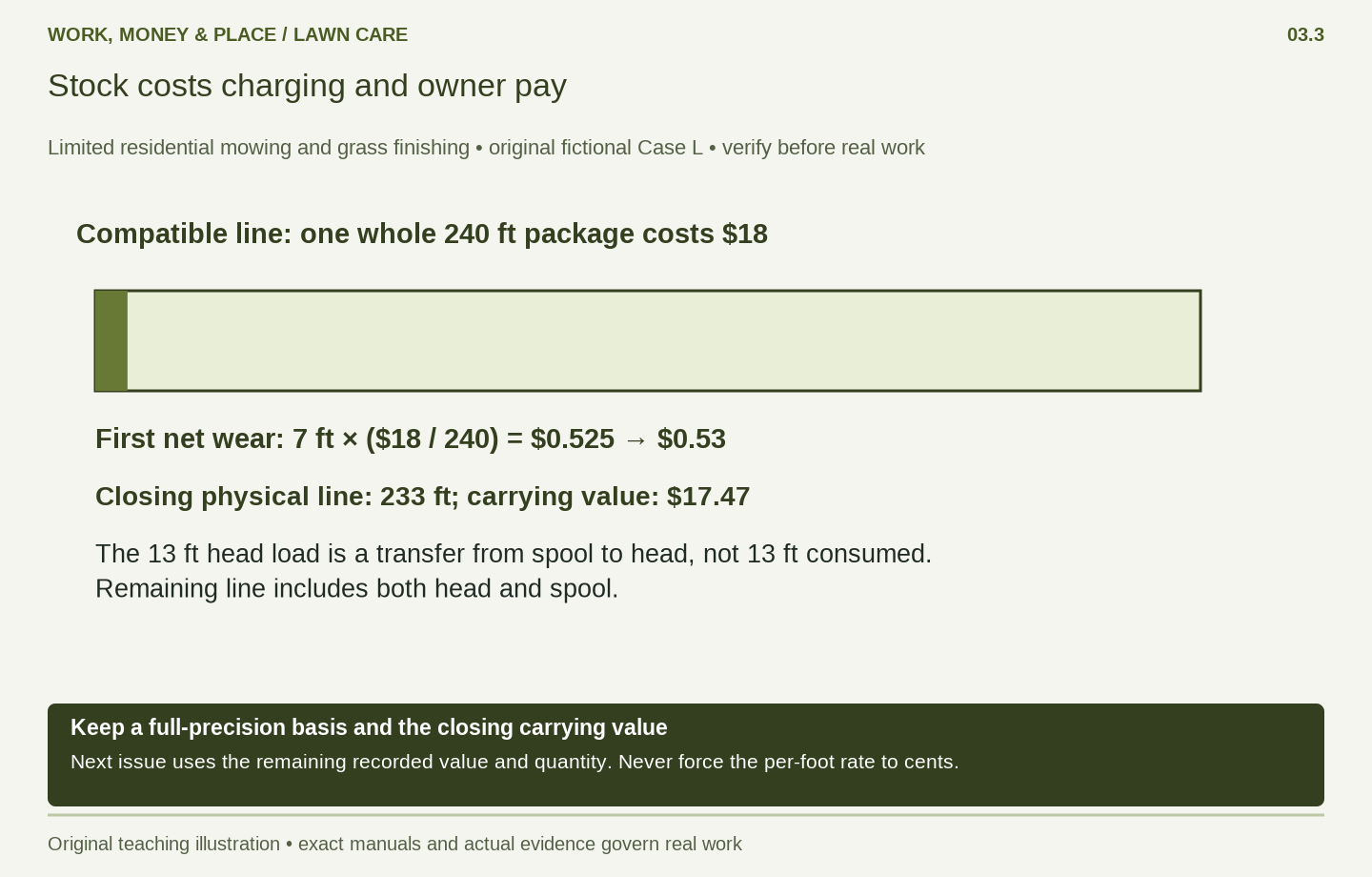
Derive unit basis without forcing fractional rates to cents. The line begins at $18/240=$0.075 per foot, bags at $0.60 each and cloths at $0.20 each. Rounding the line to $0.08 before multiplying changes its cost. Preserve the full calculated basis until money is posted. Your real record must also distinguish an ordinary dry cleanup cloth from any solvent, pesticide or other product; this starter offer does not introduce chemical turf treatment through its supply list.
Distinguish loading from consumption
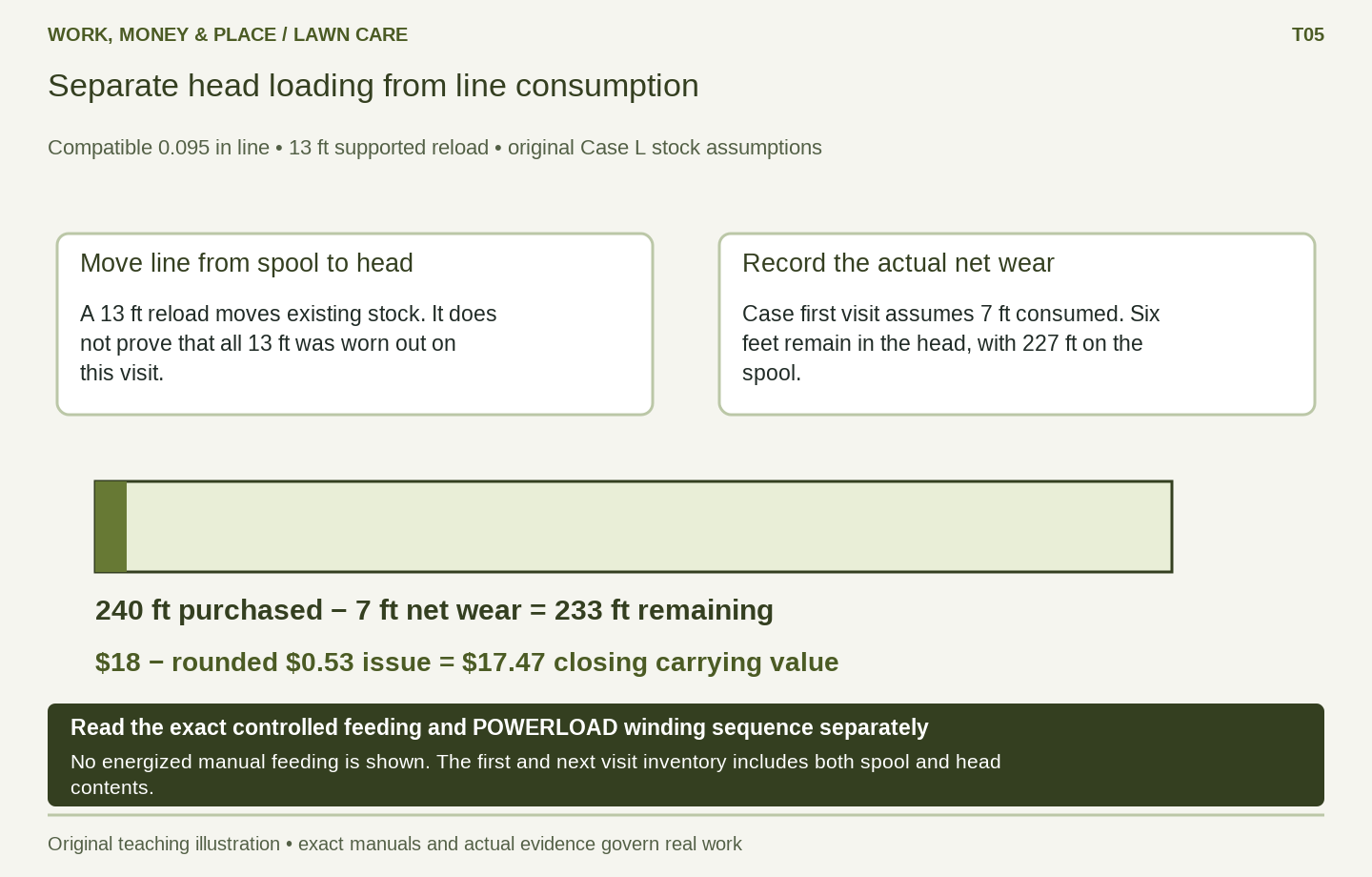
The initial thirteen-foot head load is a transfer from loose stock into the compatible trimmer head, not thirteen feet automatically consumed on the first lawn. In the base first visit, seven feet are used, leaving six feet in the head and the rest of the line available in the spool. Count line still in equipment when reconciling ending stock. Otherwise you can charge the full load now and charge the remaining head line again on the next visit.
Open the full-size illustration
Illustration sources: LB06, LB09, LB20, CASE-L-01.
Post use loss and carrying value consistently
The first planned visit uses seven feet of line, two bags and two cloths. The cent-posted line issue is $0.53, bags $1.20 and cloths $0.40, totaling $2.13. The stock ledger therefore carries $35.87 forward from the $38 purchase. Preserve that posted balance. Do not independently reprice ending quantities from a rounded nominal rate and introduce a stray cent; derive the next opening basis from the actual carried quantity and value.
The separate planned next visit uses four feet of line, one bag and one cloth, costing $1.10 and leaving $34.77 after the planned first branch. The alternative actual first visit adds eight feet of line loss, one damaged bag and one cloth to the normal issue, adding $1.40 and bringing stock cost to $3.53. No additional stock purchase is assumed in that alternative. A loss reduces stock and result even when the bank does not pay another bill that day.
Budget charging and equipment use separately
Case L models $0.30 depot charging electricity for the first visit and $0.25 for the next. These are explicit cost allowances, not measured energy, runtime or tariff claims. Real charging records need a supported method for determining electricity cost and the actual charger and environment. Do not assume every pack starts full because it was placed near a charger, or that customer power is included when the agreement provides none.
The reusable equipment allocation is different from charging and stock. A $2,400 usable kit divided by 200 modeled visits gives $12 per visit, while $360 overhead divided by forty modeled visits gives $9. Those denominators are management assumptions, not promised demand or tax depreciation. Keep actual acquisition and overhead cash payments in the dated cash model and use the allocations once when evaluating the job's economic result.
Value the owner's complete contribution
The first plan values 3.5 owner hours at $25, or $87.50. That includes assessment and quote work, preparation, travel, arrival controls, mowing/trimming, finishing and records. It is not a wage payment, household take-home amount or tax deduction established by the course. Owner payment and tax treatment depend on the real entity and circumstances; the management value simply prevents the estimate from pretending the owner's time is free.
Put it into practice
Your assignment
Reconcile the line transfer and first stock issue.
Inputs
- Purchase: 240 ft line for $18,20 bags for $12,40 cloths for $8.
- Transfer 13 ft into the head; first visit consumes 7 ft, 2 bags and 2 cloths.
- Alternative actual loses another 8 ft line, 1 bag and 1 cloth.
Your deliverable
L21 quantity/value record and L20 stock cost.
Saved only in this browser when storage is available. Export this page separately and use fictional identifiers in practice.
Show the worked answer
- Initial 13 ft is a stock transfer; 6 ft remains in the head after 7 ft use, so total ending line quantity is 233 ft.
- Post line $0.53 + bags $1.20 + cloths $0.40 = $2.13; carry total stock $35.87.
- Extra loss = $0.60 + $0.60 + $0.20 = $1.40; alternative total stock cost = $3.53, without inventing another purchase.
Show the self-check criteria
- Unit basis retains precision.
- Head stock is not double-counted.
- Rounded posted carrying values reconcile.