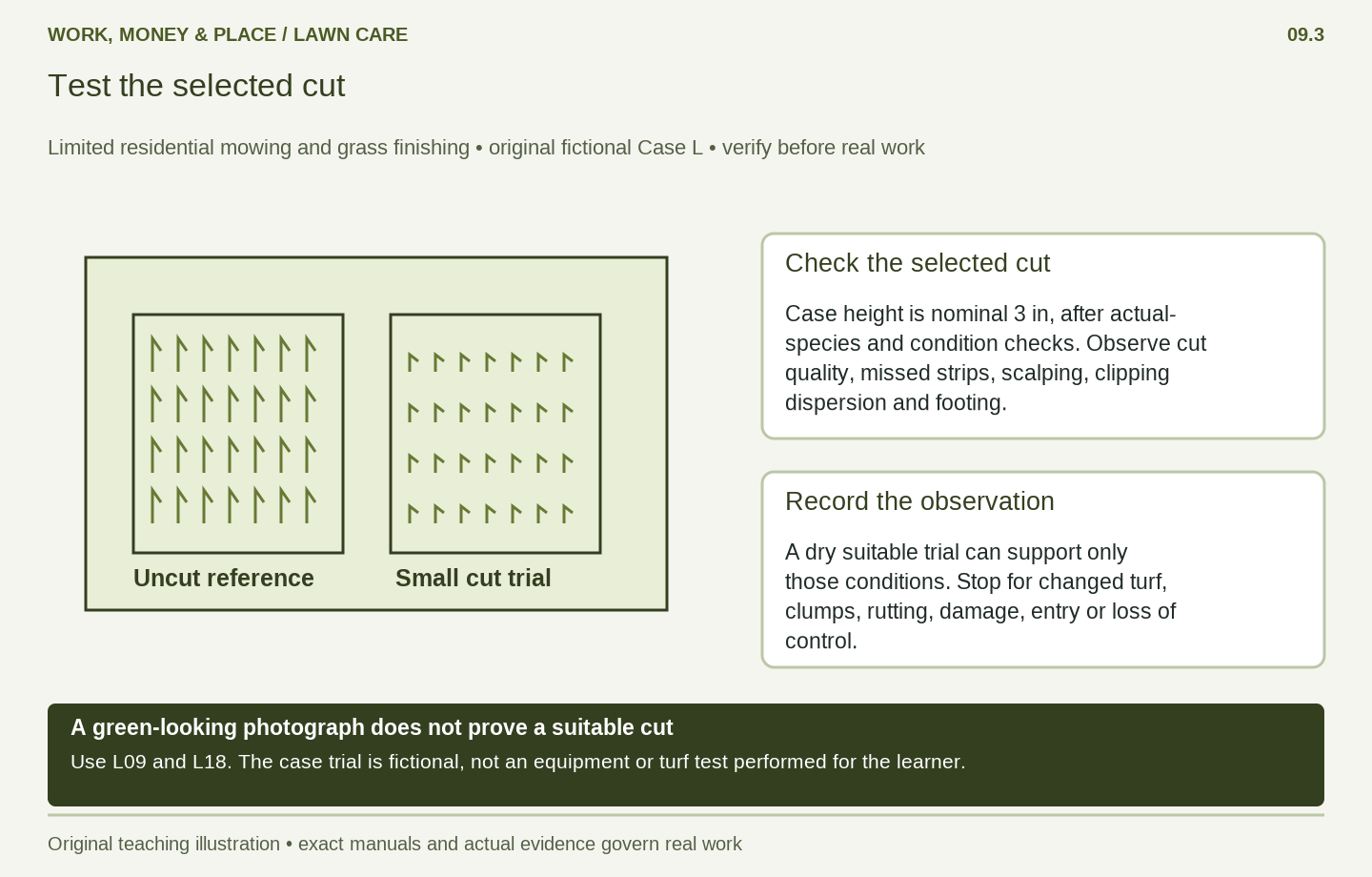
Use a small representative test to verify the selected cut, clipping dispersion and operating control before expanding.
Open the full-size diagram
Example and worksheet
- L09 working form
- L18 working form
- Case L 01 · Survey and measured lawn
- Case L 03 · Equipment, batteries and compatibility
- Case L 05 · Safety, loading and stop decisions
- Case L 07 · Whole packs, stock and complete schedule
Study the filled First actual tab. Enter your own work in the separate blank Your actual tab. Select the tab inside the downloaded file; this link downloads the whole workbook.
Choose representative small tests
With permission, select a sound inconspicuous area representing each materially different lawn condition. Do not test only the easiest corner and generalize to a wet or stressed area. Debris removal, exact configuration, personal protection, the full operating boundary and an accepted clipping route apply even to a small trial. Its size does not reduce the selected separation or resolve unknown treatment history.
Case L identifies TF01 in F01 and TB01 in B01, both stipulated mature tall fescue with representative 4.25-inch standing leaves and an established three-inch target. Each uses its own three-by-ten-foot maneuver envelope, not a claim that every square foot inside that envelope is cut. Locate the trial clear of H01 and other protected objects.
Set and start under supported controls
Stop, wait for blade stop and remove the battery before selecting the nominal height. On this current eight-position LM2130SP, position 6 is approximately three inches. Verify insert, rear door, extended rails, secured clamps and locked handle. Fit the supported pack securely only after preparation and the clear boundary are confirmed.
Follow the identified safety-button and bail starting sequence. Use stable forward control and learn the separate self-propel response at a manageable walking pace. Do not tip a running deck, reach beneath it or pull it backward into an unseen area to correct a strip. A paper time allowance is not permission to rush an unfamiliar control response.
Inspect after actual motion stop and isolation
Release travel and blade controls, observe complete stop and remove the pack before close inspection or adjustment. Measure representative remaining grass from safe positions. Look for torn tips, scalping, wheel marks, displaced objects, missed strips and persistent clipping piles. Check footing and the protected route as well as the visual stripe.
The fictional completed trials stipulate remaining leaves approximately 3.0–3.2 inches, no new tearing, scalping or ruts, and small clippings settling into the same turf. TF01 operates in the simulated 35–39-minute interval and TB01 in 40–44, followed by records around 44–45. These are invented observations and sequence, not measured performance or an instruction to cut for a fixed number of minutes. Preserve the difference between nominal selector height and observed leaf range.
Correct one supported factor or retain HOLD
A torn cut, repeated overload, clump or rut should narrow the next decision. Stop rather than lowering height or forcing speed. Determine whether condition, supported configuration, blade service or scope is unresolved, obtaining qualified assistance for a mechanical defect. Do not substitute chemical treatment or disease diagnosis for a failed routine-cut trial.
If an appropriate adjustment is supported, isolate first and record exactly what changed. Retest a bounded area before expanding. Changing height, speed, blade arrangement and clipping destination together hides the cause of the result and may change the accepted service. Keep the original failure and any damage in the record; a later pass does not erase it.
Issue a separate expand decision for each zone
L09 holds the species/height/target decision, while L18 records location, setup, actual observations, stop/correction and limits. F01 may support expansion while B01 remains HOLD; averaging their results would conceal the unsupported lawn. Expand only while clipping dispersion, machine control, footing and separation remain acceptable throughout the zone.
The first case plan allows ten onsite minutes for the test phase inside a much larger owner cycle. Real assessment or a HOLD may take longer. Record the actual time and preserve the accepted estimate. In the adverse Day 2 branch, new dry/firm conditions and 4.4-inch growth require fresh tests; the original fictional result does not carry forward as permanent authorization. A customer accepting the appearance cannot waive an unsafe method or unknown damage.
Put it into practice
Your assignment
Classify two test outcomes.
Inputs
- F01: remaining leaves 3.0–3.2 in; small clippings settle; no ruts or scalping.
- B01: wheel marks in soft soil and persistent clumps.
- Both used position 6 with representative 4.25 in starting height.
Your deliverable
A dated L09, L18 working record containing the calculation or decision, observed evidence, unresolved items, responsible action and next review.
Saved only in this browser when storage is available. Export this page separately and use fictional identifiers in practice.
Show the worked answer
- F01 may expand only while all other controls and scope conditions hold; actual work needs actual evidence.
- HOLD B01. Soft ground and clumping defeat the starter method despite the nominal setting and 29.4% screen.
- Do not force another pass or lower the target; resolve conditions and any changed agreement first.
Show the self-check criteria
- Nominal setting and observed height are separate.
- Close inspection follows blade stop and battery removal.
- Each lawn has a separate decision.