Use controlled dry-vacuum passes on accessible mats, carpet and seats while protecting trim and moving mechanisms.
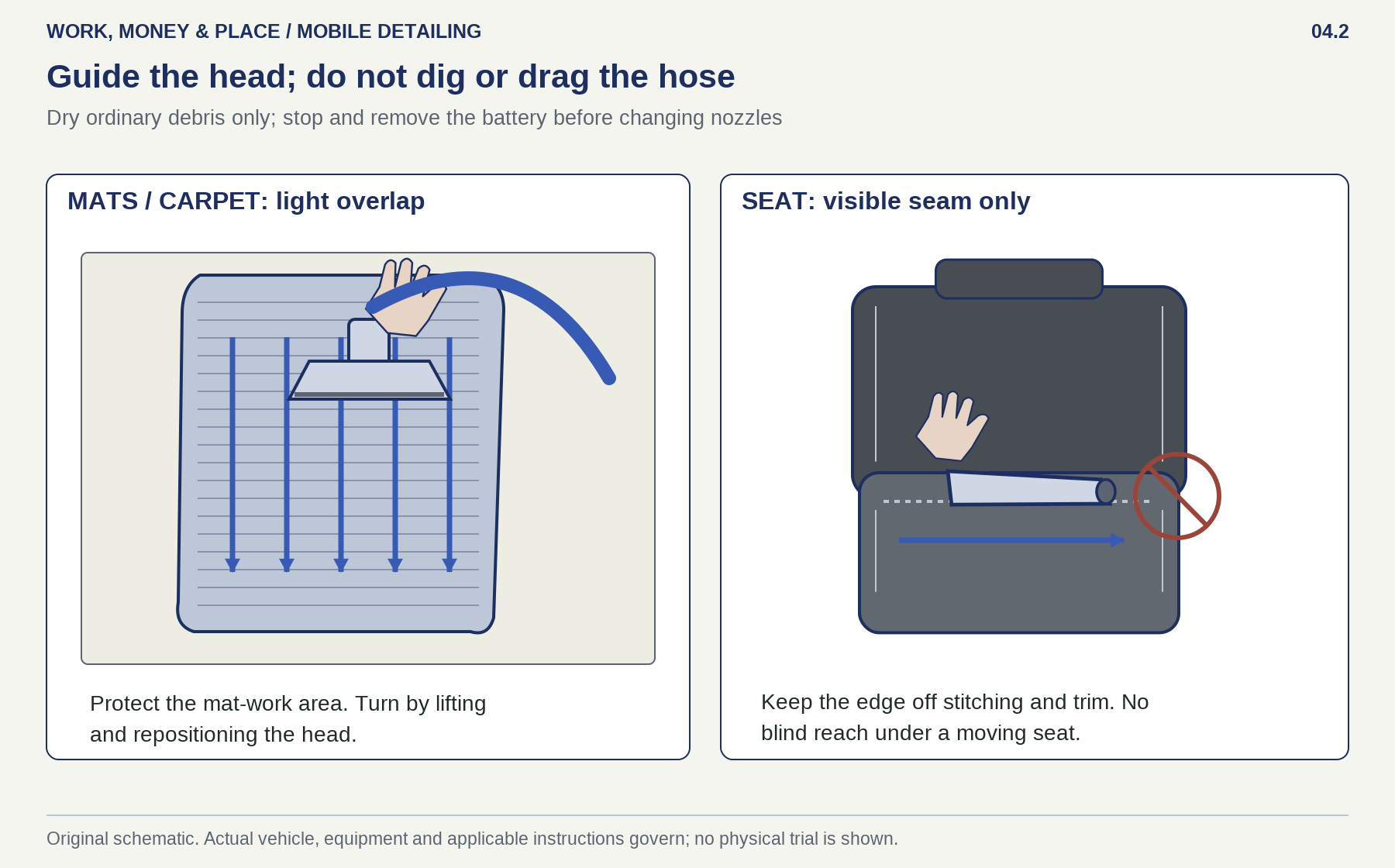
Open the full-size diagram
Example and working records
- D09 working form
- Case D 02 · Intake, condition and customer control
- Case D 04 · Equipment, material methods and tests
- Case D 05 · The applied visit and reset sequence
Relevant worksheet tabs: Jobs, Your order. Read the fictional Case D assumptions beside the example. Use Your order for your own supported plan and actual observations; a financial result does not clear a physical HOLD. Record all preparation, travel, onsite work, administration and reset time.
Clear the cabin with the owner
Reconfirm the accepted D04 condition before switching on. The customer removes valuables, documents, loose accessories and unwanted ordinary litter, or explicitly identifies what may be discarded. Put retained belongings in the agreed clean container; do not empty a pocket or sealed bag because it looks untidy. Do not reach blindly beneath a seat. A visible sharp, unknown powder, damp waste or contamination changes the job to STOP, not a more careful vacuum pass.
Keep child restraints, seats, seat belts, electrical connectors and trim installed. Ask the owner to make any agreed normal seat-position changes only after people, hands, hose and tools are clear of the whole movement area. Do not hold a nozzle under a seat while someone moves it. There is no seat-removal shortcut to reach the last crumb.
Remove the original mats without spreading dirt
For the selected 2024+ mat arrangement, Tesla's procedure prepares all four doors/windows, positions the seats for access, removes the two front mats and then the one rear mat. Have the owner manage the normal controls safely; keep the vehicle stationary, people clear and weather suitable. If access cannot be prepared safely, hold that operation rather than substituting forced seat movement.
Identify each original mat's position before lifting. Lift an accessible edge gently, release only the actual manufacturer retention as applicable, and keep loose debris facing upward while carrying the mat to the clean work pad. The service images do not establish a universal plastic clip pattern. If a mat catches, inspect rather than pulling harder. Keep driver, passenger and rear positions distinct; no mat is washed, pressure-cleaned or shaken over the cabin in this service.
Vacuum open areas with overlapping controlled passes
On the dry work pad, inspect the mat surface for excluded debris. Fit the clean wide nozzle with switch 0/battery removed, then install the pack correctly. Start on a small discreet area. Guide the head in slow straight passes with light contact, overlapping the previous path so narrow strips are not missed. Support the hose with the other hand and keep your stance stable. Avoid digging a head corner into bound edges; reverse direction by lifting and repositioning rather than twisting hard on the pile.
Work one marked zone at a time: each mat, rear footwell, front passenger carpet and driver carpet, then the accepted accessible seats. The exact order can change with access, but use the same D09 zone map so moving to another door does not erase your place. Vacuum only dry ordinary compatible dust and crumbs. Remove ordinary large loose litter by the agreed method first; never use suction to test whether an unknown object is safe.
Use the crevice head where you can see
Stop at 0 and remove the battery before changing to the supplied narrow nozzle. After reconnection and safe power installation, guide its opening along a visible seam or accessible seat gap, keeping the hard edge from scraping the material. Work beside a seam with light controlled movement, not a sharp digging motion into stitching. Stop if the material pulls, the head catches, a loose thread moves or the surface marks.
Keep the nozzle away from airbag-cover openings, belt mechanisms, display edges, switches, ports and exposed wiring. Do not remove a grille, push the nozzle into a connector recess or reach beneath a seat where you cannot see the tip. An inaccessible pocket remains excluded and documented. Ordinary interior maintenance is not disassembly or a promise to recover every embedded object.
Respond to weak suction or an automatic stop
If the head stops collecting normal debris, switch off and remove the pack before inspecting the nozzle, hose, tank and permitted filter condition. Never clear a running opening with fingers. Empty before the tank is full, following 04.5, and keep exhaust directed away from people. Do not keep working with a blocked opening or a damaged filter just to finish the zone.
Overload requires stopping the application that caused it; overheating requires cooling before restart. A depleted pack needs the approved charge/change plan. A damaged pack, unusually shortened operation or continuing malfunction stops service pending the proper manufacturer response. Protection is a warning to resolve a cause, not a reset button to defeat repeatedly. Record the interruption and actual additional time.
Check the dry result before the next stage
Inspect each zone with the work light at a shallow viewing angle and from the doorway used for access. Look along mat edges, the seat-to-backrest junction and visible carpet borders without pressing into hidden gaps. Rework supported loose debris with the appropriate clean head; do not escalate to wet extraction, aggressive brushing, compressed air or a blower.
Keep the cleaned mats on the protected pad until final dry inspection and reinstallation in 04.4. Remove the battery whenever the vacuum is not in use. Record completed zones and inaccessible areas in D09 with actual observations. The Case D time allowance is fictional; your rehearsal establishes how much supported work you can actually deliver.
Put it into practice
Your assignment
Demonstrate one controlled mat and seat-zone sequence in permitted practice.
Inputs
- Confirmed original dry mat on a protected pad.
- Intact visible seat seam with ordinary loose crumbs.
- A hidden gap contains an object that cannot be identified without reaching blindly.
Your deliverable
A D09 practice record with tool setup, pass pattern, observed result and the excluded gap.
Working forms: D09.
Saved only in this browser when storage is available. Export this page separately and use fictional identifiers in practice.
Show the worked answer
- Use light overlapping wide-head passes on the mat after checking the area.
- Isolate power for the crevice-head change; guide it beside the visible seam without scraping or digging.
- Leave the unidentified hidden object undisturbed, record the location and consult the owner. Do not claim the practice passed until the actual work is observed.
Show the self-check criteria
- Head and hose stay controlled, and power is isolated for changes.
- No hidden reach, disassembly or excluded debris pickup occurs.
- Actual zone observations support the recorded result.