Choose a supported response to new conditions, a new request or an own-fault callback without an automatic fee.
Open the full-size diagram
Example and working records
- D11 working form
- D07 working form
- Case D 06 · The agreement and complete timeline
- Case D 09 · Own missed glass: a no-charge correction
- Case D 10 · Inspection, handover, invoice and records
- Case D 11 · Actual review and the separately assessed next customer
Relevant worksheet tabs: Your order, Time and costs, Stock, Cash example. Preserve the fictional case and your accepted estimate. Enter supported own-job inputs and retain the evidence behind actual results; an unknown is not a confirmed zero.
Identify why the work stopped or changed
Use D11 to name the item/area, observed condition, evidence, immediate control and customer contact. A newly requested task, an undisclosed incompatible condition and a missed included task are different events. Do not call every problem extra work. Preserve the accepted D07 scope and compare the actual issue with the result you promised.
Stop the affected method for liquid ingress, suspected airbag or belt damage, an unsecured driver mat, unknown contamination or an unsupported material. Keep tools and loose items away from controls and moving-seat/pedal areas. Do not invent a repair, chemical recipe or diagnosis to finish the appointment. Record what remains incomplete and the supported next step. A customer’s permission does not make an unsafe method acceptable.
Switch the vacuum to 0 and remove its battery before inspecting a blockage, changing a nozzle, opening the tank or touching its filter assembly. Do not bypass a protection stop or continue with damaged, wet or missing filters. Inspect only the permitted user-service parts, with the specified dust mask and, for emptying or filter cleaning, goggles. A damaged or malfunctioning machine goes out of service; it does not become a reason to substitute an unapproved borrowed cleaner.
Keep unknown powder, sharps, wet waste, bodily fluids, mold, burning material and suspected toxic contamination outside this service. Stop without disturbing the material. Gloves, a HEPA label or a dust mask do not expand the accepted scope. Record visible facts without identifying an unknown substance or promising remediation.
Work through the own fault example honestly
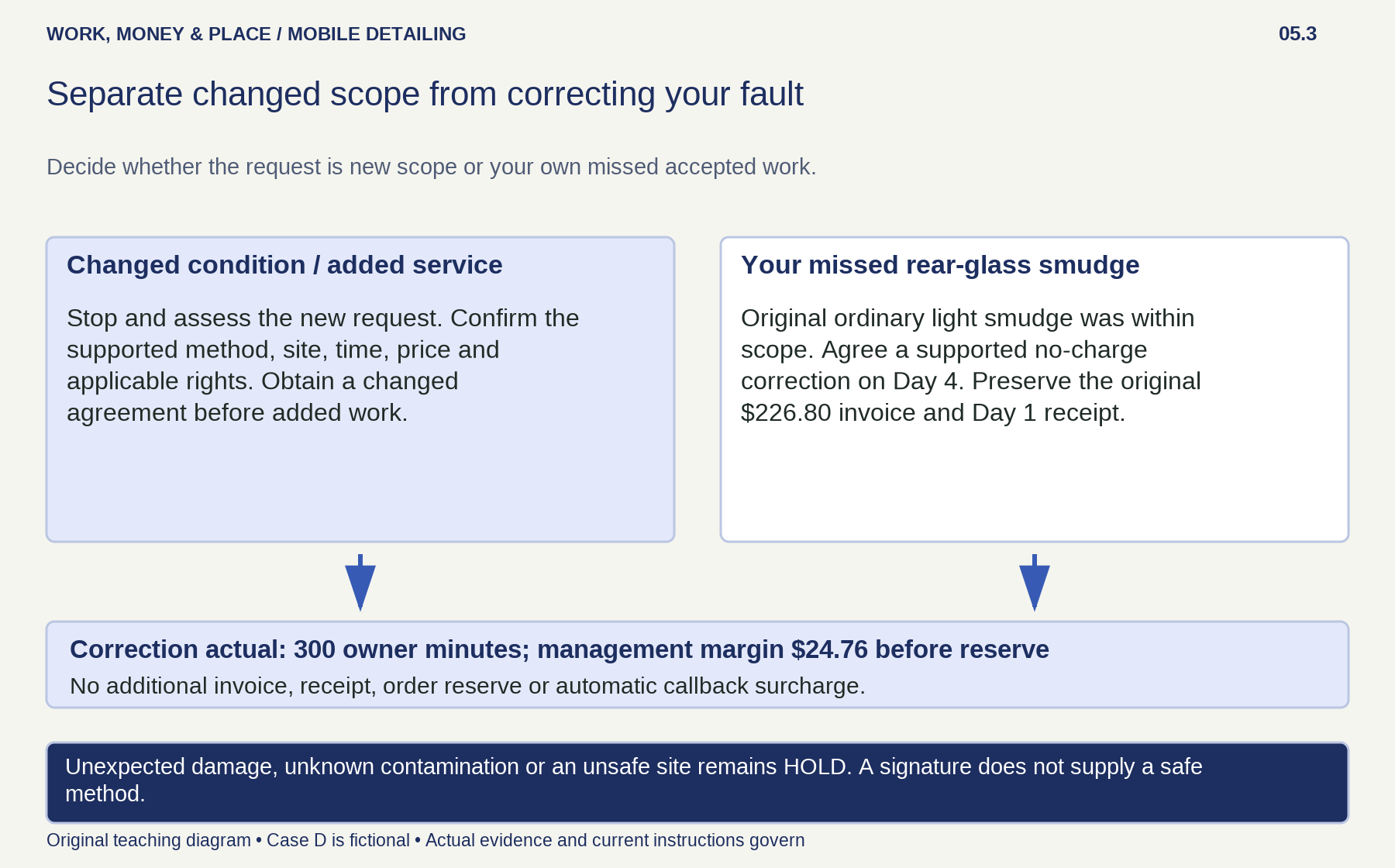
In the simulated Case D alternative, the operator completed the first appointment and received its original payment. The customer reports a missed rear-glass smudge on Day 3. It is an ordinary light smudge within the accepted service, not newly requested stain restoration. The operator agrees a supported no-charge corrective appointment on Day 4. These are invented case facts, not an actual complaint or completed correction.
Confirm the affected area and access, use the same compatible supported method, and inspect the included glass from more than one viewing angle or light direction. If the real condition instead needs an unsupported method, stop and resolve that difference honestly. Do not keep wiping with a more aggressive product simply because the case describes a removable light mark. Document the actual result and any unresolved concern.
Agree any legitimate different scope before doing it
For a customer addition, explain the assessed options, time, supported method and lawful revised price before work. For a site or material that is no longer suitable, use the agreed HOLD, rescheduling or decline process. Preserve mandatory cancellation/refund/remedy rights and the real formation history for a new sale. A fixed price does not entitle the operator to perform an unsupported substitute.
For your own missed included work, do not impose an automatic callout fee or sell the correction as a second package. Customer acceptance or earlier payment does not erase a valid concern. If damage or a potential claim is reported, preserve factual evidence with appropriate permission, follow actual notification duties and seek the relevant qualified help or insurer response. Do not promise coverage or erase an observation to avoid an awkward conversation.
Record the whole corrective cycle once
Add the real preparation, travel, onsite work, administration and reset/laundry associated with correction. Record extra stock use and cash payments even when no extra invoice is issued. Case D’s callback history keeps the same first-order invoice and original receipt; it replaces that order’s original cost history rather than adding a second customer sale, receipt, fee or business reserve.
Close D11 with the agreed response, responsibility, dates, actual inspection and remaining actions. Use Lesson 06.1 to quantify what changed in the management result and the next offer. Keep the original promise visible: a financial variance explains the cost of an event, but does not decide customer rights or authorize retroactive billing. Improve the inspection that missed the mark rather than inventing an automatically chargeable return policy.
Put it into practice
Your assignment
Distinguish an own-fault correction from new scope and an unsupported condition.
Inputs
- A paid customer reports the missed included rear-glass smudge.
- Another asks for greasy-seat restoration, while a third vehicle presents unknown contamination.
Your deliverable
D11 separate decisions and a D07 change only where genuinely supported and agreed.
Saved only in this browser when storage is available. Export this page separately and use fictional identifiers in practice.
Show the worked answer
- Arrange the supported own-fault correction without an automatic new fee or receipt.
- Do not relabel restoration as routine maintenance; assess or decline it before any new agreement.
- Stop unknown contamination, preserve the actual condition and record a supported next step instead of an improvised cleaning attempt.
Show the self-check criteria
- Responsibility and accepted scope guide the response.
- No unsafe fix, automatic fee or insurance payment is invented.
- All correction time/cost is recorded without a second sale.
Sources: CASE-D-01, DB06, DB07, DB15, DB16, DT01, DT02, DT03, DT04, DT06, DT08, DT09, DT10, DT11, DT15.