Turn a visual survey into an unambiguous service inventory that another person can check.
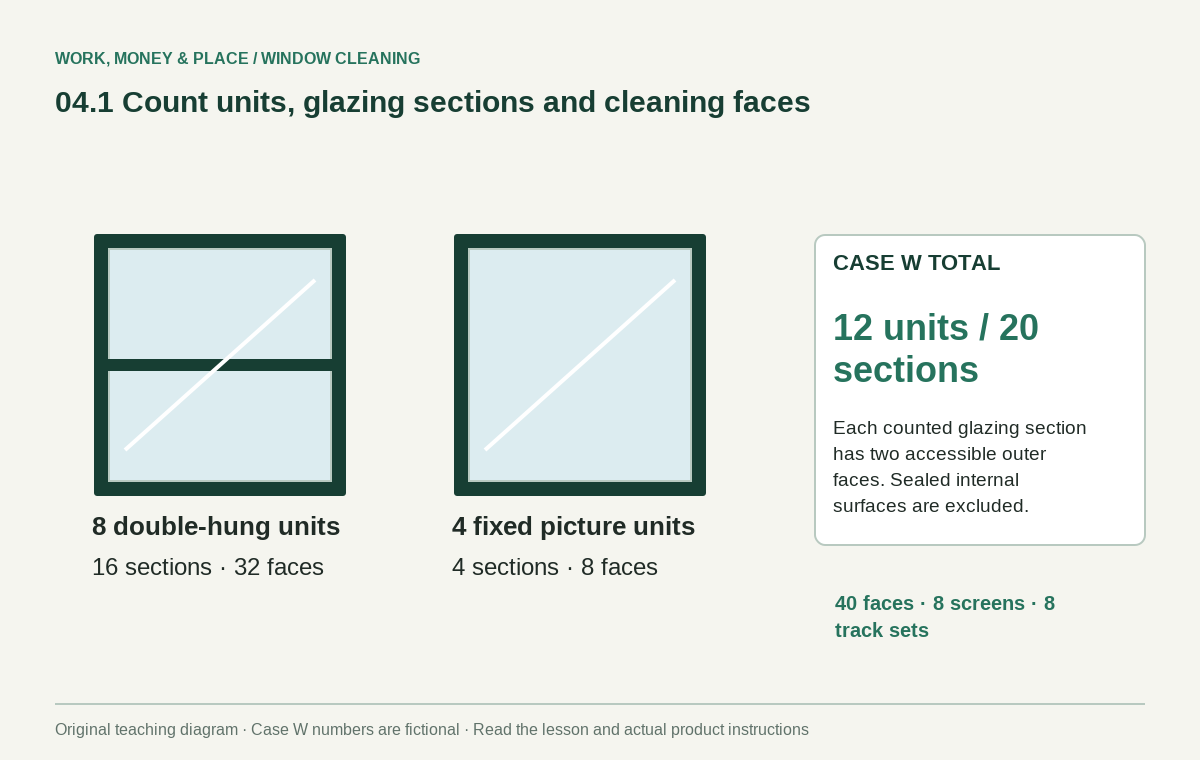
Open the full-size diagram ↗
Example and worksheet
Read the numbered Case W sections for the related fictional records. Apply the method to your own conditions.
- Case W 02 · Count assemblies glazing sections and cleaned faces
- Case W 03 · Agree on one service scope
Download the formula planner ↓
Example tab: First plan. Your blank tab: Your estimate.
Open the downloaded workbook and select the named tab. Use the example for reasoning, then enter your own supported inputs in a separate blank Your sheet.
Use a counting language before you use a price
A customer asking for twelve windows has not yet described twelve equal pieces of work. A picture window, a double-hung unit, and a unit with exposed decorative dividers can all be called one window. Count the physical work first and attach a price only after the schedule is clear. Your inventory should make sense to a customer who has never used the trade vocabulary.
A unit is one complete window assembly in an opening. For this service inventory, a glazing section is one distinct glazed opening within that unit, regardless of how many glass sheets are sealed inside it. A cleaning face is one included, accessible room-facing or outdoor-facing surface of that section. Glass manufacturers also use lite to mean an individual glass sheet; therefore our twenty service glazing sections are not a count of the physical sheets inside insulated glass units. These are service-count definitions; businesses should state their own billing convention clearly.
A double-pane insulating glass unit contains two physical glass lites and four glass surfaces, but routine cleaning can normally reach only its outermost outdoor surface and innermost room surface. The sealed cavity surfaces are excluded. A triple-pane unit still normally presents only those same two accessible outside faces. Count the included accessible faces for cleaning, not every physical surface within the sealed construction. Neither the hidden sheets nor the air spaces create additional routine cleaning tasks.
Count the teaching job in two independent ways
The fictional teaching property has eight double-hung units, U01 through U08. Each has two exposed glazing sections, and both accessible sides are included. Those units produce sixteen glazing sections and thirty-two cleaning faces. The property also has four fixed units, U09 through U12. Each has one exposed glazing section and two included faces, producing four glazing sections and eight faces. The full order therefore contains twelve units, twenty glazing sections, and forty cleaning faces.
Check the answer by starting at the face level: eight double-hung units times four faces equals thirty-two; four fixed units times two faces equals eight. Thirty-two plus eight equals forty. This second calculation helps catch a common mistake: multiplying by the two sheets inside an insulated assembly after already counting its two exposed sides.
Eight removable screens belong to U01–U08. The agreed extras are eight routine track sets and twelve frame wipes. Screens, track sets, and frame wipes stay in their own columns. They are not hidden inside the forty-face number. A frame wipe is counted once for the agreed unit outline; a track set is the expressly described accessible cleaning area of one operable unit.
Treat decorative divisions as a separate observation
A decorative grid visible through glass does not always create exposed cleaning edges. A grid inside the sealed cavity leaves the accessible face substantially continuous. Permanently applied bars on the room side or outside divide the tool path and add edge work. Removable interior grilles create a different handling task, and removal belongs in the scope only when the correct instructions and your competence support it.
Record what is exposed on each side rather than guessing from the street. An exterior-applied grid and a between-glass grid can coexist on the same unit. Photograph or sketch the pattern with permission and identify whether it changes the washing path, detailing time, or removal requirement. Do not promise to release an unfamiliar grille while preparing a quick estimate.
For a pricing system based on faces, label divided work explicitly, for example one exterior face with exposed applied bars, rather than pretending it takes the same time as an unobstructed pane. For a pane-based system, state your own pane definition on the quote. Either convention can work; switching between conventions during a dispute cannot.
Make a route map that survives the visit
Start at a recognizable corner or room and move in a consistent direction. Put U01 on the sketch, not on a delicate finish with an unapproved adhesive. Note the room, opening type, included sides, screen identifier, track agreement, frame agreement, and any access limit. A photo number can link a condition note to that same unit. Keep the customer's private rooms and identifying details out of public portfolio material.
Write an exclusion on the row where it matters. If a fixed exterior face is blocked by an unsafe obstacle, its row should say exterior excluded pending access resolution. Do not leave the forty-face teaching total unchanged after an omission. A revised scope needs a revised count, price decision, and customer acknowledgment before work proceeds.
Use the map again when removing screens, recording progress, checking completion, and reconciling the invoice. This is why a simple handwritten plan can be more useful than a polished total with no traceable window list. Your inventory should answer both how much work was agreed and exactly where the unfinished work is.
For a final check, ask someone else to read the schedule without looking at your sketch first. If they cannot identify which side or component is included, improve the row before pricing it.
Put it into practice
Your assignment
Complete the fictional inventory, then prepare a separate inventory for an accessible practice opening.
Inputs
- Eight double-hung units with two glazing sections each; four fixed units with one glazing section each; both faces included.
- Eight removable screens, eight routine track sets, twelve frame wipes.
- One alternate scenario excludes the outdoor face of U12.
Your deliverable
A checked W07 schedule with base and alternate totals and clear definitions.
Saved only in this browser when storage is available. Export this page separately and use fictional identifiers in practice.
Show the worked answer
- Base: 12 units; 8×2+4×1=20 glazing sections; 20×2=40 cleaning faces; 8 screens; 8 track sets; 12 frame wipes.
- Alternate: the physical units and glazing sections stay 12 and 20, but included cleaning faces become 39. Record U12 exterior as excluded; do not describe a completed forty-face service.
- Between-glass grids alone add no separately accessible grid-cleaning task. Exposed bars must be noted because they change the tool path.
Show the self-check criteria
- Every quantity can be traced to a unit row.
- Physical configuration and included service quantities are separated.
- No inaccessible sealed-cavity surface is counted as routine cleaning.