Write a specific service offer and build honest visual evidence without inventing customer experience, results, or endorsements.
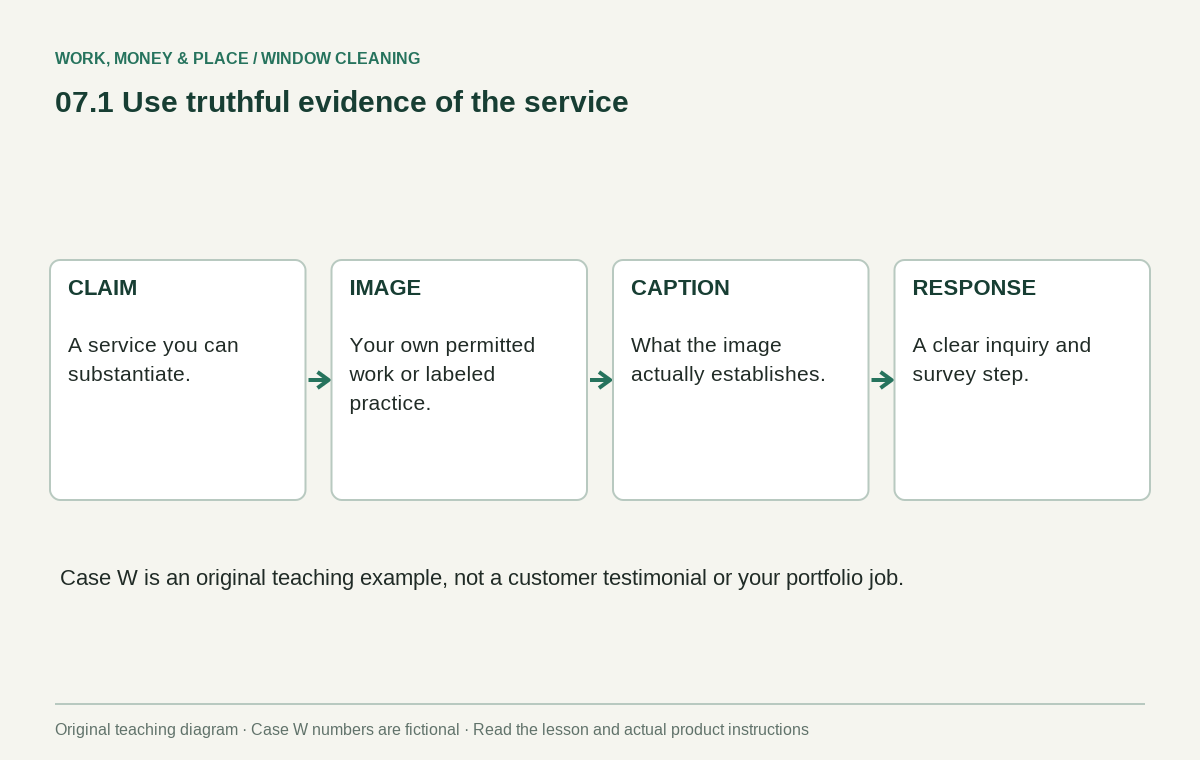
Open the full-size diagram ↗
Example and worksheet
Read the numbered Case W sections for the related fictional records. Apply the method to your own conditions.
Make the Offer Understandable Before Making It Attractive
A prospective customer needs to know whether your service fits the property and what happens after an inquiry. Lead with the defined routine service, area, assessment process, and the result you agree to deliver. Clear wording is more useful than a broad promise to handle every window, every stain, or every access condition for one unexplained price.
Use the decisions in W01 to write a short service description. Name the glass faces and any separately counted screens, tracks, or wipe tasks. Explain that the quote follows an assessment of count, access, and condition. Keep the ordinary-service boundary visible. A customer should not need to discover an important exclusion only after arranging time away from work for your visit.
Your first draft can be straightforward: “Routine cleaning of assessed accessible residential glass, with included faces and component tasks listed in your quote. Send the requested scope information to arrange an assessment.” Replace the area and contact process with your real operating details when ready. This sample is original practice copy, not a claim that a real company or customer has approved it.
Use Evidence With a Truthful Origin
A strong image demonstrates something relevant: the condition assessed, the protection used, a finish check, or an agreed component restored to position. Multiple nearly identical overall views may add little. Choose different useful angles and explain what each establishes. Do not claim that a photograph proves hidden product compatibility, unseen work, or a complete cleaning face count.
If you have no customer work to show yet, use your own permitted practice samples and label them accurately. A practice window is not a paid client project. A purchased stock image or an AI illustration is not evidence of work you performed. The fictional course property is a teaching model and cannot become your personal portfolio merely because you downloaded its diagrams.
Before using a real image publicly, confirm that you have the relevant permission and rights and remove unnecessary identifying details. A customer’s agreement to an assessment photo does not automatically authorize an advertisement. Keep the protected original work record separate from any approved marketing version, and avoid displaying occupants, addresses, security equipment, documents, or unrelated possessions.
Explain Quality Through Observable Checks
Claims such as “professional quality” need a practical meaning. Describe the agreed scope, your assessment process, protection, selected method, inspection, and a clear process for concerns. These are actions you can demonstrate and keep in a job record. Do not substitute an unsupported guarantee of perfect glass for a repeatable check of the work you actually agreed to perform.
A useful caption might identify that both agreed faces were inspected after detailing, or that a suitable screen was refitted and checked in its original location. It should not imply that routine cleaning repairs scratches, seal failure, damaged mesh, or a coating problem. Preserve the distinction between cleaning defects you should correct and conditions outside the accepted scope.
Use numbers only with their definition and source. The teaching property’s 12 units, 20 glazing sections, and 40 faces can explain counting in private practice. They are not a real completed-job claim. Likewise, a fictional $320 package is not a verified market price or evidence that a beginner can complete a profitable job in five hours. Keep a teaching example labeled wherever it appears.
Ask for Honest Feedback Without Manufacturing It
The course provides no real customer review, and it does not authorize you to invent one. When you have actual completed work, ask for honest feedback through a permitted process. Avoid offering a benefit only for a positive rating, directing unhappy customers away from the public option, or publishing words attributed to a person who did not have that experience.
FTC review guidance addresses deceptive review and testimonial practices, and a platform can impose additional rules. Review the current policy of the service you use. Google prohibits incentives in exchange for reviews even when a positive rating is not required; do not offer a review reward there. A private request for feedback and a public testimonial are different records. If you quote a real statement in your own marketing, confirm its origin, accuracy, relevant permission, and any disclosure that the actual relationship requires.
Respond to a concern with a factual service process. Acknowledge that the customer can use the stated contact route, investigate the affected scope, and keep private household details out of the public reply. Do not write a hostile response to protect a numerical rating. The long-term asset is truthful evidence of completed work and a workable response when the outcome needs attention.
Build One Small Set of Reusable Service Materials
Prepare a service card, a short inquiry reply, a photo-permission decision, and a small selection of accurately labeled images. Each should use the same service area, inclusions, boundaries, and next step. If one says “all windows” and another says “accessible exterior faces only,” revise the mismatch before either is used publicly.
Use W14 to record the offer version and where the material is tested. If a customer repeatedly asks whether screens are included, that can justify a clearer sentence. It does not prove that the customer failed to read. Treat the question as information about how your offer is understood, then test a specific revision rather than redesigning every part of the business at once.
For this assignment, keep the materials private. You are preparing a truthful first version, not being asked to publish an advertisement or create a business profile. Before actual use, replace practice contact details, verify the current platform requirements, and confirm that every claim can be supported by your own work and records. A small, consistent set is enough to begin a measured test.
Put it into practice
Your assignment
Draft a truthful service card, an inquiry reply, and a three-image private practice plan.
Inputs
- W01 service boundaries and proposed area.
- Only your own permitted practice samples or clearly labeled original teaching diagrams.
- A fictional customer asks whether both faces, screens, and tracks are included.
Your deliverable
Private service copy and an evidence plan, with origin/permission labels and a clear next step.
Saved only in this browser when storage is available. Export this page separately and use fictional identifiers in practice.
Show the worked answer
- List the included faces and separately counted component tasks; assessment confirms suitability and final price.
- Label a course diagram “fictional teaching example,” not “our recent customer job.”
- Example reply: ask for the defined count/access information and explain that screens/tracks appear only when listed in the accepted quote.
- Request honest actual-customer feedback without a positive-rating condition or an invented testimonial.
Show the self-check criteria
- Claims match the service actually planned.
- Every image has a truthful origin and permitted use.
- Private customer details are excluded.
- The exercise does not publish or contact anyone.
Sources: BIZ-FTC-REVIEWS, BIZ-GOOGLE-REVIEWS, BIZ-FTC-PRIVACY.