Track a lead channel through qualified work and collection while separating cash acquisition spending from owner time.
Open the full-size diagram ↗
Example and worksheet
Read the numbered Case W sections for the related fictional records. Apply the method to your own conditions.
Choose One Channel and a Defined Offer
A channel is the route by which a potential customer finds or contacts you. It could be a permitted local introduction, your own service page, a business listing, or an advertisement. The course does not require a particular provider. Choose a channel you can describe, measure, and maintain honestly for the bounded test you intend to run.
Use one offer version and area so the results are interpretable. Record the start, effort or spending limit, inquiry route, response process, and review point. If you use several channels, assign a practical source field and allow “unknown” when attribution is uncertain. Do not force every customer into the channel you hope is performing best.
A channel needs an operating response behind it. Decide who replies, what information is needed to qualify the inquiry, how assessment is arranged, how a quote is delivered, and how the result is recorded. Spending to generate messages while you cannot assess or fulfill suitable work can create frustration without testing whether the service itself is viable.
Record Stage Changes as Events
Build W14 around events rather than an undated list of names. Record when an inquiry arrived, its source, the offer version, whether it fits the area and scope, assessment status, quote date/version, accepted or declined outcome, and any known reason. Track later completion, collection, rescheduling, or cancellation separately so you can explain where an opportunity stopped.
A polite message saying a customer will “keep you in mind” is not an accepted appointment. A tentative date without the agreed scope and price is not necessarily a confirmed booking. Define your own documented confirmation process and use it consistently. The purpose is to make the record useful, not to inflate the number of customers in a success column.
Use an identifier and the minimum necessary contact information in your real protected system. Course practice should use fictional details. If a customer does not answer, record the follow-up you actually made and any permission or preference relevant to further contact. Do not create an endless sequence of unwanted messages merely because the worksheet has another follow-up field.
Calculate Costs With a Named Denominator
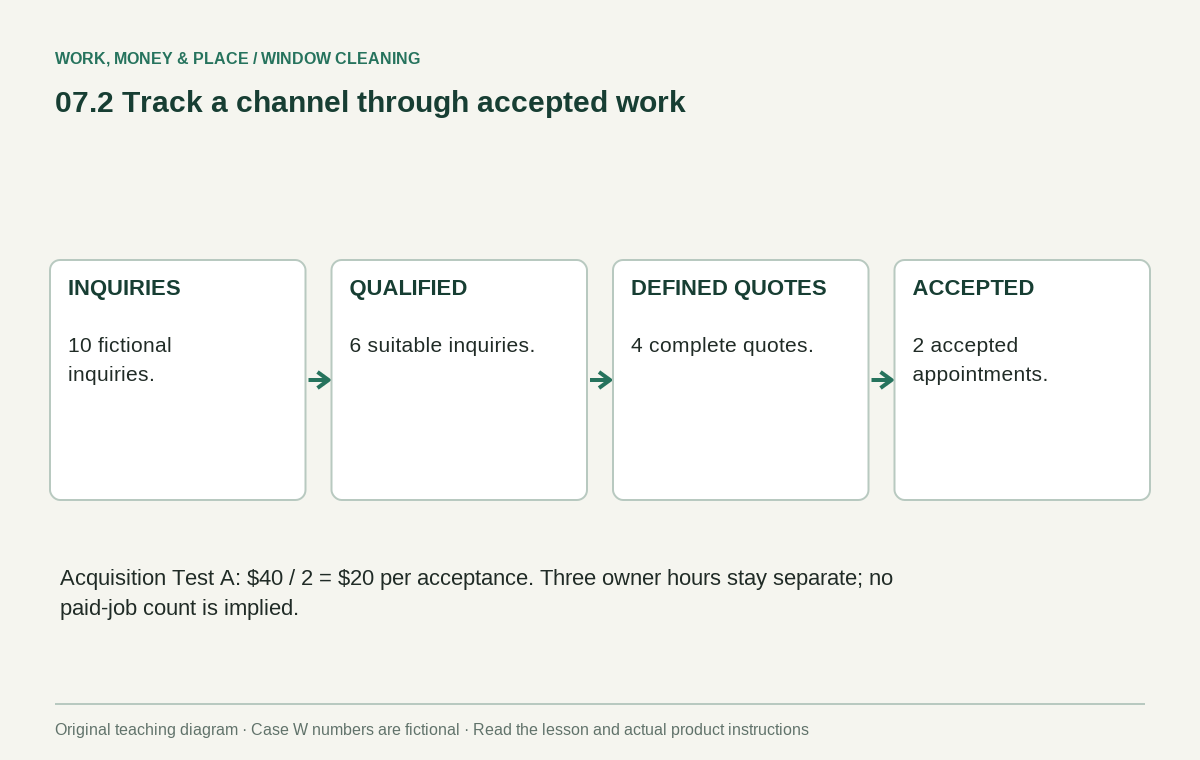
Acquisition Test A is the same fictional example used in Module 02, form W14 and the funnel diagram. It has 10 inquiries, 6 qualified inquiries, 4 complete quotes and 2 accepted appointments, with $40 of channel cash spending and 3 owner hours. Cash spending per quote is $10; per acceptance it is $20. Neither ratio includes the owner’s time, and neither is a cost per completed paid job until completion and collection are established.
If you assign a management value to the owner’s marketing time, show that valuation separately with its rate and purpose. It is not automatically a cash wage paid to the owner or a tax deduction. Do not add the same time to a job cycle and an acquisition allocation without a clear boundary. An internal comparison needs a consistent cost base.
Compare the channel’s outcomes with the actual economics of the accepted work. A channel that produces many messages outside your service boundary creates qualification effort but little suitable work. A channel with fewer messages can still deserve another test when the resulting jobs fit the route, scope, and delivery capacity. A small sample supports a bounded decision, not a permanent ranking.
Keep Business Listings Accurate
If you choose to use Google Business Profile, follow its current service-area instructions. A business that visits customers but does not serve them at its address is treated as a service-area business; Google says to remove the address when customers are not served there. Do not advertise a home as a walk-in storefront merely to make the listing look established.
A platform service area is also not your internal travel model. Google’s named service-area controls do not replace the route and appointment checks in W03. Use accurate areas you can actually serve, then evaluate each inquiry’s journey and access. The settings of one provider do not establish the legality or economic suitability of operating in every listed location.
Keep the service description, contact route, hours, and photographs current and truthful. No page in this course creates, verifies, or edits a real profile automatically. A checklist of possible profile information is a preparation tool. Review the live provider instructions and applicable business requirements before making an actual public change, and preserve the source of any platform-dependent decision.
Review the Channel and Decide the Next Action
At the review point, reconcile the log before interpreting it. Are duplicate inquiries counted twice? Did the same person contact you through two routes? Are accepted appointments still tentative, or have they been completed and paid? Are lost-opportunity reasons known or only guessed? Correct the record while preserving the original events and any relevant version history.
Then identify one next action. You may clarify scope wording, improve the assessment request, change response availability, reduce the area, adjust the offer based on a full cost review, or stop spending on that test. Avoid treating a lower price as the default response to every rejection. A quote may be unsuitable because of timing, access, scope, or a customer’s decision you cannot establish.
Carry the result into W11 and the first-period review. Acquisition cash and owner time are business resources even when the work they produce is booked weeks later. Plan capacity and cash commitments together. A useful lead system makes the next business decision clearer while maintaining truthful claims, respectful contact, and a record of what actually happened.
Put it into practice
Your assignment
Create W14 for the fictional test and distinguish quote, acceptance, and collection measures.
Inputs
- Acquisition Test A: $40 cash spending, 3 owner hours, 10 inquiries, 6 qualified inquiries, 4 complete quotes, 2 accepted appointments.
- One accepted appointment has not yet been performed; no final collection is recorded.
- An inquiry has uncertain channel attribution.
Your deliverable
A reconciled inquiry log, named cost ratios, and one next test decision.
Saved only in this browser when storage is available. Export this page separately and use fictional identifiers in practice.
Show the worked answer
- Cash spending per complete quote is $40/4 = $10; per acceptance is $40/2 = $20.
- Do not report a cost per completed paid job when completion/collection is not established.
- Keep the 3 owner hours separate until a stated management valuation and allocation are chosen.
- Record uncertain attribution as unknown rather than assigning it to the preferred channel.
Show the self-check criteria
- Stage counts are based on documented events.
- Ratio denominators and included costs are explicit.
- No provider is presented as required or guaranteed to produce work.
- The proposed next action follows a known issue rather than an invented lost-sale reason.
Sources: BIZ-SBA-PLAN, BIZ-GOOGLE-SERVICE, BIZ-IRS-RECORDS.