Check whether cash is sufficient on each date and for each obligation, without confusing forecast profit with an available balance.
Example and worksheet
Follow receipts, fees, tax reserves, payment dates, and the cash shortfall.
Example sheet: B cash. Your worksheet: Your cash.
Read B cash first, then enter your own consecutive events in Your cash. Review its tax-reserve warnings before using the available-cash total.
Download the file, then select the named worksheet tab. The example sheets are fictional; the Your sheets are for your own project.
Open the full-size illustration ↗
A Profitable Job May Still Lack Cash to Start
An estimate adds up project costs. A cash calendar answers a different question: Exactly when will money be needed, and when will it arrive? A job can show a positive final result and still stop before material purchasing or paying a helper. The problem is a timing mismatch, not the profit arithmetic.
Record the business’s available starting cash without mixing it with money needed for obligations already coming due. Then enter customer payments, materials, delivery, rentals, help, and other actual disbursements by date. Mark an expected receipt as expected. An agreed payment term is not money already received. On the balance line, do the arithmetic first, then assess which commitments already tie up that balance.
For this job, the author took a thirty percent deposit. Applied to the original total of six thousand one hundred ninety-two dollars, that gives eighteen hundred fifty-seven dollars and sixty cents, leaving forty-three hundred thirty-four dollars and forty cents to pay. This is a calculation from the stated terms, not a copy of a bank transaction. Actual receipt and purchase dates have not been provided, so we will not create a false payment calendar. A deposit percentage from one job also does not become a rule for every contract.
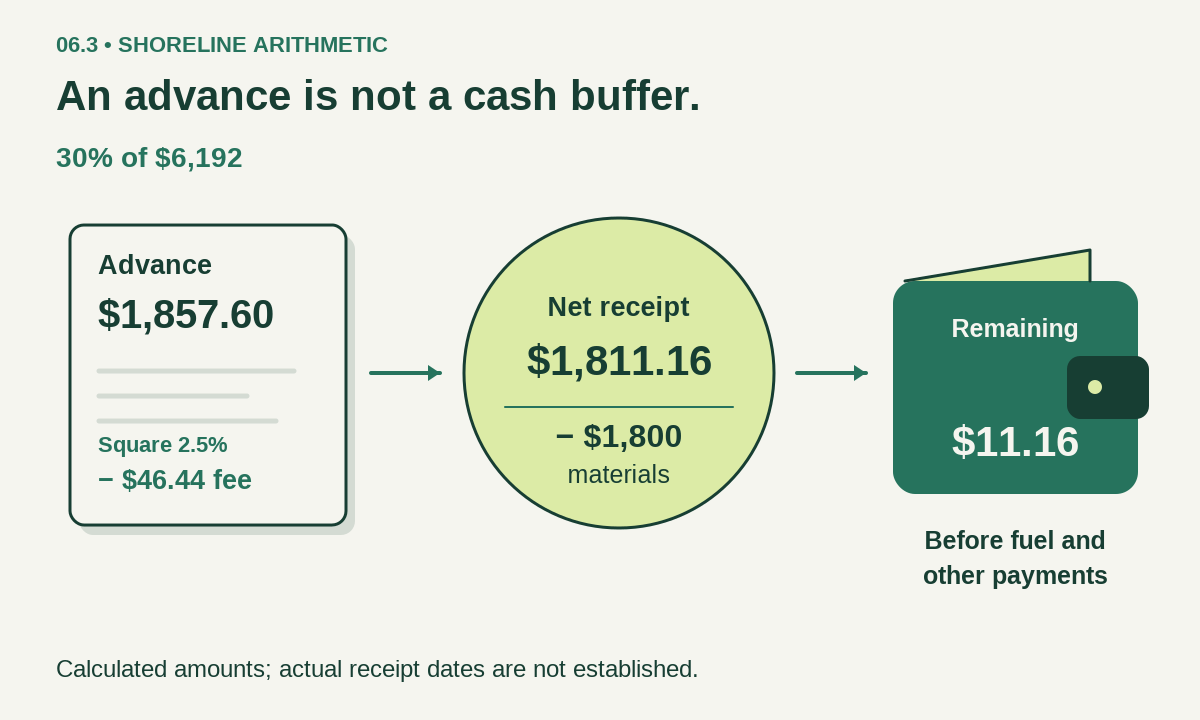
Thirty percent of sixty-one hundred ninety-two dollars is eighteen hundred fifty-seven dollars and sixty cents, slightly more than the reported eighteen hundred dollars in materials. To check starting cash, deduct the confirmed two and a half percent fee from that deposit. The calculated net receipt is eighteen hundred eleven dollars and sixteen cents. After materials, eleven dollars and sixteen cents remains before fuel and other payments. This is an arithmetic reconstruction, not confirmation of a bank posting date. Even with a deposit, the job needs a cash buffer.
Follow a Fictional Calendar to the Negative Balance
Project B has a $5,500 customer total, including a strictly fictional $500 sales-tax amount. For this exercise only, a $1,500 advance clears five days before work and $4,000 clears at completion. Processing costs 2.5% of each gross receipt. Reserve tax proportionately: $136.36 from the advance and the remaining $363.64 from the final payment. These are teaching payment terms, not a recommended deposit or verified local tax rate.
Start with $800 of your own available cash. The $1,500 advance less its $37.50 fee leaves bank cash of $2,262.50. Hold $136.36 for tax, leaving $2,126.14 available. Materials of $1,750 then leave bank cash of $512.50; delivery of $190 leaves $322.50; rental of $140 leaves $182.50; and fuel of $40 leaves $142.50. After the tax reserve, only $6.14 is available at that point.
Paying $480 for help takes bank cash to negative $337.50. With $136.36 still committed to tax, available cash is negative $473.86 before the final payment. A later receipt does not erase this earlier inability to meet obligations. The amount needed is not just the negative bank balance: protected tax money is also unavailable for project spending.
Find a Solution That Actually Changes a Date or Amount
An additional $473.86 above the original $800 closes the available-cash shortfall but leaves no cushion. Total own starting float is therefore $1,273.86 before a buffer. Test changes to a specific calendar line: more available owner funds, a genuinely agreed supplier date, lower optional spending, or a revised agreed scope and schedule. Do not count a hoped-for customer payment as cleared money.
Customer payment terms can be discussed only with applicable rules and a clear contract in mind. Do not prescribe an arbitrary deposit percentage as a universal way to finance a business. Do not use a new customer’s payment to hide a cash shortage on a job already promised. When money arrives for particular work, maintain clear records of which obligations on that job remain unfulfilled.
Now add a delayed-final-payment scenario. Move the receipt two days later in this fictional exercise, for example, while leaving required payments in place. If the plan depends on everything aligning perfectly, you will see it. The exercise does not predict customer behavior; it shows cash sensitivity to an event worth discussing in advance.
Do Not Treat Tax and Refundable Deposits as Available Cash
The final gross receipt of $4,000 has a $100 processing fee, so it adds $3,900 to bank cash. The bank balance becomes $3,562.50. Hold the full $500 sales-tax obligation, leaving $3,062.50 available, including the original $800 of owner funds. That available balance is not the management profit: it still combines owner funding with project cash, and owner labor and overhead have not been paid out in this simple calendar.
The actual tax payment deadline depends on the applicable accounting and reporting rules, not an arbitrary date in our table. For management control, show existing obligations separately from the funds set aside for them. Setting money aside inside the business and actually remitting it are different events. Do not record the same payment twice.
A simple bank-balance check is useful even without a large calendar. In a separate mini-example, an account holds one thousand dollars, but three obligations await payment: three hundred fifty, two hundred fifty, and two hundred. Together they commit eight hundred, leaving two hundred available. That does not mean every obligation is automatically paid today. It means you cannot assume you can spend the full thousand on a new purchase. In F12, also record how certain each date is: documented, agreed with the other party, or still an assumption to verify.
A refundable rental deposit also reduces available cash until it is returned, even though it may not become an expense. Plan owner withdrawals after checking obligations, rather than relying on an attractive bank balance. A completed F12 shows more than a positive ending. It identifies the lowest balance, receipts not yet collected, required payments, and an action for delays. Those lines tell you whether you can support the promised schedule.
Put it into practice
Review this lesson’s Project B sections and worksheet tabs ↑
Your assignment
Complete F12 for the fictional project and propose two practical ways to eliminate the minimum shortfall.
Inputs
Available starting cash of 800 USD
Gross customer receipts of 1500 and 4000 USD; fee 2.5% on each receipt
Non-processing outflows of 1750, 190, 140, 40, and 480 USD
Strictly fictional 500 USD sales tax, reserved proportionately from receipts; reserve is not a second bank payment
Your deliverable
A calendar showing the minimum balance, obligations, and a delay scenario.
Notes are saved only in this browser. Keep a separate copy of important work and avoid entering customer personal information.
Show the worked solution
- Before final payment, bank cash reaches −337.50 USD; 136.36 USD is also committed to tax, so available cash reaches −473.86 USD. The total own starting float needed is 1273.86 USD, before any extra cushion.
- After final payment, bank cash is 3562.50 USD. Reserve the full 500 USD of sales tax: 3062.50 USD is available, including the initial 800 USD. When tax is actually remitted, reduce both bank cash and the reserve; do not deduct the tax twice.
- An additional 473.86 USD above the original 800 USD closes the available-cash shortfall but leaves no cushion. Confirm payment timing or change supplier commitments with agreement; do not spend expected receipts as cleared cash.
- The author’s terms: 30% of 6192 = 1857.60 USD. After a 2.5% deposit fee, the calculated net receipt is 1811.16 USD; after materials of 1800, 11.16 USD remains before fuel and other payments. The receipt date is unspecified.
Show the self-check criteria
- The fictional schedule is not presented as Shoreline’s actual terms or a universal deposit rule.
- Expected receipts are not treated as money already received.
- Tax, refundable deposits, and owner funds are not automatically converted into project earnings.
Sources: OWNER-CASE, WA-DOR-OVERVIEW.