Build a checked Shoreline analysis and a complete practice calculation, then identify why planned and actual results differ.
Example and worksheet
Compare the same accepted scope and categories before interpreting a variance.
- Project B · Connect the estimate to the agreed result →
- Project B · Compare the fictional actual record with the plan →
Example sheet: B actual. Your worksheet: Your actual.
Compare B estimate with B actual. Build your own plan in Your estimate and enter the actual records separately in Your actual.
Download the file, then select the named worksheet tab. The example sheets are fictional; the Your sheets are for your own project.
Open the full-size illustration ↗
Reconstruct the Calculation from the Project Terms
Let’s begin with an instructional reconstruction of the proposal for the actual Shoreline job. Ninety-six feet of solid fence at fifty-two dollars gives four thousand nine hundred ninety-two. The openings for the two gates are not included in that footage. Two separately priced gates at six hundred dollars add twelve hundred. The original proposal totals six thousand one hundred ninety-two dollars, with sales tax stated as included. This presents the author’s terms. The course does not show the customer’s actual estimates or invoices.
First, establish the measurement rule: ninety-six feet means solid fence sections, excluding openings. Eighty-six feet is one long run; the short solid sections near the gates add up to ten more. The author reports eighteen posts and two gate openings, each three and a half feet clear between posts. Board and rail quantities, individual short-section lengths, and exact products needed to reproduce the complete purchase are still being clarified. In F11, known quantities remain facts; only missing information stays open.
According to the author, customer sales tax was six hundred twenty dollars, materials were eighteen hundred, and fuel was fifty. He worked alone from November seventh through ninth, two thousand twenty-six, and the full cycle took twenty-one hours. We now also know about the thirty percent deposit, recurring insurance cost, and payment fee percentage. Add these clarifications as separate lines. Do not replace the purchase details, applicable tax calculation, or actual cash dates with convenient assumptions.
The author considers this an average job in his practice, priced relatively low during the slow season. His prices can be higher in the regular season, but he does not provide a specific seasonal price list here. Keep this calculation tied to the job’s actual terms. A higher price in another period must be assessed alongside that period’s workload, expenses, and scope, rather than automatically converted into a consistent monthly income.
Build an Honest Result from Known Information
Subtract the reported sales tax from the total, leaving fifty-five hundred seventy-two dollars. Subtract materials and fuel to get thirty-seven hundred twenty-two. We do not add another six hundred twenty to the total or deduct that tax again from a pretax amount. Correct addition does not replace checking the tax rate and documentation.
Now subtract the confirmed Square fee: two and a half percent of sixty-one hundred ninety-two dollars is one hundred fifty-four dollars and eighty cents. That leaves thirty-five hundred sixty-seven dollars and twenty cents. Allocated company expenses and the owner’s labor come next in the form. Insurance, vehicle maintenance, and equipment usage costs do not disappear because the vehicle and tools were purchased earlier.
Label the result with the lines it covers. First show the remainder after the sales tax, materials, and fuel reported by the author; then show the remainder after the Square fee. Determine full company profit after the remaining relevant costs and your chosen management treatment of owner labor. The value for the student is in rebuilding the chain: agreed scope, purchasing, cash, time, and a lesson for the next estimate. Form F11 keeps the starting facts separate from test scenarios.
Complete the Full Practice Calculation
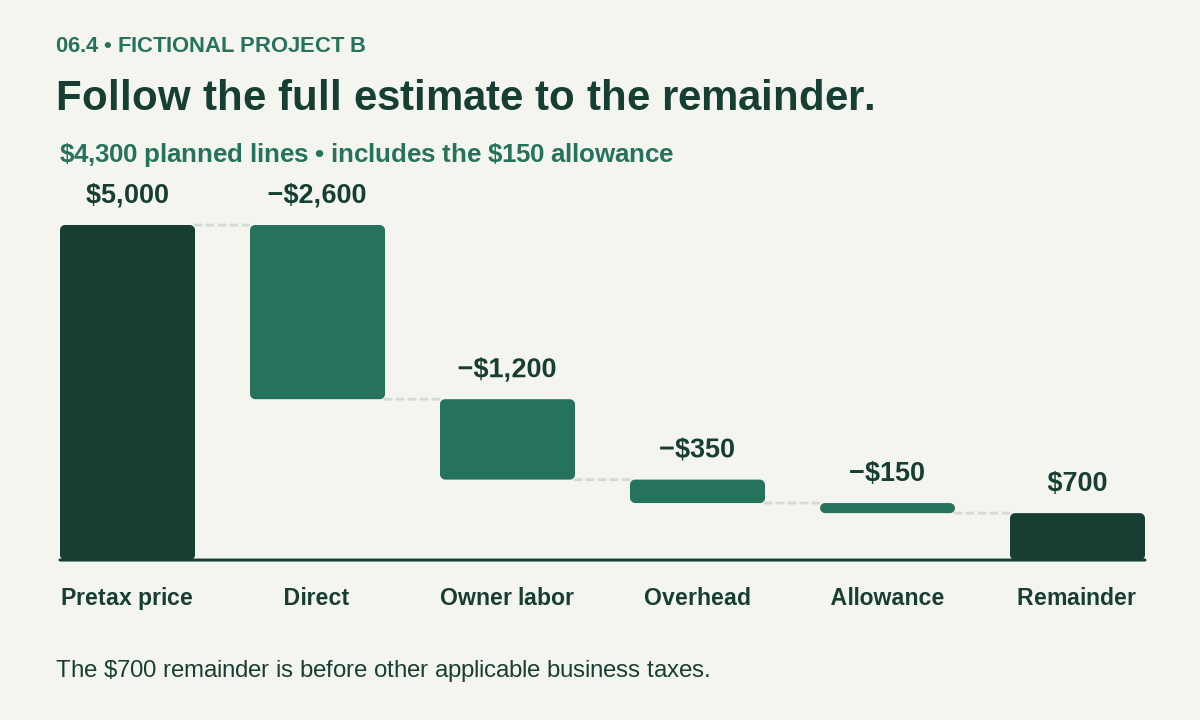
Use fictional Project B to practice every line without changing Shoreline facts. The pretax price is $5,000. Materials $1,750, help $480, delivery $190, rental $140, and fuel $40 total $2,600. Add a fictional 2.5% processing fee on the $5,500 tax-inclusive customer total: $137.50. Direct cash costs are $2,737.50. The complete Project Guide connects this total to a geometry, stock takeoff, procurement package, and work sequence.
Thirty owner hours at a fictional $40 give $1,200 of management labor value. Subtract direct cash costs, owner labor value, and $350 allocated overhead from the $5,000 pretax price: $712.50 remains before the allowance. A separate $150 planning allowance leaves $562.50 before other applicable business taxes. The allowance is a planning provision, not an automatic actual expense.
Using 10% strictly as a tax arithmetic assumption gives a $5,500 customer total. With only $800 of owner starting cash, the previous lesson shows a $473.86 available-cash shortfall before the final receipt, even though the planned project has a positive management result. F11 examines economics; F12 examines timing and protected obligations. Both are needed.
Compare Consistent Categories and Identify the Cause
In the fictional actual record, materials cost $100 more, help $80 more, and fuel $20 more. Other direct lines and the $137.50 processing fee are unchanged. Direct cash costs rise from $2,737.50 to $2,937.50. The owner spends 36 hours instead of 30, adding $240 of labor value at the same $40 management rate.
Compare matching categories before the allowance: planned $712.50 versus actual $272.50. The $440 deterioration comprises $200 additional cash costs and $240 additional owner labor value. Do not deduct the full planning allowance again from the actual costs it was intended to anticipate. Preserve the difference between the cash result, the management result, and the tax return.
Do not rewrite the original estimate afterward so it always matches the actual result. Preserve the accepted version, separately approved changes, and completed result. If the job genuinely became longer, a cost comparison that ignores the added scope is also wrong. In F13, first align planned and actual figures to the same agreed scope, then assess overruns. An approved third gate, for example, is a scope change. Hardware omitted during purchasing for the already approved second gate is an execution issue. Those causes call for different changes on the next project.
Next to each variance in F13, record its cause and the change needed in the next estimate: a forgotten component, an incorrect productivity assumption, different access, or another verified reason. Do not write “materials always get more expensive” when you simply left hardware off the list. The lesson is complete when you can recalculate the project, identify the limits of known information, and show which specific conclusion improves the next estimate.
Put it into practice
Review this lesson’s Project B sections and worksheet tabs ↑
Your assignment
Reconstruct the known Shoreline lines, then complete the plan and actual results for fictional Project B.
Inputs
Anonymous instructional case card based on the author’s information, without actual customer documents
Practice figures from the lesson
Planned and actual labor of 30 and 36 hours
Your deliverable
F11 for the real case with open fields, and F13 for the fictional project with explained variances.
Working forms: F08, F09, F11, F12, F13.
Notes are saved only in this browser. Keep a separate copy of important work and avoid entering customer personal information.
Show the worked solution
- Shoreline: 96 × 52 + 2 × 600 = 6192; 6192 − 620 − 1800 − 50 = 3722 USD before the fee; 3722 − 154.80 = 3567.20 USD after the Square fee on the full amount, before overhead, labor, and other business taxes.
- Project B: planned result before the allowance is 712.50 USD. Actual direct cash costs are 2937.50 USD including the unchanged 137.50 USD fee. Actual result: 5000 − 2937.50 − 1440 − 350 = 272.50 USD before other business taxes; comparable variance is −440 USD. Do not deduct the planning allowance again from actual costs.
Show the self-check criteria
- Unknown information in the real case is not filled with fictional data.
- The fictional 10 percent tax is not presented as the local rate.
- The same categories are compared, without deducting the allowance twice.
Sources: OWNER-CASE, IRS-P334, WA-DOR-CUSTOM.