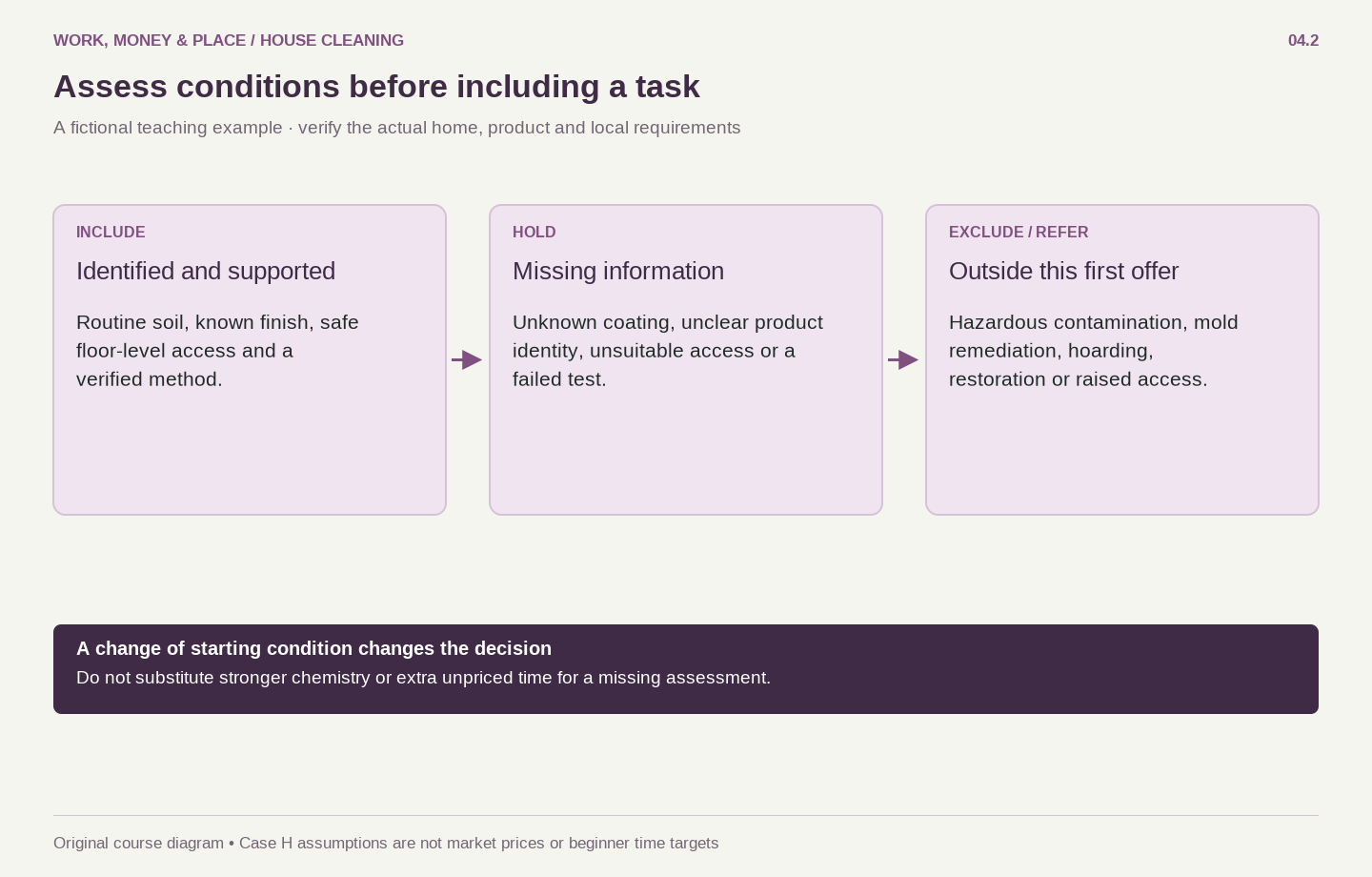
Distinguish routine soil from a condition that needs identification, different scope, or a stop before quoting.
Open the full-size diagram ↗
Example and worksheet
Connect this lesson to the complete Case H records. Keep the fictional example separate from your own project.
Inspect the condition before choosing effort
Look for loose dust and crumbs, ordinary fingerprints, light grease, and routine soap residue. Describe their location and extent rather than labeling every room light, medium, or heavy without examples. A counter with loose crumbs and two small grease marks differs from a stove surrounded by baked-on deposits. The latter may require a different service, time, tools, and risk review. A routine price should not quietly include restoration because the photographs looked attractive.
Walk the same eight zones as the inventory. Note which condition is observable and which is concealed by belongings. For Case H, the starting assumption is ordinary occupied-home soil on assessed, reachable surfaces. There is no mold treatment, hazardous contamination, hoarding cleanup, pest work, or construction residue removal. If the actual visit reveals one of those conditions, the assumption has failed. Stop the affected work, explain the finding, and reassess the agreement instead of improvising a stronger chemical.
Identify material, finish, and neighboring edges
A surface name alone can hide important differences. Wood may be waxed, oiled, coated with polyurethane, or worn through. A stone-looking counter may be laminate, engineered material, or natural stone. A shower can combine tile, grout, metal trim, a glass coating, and a repaired seal. Ask for the product name, installation record, care instructions, or other credible identification. A customer's guess is useful information, but it is not a manufacturer's permission.
Record the finish and the weak boundaries as well as the central surface. Check laminate seams, exposed edges, damaged coating, loose trim, and the perimeter around controls. You are deciding whether an approved routine method can stay within its intended area. A test on one intact patch cannot approve a cracked seam or an unidentified coating elsewhere. Natural-stone care requires identification; acidic products can damage some stones. This course does not teach stain extraction, polishing, or repairs.
Check access from the position you will use
Stand where you would actually work. Can you reach the agreed area with both feet on a stable floor, without twisting around a toilet, leaning over fragile objects, or stepping onto a chair? Look at the route for equipment, the position of doors, cords, rugs, and household traffic. A photograph taken from a doorway can hide a narrow passage or an unstable object. Access is part of the assessment, not a problem to solve after carrying in chemicals.
Do not move heavy furniture, disconnect appliances, remove electrical covers, or climb to reach excluded surfaces. A small approved item can be handled under the agreed method, but weight, fragility, or uncertainty changes that decision. Mark blocked surfaces on H07. The customer may clear them before the visit, approve a narrower package, or arrange a different qualified service. An uncompleted inaccessible task must remain visible on the final record even when the rest of the room is finished.
Separate cleaning from antimicrobial service
Routine cleaning is the removal of dirt and residue using an appropriate method. It does not by itself establish that a surface has been sanitized or disinfected. CDC explains that ordinary cleaning is generally the routine starting point in homes; circumstances such as illness may require a different plan. Ask about a changed household condition privately and respectfully. Do not solicit detailed medical histories or publish household health information.
If an antimicrobial task is proposed, identify the exact EPA-registered product, permitted surface and use, required preparation, application, wet contact time, and any rinse instruction. A wipe that dries quickly is not automatically the labeled disinfecting procedure. A product's brand name or pleasant smell does not prove the required outcome. Case H prices routine cleaning, with no universal disinfection claim. A special request must be assessed before acceptance, including your competence and the rules applicable to the actual work.
Turn uncertainty into a clear decision
Use three practical statuses. Proceed means the task is included, accessible, identified, and supported by matching instructions and a satisfactory limited practice check. Hold means information or a condition must be resolved first. Exclude means the work is outside the accepted package. These statuses apply to particular tasks; holding an unknown vanity does not require guessing at it to finish the bathroom, nor does it automatically cancel unrelated safe tasks.
On H08, connect every limitation to the quote. For example, accessible painted cabinet fronts may be included after identification, while a peeling section remains excluded from wet treatment. Record existing defects with permission and restrained, factual photographs. Avoid diagnosing their cause. If an unknown floor finish cannot be identified before the visit, remove that damp-cleaning task from the accepted scope and resolve the price and completion expectation in advance. A conditional promise is useful only when its condition is understandable.
Put it into practice
Your assignment
Classify three survey findings without inventing a cleaner.
Inputs
- Kitchen counter is identified Wilsonart HPL with intact seams.
- Hall floor resembles wood, but no finish identification exists.
- Shower shows an unfamiliar dark growth and the customer requests mold removal.
Your deliverable
H06–H08 decision rows with evidence needed and customer-facing scope language.
Saved only in this browser when storage is available. Export this page separately and use fictional identifiers in practice.
Show the worked answer
- Counter: assess matching label, surface care and limited test on H18 before proceeding.
- Hall: HOLD damp treatment until floor and finish instructions are identified; appearance alone is insufficient.
- Shower: exclude mold-remediation request from this routine service; stop affected work and discuss an appropriate separate assessment.
Show the self-check criteria
- Each finding has a distinct status and reason.
- No test is used as permission to clean an unidentified finish.
- No routine price includes hazardous or restoration work.