Assemble a maintainable, separated kit and connect each product to its own label, SDS, surface, and tool.
Open the full-size diagram ↗
Example and worksheet
Connect this lesson to the complete Case H records. Keep the fictional example separate from your own project.
Start with tasks rather than a crowded bottle shelf
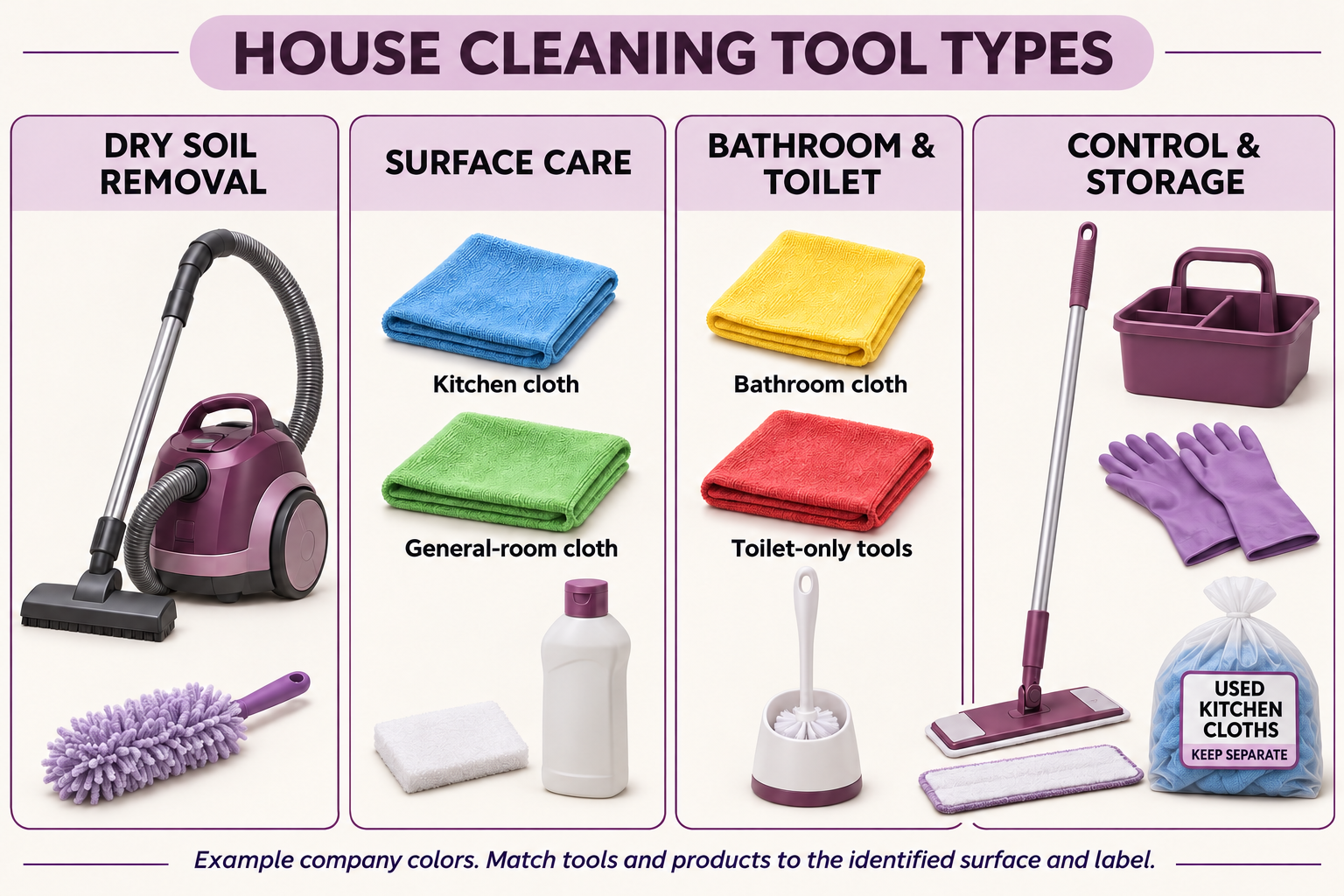
Use the assessed inventory to build H09. A small routine kit needs tools for dry soil removal, controlled wiping, verified floor care, waste handling, and protecting the work area. Choose cloths and pads that the surface instructions allow, enough clean replacements to finish the visit, suitable gloves and eye protection for the actual chemical task, and secure containers for transport. A tool advertised as professional still needs a compatible use and a maintenance plan.
Keep a dry vacuum with the correct bags, filters, and attachments, a controllable floor tool, nonabrasive wiping tools, and a dedicated toilet brush. Inspect the contact surfaces for trapped grit or damaged edges before use. A new microfiber cloth can pick up a hard particle during the first room and then damage another surface. Changing tools at the right time is more valuable than carrying extra chemicals that you have never assessed.
Open the full-size illustration ↗
Illustration sources: HT03, HT05, HT20.
Use an understandable separation system
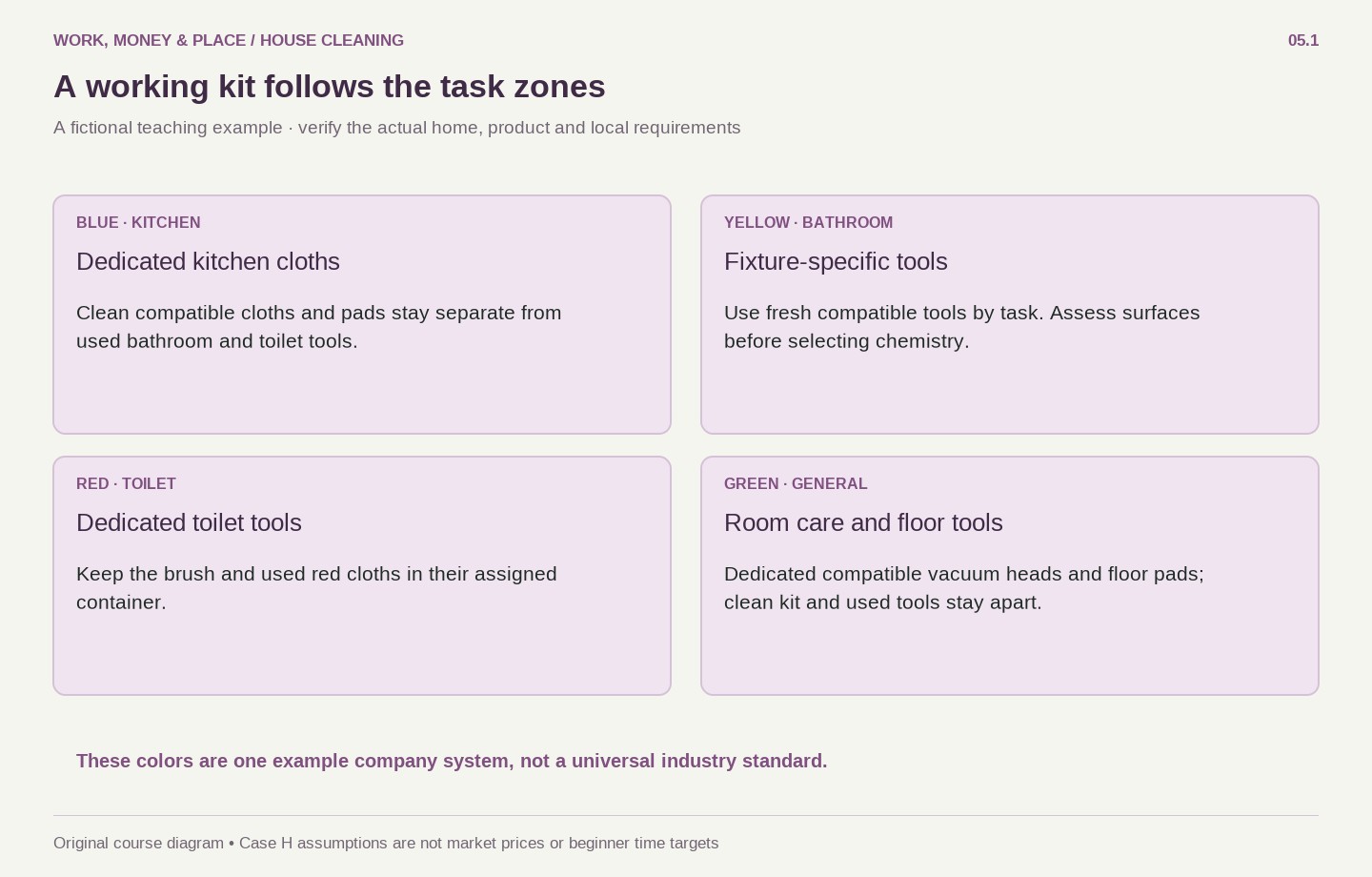
For this course, blue identifies kitchen cloths, yellow identifies bathroom vanity and shower cloths, red identifies toilet-only cloths, and green identifies general-room cloths. These colors are our company example, not a universal industry color standard. Add written labels so the system does not depend on color recognition alone. Floor pads are separately identified by zone and floor method. A bathroom floor pad does not move into the kitchen because it still looks clean.
Keep unused cloths protected from used tools. Fold a clean cloth to present a manageable face; turn to a genuinely clean face as soil is collected and replace it before all faces are used or contamination is uncertain. A folded dirty cloth has not become a new clean tool. Put used toilet cloths and other used zone tools into marked, suitable containers. Do not dip a used cloth back into clean supply water. Keep kitchen, bathroom, toilet, and general-room workflows separate through cleaning, transport, and reset.
Match exact bottles to exact documents
The kitchen example uses US Formula 409 Multi-Surface Cleaner Original on identified Wilsonart laminate. H18 links the manufacturer's current cleaning directions, Wilsonart care, and Clorox SDS USA001160, issued February 14, 2022. This is a cleaning-only example. Read the bottle actually purchased: name, formulation, country, restrictions, and registration when relevant. A similarly colored bottle or a different product in the same brand is not the same selection.
The wood-floor example uses Bona Professional Series Hardwood Floor Cleaner, SKU WM700051187, on confirmed unwaxed polyurethane-finished wood. The linked technical sheet and matching product SDS form a separate record. Luxury vinyl and ceramic tile need their own assessed method; the wood cleaner is not a universal bottle. Retain readable original labels, keep the matching SDS available before use, and follow the actual refill instructions. Never put chemicals into food or drink containers or mix products to improve their action.
Inspect and maintain the equipment you own
Read the manual for your exact vacuum and attachment, including electrical supply, permitted surfaces, bags, filters, and maintenance. The BISSELL BG1006/BG1001 commercial manual is a worked manual-reading example: it limits use to dry indoor surfaces and excludes chemical pickup. Do not use a dry vacuum to recover a spill. Its requirements are not a substitute manual for a different model. A tool suited to ordinary carpet may still be unsuitable for a delicate wood finish.
Before leaving, check the cord and plug, hose, bag or collection system, filters, wheels, and floor-contact tool. Disconnect equipment before maintenance as its manual requires. Quarantine damage instead of taping over an electrical fault or defeating a safety feature. Clean and maintain reusable equipment by its maker's instructions, including complete drying where required before reassembly. Record service dates and replacement parts. Check commercial suitability and the real purchase price independently; the teaching kit allowance is not a current equipment quotation.
Prepare for a problem before opening a bottle
H17 contains a six-step incident card. Add the actual job address and callback number privately, identify a safe access route for responders, and know where each product's label and SDS are stored. Practice locating Section 4 for exposure instructions, Section 6 for release response, and Section 8 for protection. These sections have different purposes. A surface-care sheet cannot supply first aid, and an SDS does not approve the product for every countertop.
For the Formula 409 example, the cited SDS lists a medical emergency number, 1-800-446-1014; verify it against the current matching document when preparing your kit. Call 911 for an immediate emergency and follow dispatcher directions. A nonemergency product question belongs with the appropriate product or medical resource. Do not memorize one rinse duration or one spill treatment for every chemical. Your plan must support stopping work and keeping people away when cleanup exceeds your training or equipment.
Write the release decision beside the item, with the date and initials of the person who checked it. This makes a packed kit distinguishable from a kit that is actually ready for use.
Put it into practice
Your assignment
Prepare a kit release check and solve a cloth-mixup scenario.
Inputs
- The blue kitchen pack is clean; a red toilet cloth has been placed in it.
- The vacuum bag is fitted, but the cord insulation is damaged.
- The kitchen bottle has a similar brand name but a different formulation from H18.
Your deliverable
H09 kit status plus an H18 document-match correction.
Saved only in this browser when storage is available. Export this page separately and use fictional identifiers in practice.
Show the worked answer
- Hold the affected blue pack; separate and reset it under the tool-care protocol rather than guessing which cloth touched which.
- Do not operate the damaged vacuum; arrange service or a suitable checked replacement.
- Obtain the actual product label and matching SDS and reassess compatibility before use. The old record does not transfer.
Show the self-check criteria
- No toilet tool returns to a kitchen or general-room task.
- Equipment faults are resolved before release.
- Every selected chemical has a matching, accessible label and SDS.