Build a complete house-cleaning job cost that distinguishes stock consumption, cash purchases, all owner time, shared resources and uncertainty.
Open the full-size diagram ↗
Example and worksheet
Read the matching Case H records, then complete a separate assessed job using your own verified inputs.
- Case H 02 · Document the assessed package before pricing
- Case H 04 · Prepare the kit without counting it twice
- Case H 05 · Reconcile purchases use losses and remaining stock
- Case H 06 · Read the management result on a consistent basis
- Case H 07 · Budget the entire owner cycle
Download the formula planner ↓
Example tab: First plan. Your blank tab: Your estimate.
Save your own copy. Use the named example as a worked record, then enter verified scope, costs, payment events and full-cycle hours in the blank Your worksheets.
Turn the agreed checklist into a cost record
A usable estimate starts with the home and tasks you actually assessed. Case H has three bedrooms, two bathrooms, one kitchen, a living/dining zone and a hall/entry zone. Those are eight named zones. The floor route is work through those zones, not another room to charge or time twice. Approximately 1,600 square feet is background information. It cannot tell you the condition of a bathroom, the number of objects on a counter or which finishes require a different compatible method.
Connect H07 and H08 to the estimate before entering a selling price. Record what will be cleaned, the assessed condition, the permitted approach and any customer preparation. Confirm exclusions such as oven interiors, interior window washing, laundry service, organization and heavy furnishing moves. Hazardous contamination, restoration and raised access remain outside the first offer. An undefined task is an unresolved decision, not a harmless zero. Complete the survey or narrow the proposed work before promising a result.
Separate supplies bought from supplies consumed
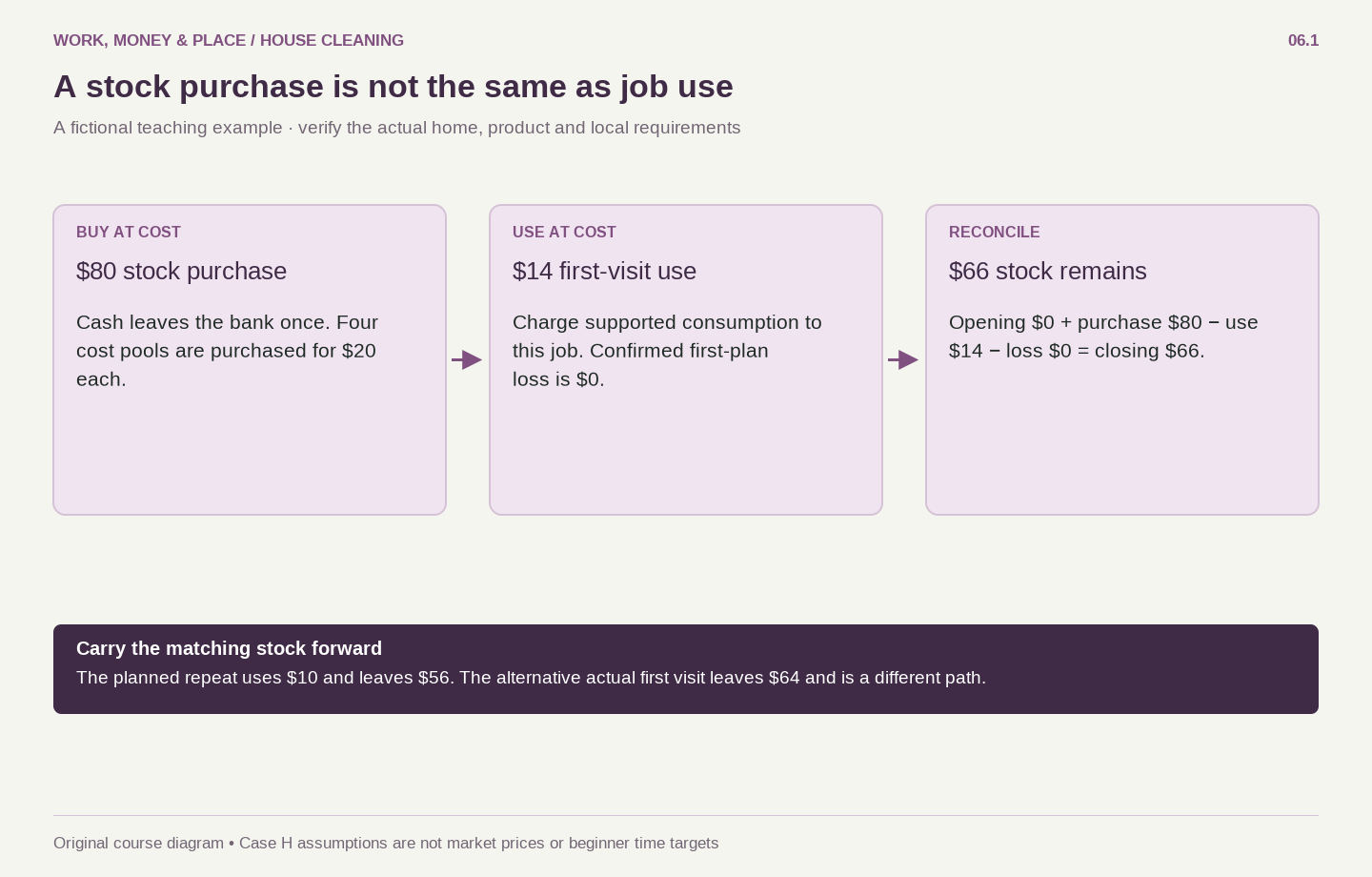
The fictional business purchases an $80 stock lot before its first visit. Four categories receive $20 each: compatible general surface-care supplies, compatible bathroom-care supplies, cloth laundering supplies, and liners/disposable protection. Planned usage is $4, $4, $4 and $2, totaling $14. The remaining $66 is inventory available for later work. The $80 purchase belongs on its payment date in H12. The $14 consumed belongs in this visit’s H11 cost. Charging both as two expenses against the same visit would count the supplies twice.
H10 tracks opening stock, purchases, use, all losses and closing stock, with dates, source evidence and a job identifier. Total loss reduces inventory even when it did not arise on this job. Only the supported job-related portion joins usage in this job’s cost. Case H confirms both loss fields at $0. If an unrelated storage spill occurs, record it in the business stock log without assigning it automatically to the next customer. Use dollars and cents so separate row calculations and totals reconcile.
Include the complete owner work cycle
Case H budgets 270 minutes on site and 90 minutes off site, or six owner hours in total. The on-site phases include arrival/protection, both bathrooms, the kitchen, three bedrooms, living/dining, hall/entry, the floor route and final inspection. Off-site work includes intake and quoting, loading/laundering/restocking, all round-trip travel and invoice/records. A calculation based only on time inside the house would omit work the business still has to perform. Track the whole cycle, including a return trip when one is actually needed.
The chosen management value is $30 for each owner hour. Six hours therefore carries $180 of owner labor value. This is a planning measure of the owner’s contribution, not evidence that $180 has left the bank or a claim about tax deductibility. A helper’s verified cost is a separate input. Case H has one owner and no helper, so help cost is a confirmed $0. A beginner must measure controlled practice and allow for their own pace rather than using the case as a speed requirement.
Allocate reusable equipment and business overhead once
The $560 reusable kit is funded at launch. The example allocates $8 to a visit using 70 modeled uses. This does not prove a tool will last for 70 jobs or establish tax depreciation. Record the actual purchase, maintenance and replacement basis for your own kit. The purchase affects launch cash; the allocation helps a visit contribute toward the resources it uses. Deducting the entire kit purchase and the $8 allocation from one ordinary visit would confuse these two planning questions.
Monthly overhead is a fictional $480: insurance $120, communications $40, marketing $160, bookkeeping $60 and fixed vehicle/business costs $100. Dividing by 20 modeled completed visits produces $24 per visit. Twenty is an assumed workload, not evidence of customer demand. Ten visits carrying the same monthly budget would require $48 each. Keep variable fuel separate from the stated fixed vehicle allowance, and check what your own budget includes. Do not put the same marketing payment into overhead and another unexplained job expense.
Calculate the result and preserve its meaning
First direct cost is $14 consumed stock, $10 fuel and an $8.80 receipt fee, totaling $32.80. The $340 agreed package less $32.80 direct cost, $180 owner labor value, $8 equipment allocation and $24 overhead leaves $95.20 before a planning allowance and other business taxes. A separate $20 allowance leaves a planned $75.20. The allowance is a provision for uncertainty, not another supplier bill or permission to skip recording an actual cost. The case makes no promise that this result will occur.
Finish H10 and H11 with a reason and source for each amount. IRS recordkeeping guidance calls for supporting business records; keep invoices, receipts and payment evidence organized without treating this management worksheet as a tax return. Confirm whether costs include applicable purchase taxes and delivery. Save the dated estimate that supports the accepted scope. Your result is useful when another person can trace it from the home’s checklist to stock, time, payment fees and shared resources, then identify exactly which assumption needs replacing.
Put it into practice
Your assignment
Rebuild the first-visit cost and explain why its $80 purchase is not a second $80 consumed-supplies expense.
Inputs
- Eight assessed task zones; $340 package
- Purchase $80; use $14; losses $0; fuel $10; fee $8.80
- Six owner hours at $30; equipment $8; overhead $24; allowance $20
Your deliverable
Completed H10 stock log and H11 estimate, including all owner phases and dated cost assumptions.
Saved only in this browser when storage is available. Export this page separately and use fictional identifiers in practice.
Show the worked answer
- $0 + $80 − $14 − $0 = $66 closing stock.
- Direct cost = $14 + $10 + $8.80 = $32.80.
- Before allowance: $340 − $32.80 − $180 − $8 − $24 = $95.20.
- After the $20 planning allowance: $75.20 before other business taxes.
Show the self-check criteria
- Purchase and consumption are distinguished.
- All owner phases are included once.
- Equipment and overhead bases are stated.
- Only supported job loss enters the job cost; confirmed zero is distinct from unknown.
Sources: HF02.