Turn an assessed kit into a launch cash plan without confusing purchases, job use, and long-term allocations.
Open the full-size diagram ↗
Example and worksheet
Connect this lesson to the complete Case H records. Keep the fictional example separate from your own project.
- Case H 04 · Prepare the kit without counting it twice
- Case H 05 · Reconcile purchases use losses and remaining stock
- Case H 08 · Fund the visit before its receipt clears
- Case H 10 · Reconcile launch cash and the coverage floor
Download the formula planner ↓
Example tab: First cash. Your blank tab: Your cash.
Open the downloaded workbook and select the named tab. Use the example for reasoning, then enter your own supported inputs in a separate blank Your sheet.
Separate what lasts from what gets consumed
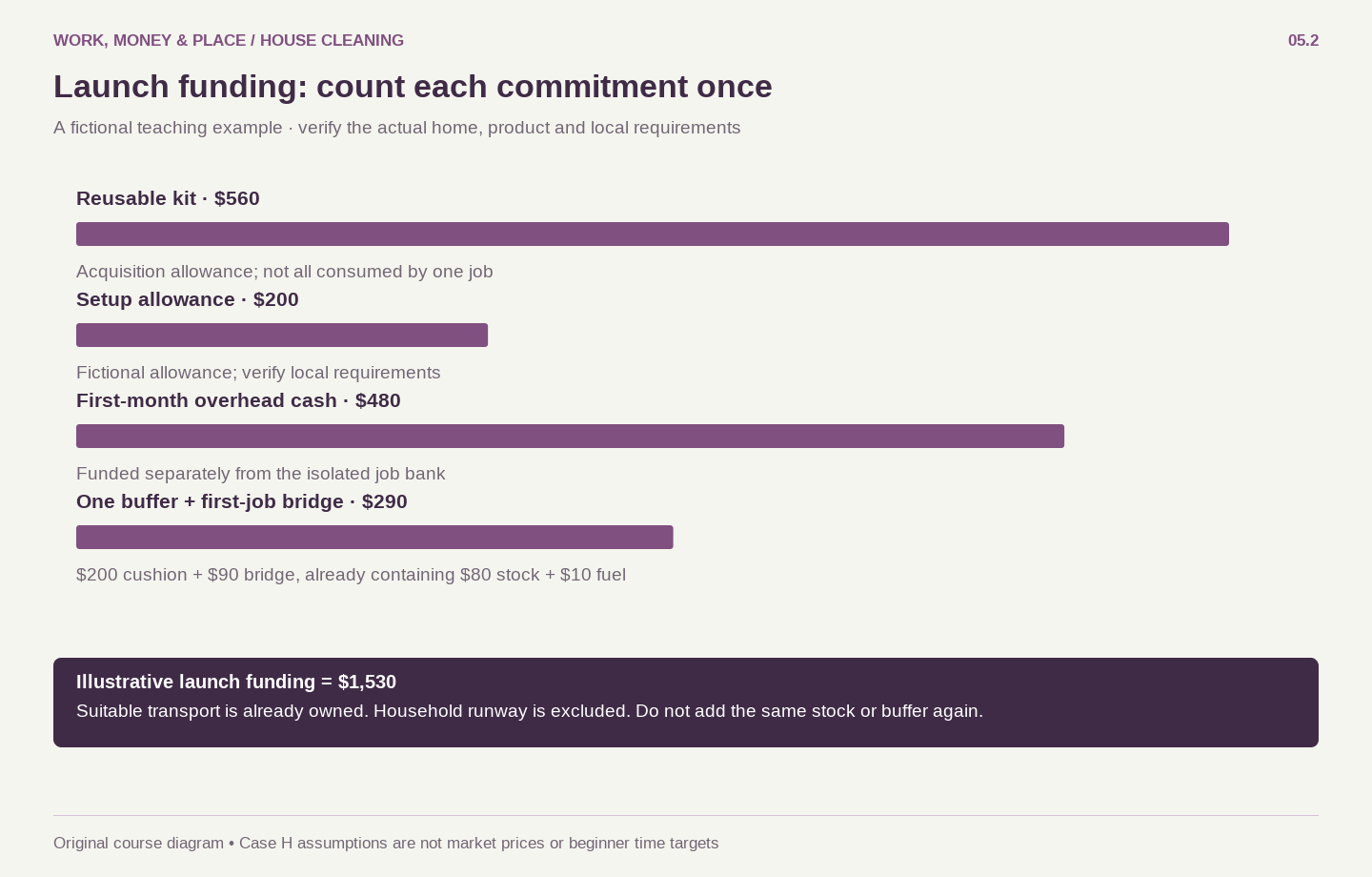
A reusable vacuum, handle, caddy, and durable tools are different from cleaners, liners, and replacement consumables. List both groups on H09, but do not charge the full reusable kit purchase to every visit. Case H uses a fictional $560 reusable kit allowance. It is a planning amount for a suitable, verified kit, not a promise that one currently advertised premium machine and every accessory will fit the allowance. Request real prices and adjust the launch plan before spending.
Inspect items already owned. Ownership does not prove commercial suitability, adequate condition, or compatibility with the assessed home. A usable existing tool may reduce today's cash purchase, but it will still wear out. Keep its replacement planning visible. Conversely, an expensive specialty machine does not become necessary because a video demonstrates it. The initial offer excludes restoration and specialty extraction; equipment for those services does not belong in this launch merely to make the kit appear complete.
Buy enough clean capacity to complete the route
Count cloth and pad changes by zone, expected soil, and the method rather than assuming one cloth can cover an entire home. A plan needs reserve clean tools for replacement and corrections, plus suitable used-tool containment. If the available clean kitchen pack runs out, you cannot borrow a toilet cloth to finish on time. Replenishment and laundering take owner time even though the customer never sees that work.
H10 carries the stock movement. Case H starts with no stock and purchases $80: $20 general care, $20 bathroom care, $20 cloth laundering, and $20 liners and protection. Planned first-visit use is $4+$4+$4+$2=$14, leaving $66. The repeat consumes $3+$3+$2+$2=$10, leaving $56. These are dollar-valued teaching categories; they are not chemical recipes or permission to combine products. Record actual quantities and valuation consistently so an empty bottle and a receipt can be reconciled.
Calculate allocations without buying the kit again
The Case H management model spreads $560 over seventy modeled uses, producing an $8 equipment allowance per visit. That denominator is a planning assumption. It does not guarantee seventy jobs, predict a tool's life, or establish tax depreciation. If your practice or service mix changes wear, revisit the assumption. A job's equipment allocation and the cash paid to acquire the tool belong in different views of the same business.
The example also uses $480 monthly overhead over twenty modeled visits, or $24 per visit. This is a workload assumption, not booked demand. At ten visits, the same monthly total would represent $48 per visit if everything else stayed equal. The $14 stock use, $8 equipment allowance, and $24 overhead share describe different costs. Buying stock for $80 and then subtracting $80 plus $14 from the same job result would count that consumption twice.
Fund costs before customer funds clear
A payment marked successful is not automatically cleared cash available for tomorrow's purchases. Use H12 to place actual cash events in date order and keep restricted tax money separate from free money. The base Case H customer-tax setting is zero under its documented teaching transaction; this is not a tax rule for every learner. If your researched transaction requires collection, add the correct reserve and remittance schedule before treating receipts as spendable.
The modeled project bank opens at $290: a $200 operating cushion plus a $90 first-job float. Before collection, stock purchase 80 and fuel 10 reduce the bank to 200. The first $340 card receipt, less its modeled $8.80 fee, adds 331.20, ending at 531.20. Do not subtract the $14 stock use again from that cash calendar: its purchase was already paid. Owner compensation, other business taxes, and later obligations still require their own plan; this ending bank is not a take-home-profit promise.
Release the launch plan after a small practice run
Case H totals $1,530 of launch funding: kit 560, setup 200, first-month overhead 480, buffer 200, and first-job float 90. Keep each line's purpose visible. The single buffer is not added again inside the float. This model assumes transportation is already owned; anyone needing a vehicle must add that real cost and related operating obligations. A copied launch total cannot replace personal readiness or local supplier quotations.
Use a controlled practice to measure actual cloth changes, stock use, load time, laundering, and travel. Suppose the first actual visit uses $16 of stock and $12 of fuel. With the same opening bank and purchase, minimum free cash falls to 198 because fuel is paid before collection. Another $2 would be needed to retain the $200 cushion. Remaining purchased stock is 64. Record these differences rather than changing the accepted plan to make the result look better.
Keep the supplier quotation date and what its price includes. Delivery, sales tax on purchases, replacement filters, and required attachments can change the amount actually needed before the first job.
Put it into practice
Your assignment
Reconcile the launch kit, stock, and first cash cycle on H09/H10/H12.
Inputs
- Kit 560 over 70 modeled uses; monthly overhead 480 over 20 modeled visits.
- Opening bank 290; purchase 80; fuel 10; net first receipt 331.20.
- Alternative actual stock use 16 and fuel 12, with no stock loss.
Your deliverable
Three separate views: launch purchases, stock ledger, and dated project cash.
Saved only in this browser when storage is available. Export this page separately and use fictional identifiers in practice.
Show the worked answer
- Equipment 8 and overhead 24 are management allocations, not duplicate cash purchases per visit.
- Planned stock closes 66; bank ends 531.20 and bottoms at 200.
- Alternative stock closes 64; bank ends 529.20 and bottoms at 198. Add 2 before the expense if a 200 minimum must be protected.
Show the self-check criteria
- Purchases, consumption, and allocations are distinct.
- Receipt timing and actual payment fees are preserved.
- The alternative actual is not silently chained into the planned repeat.