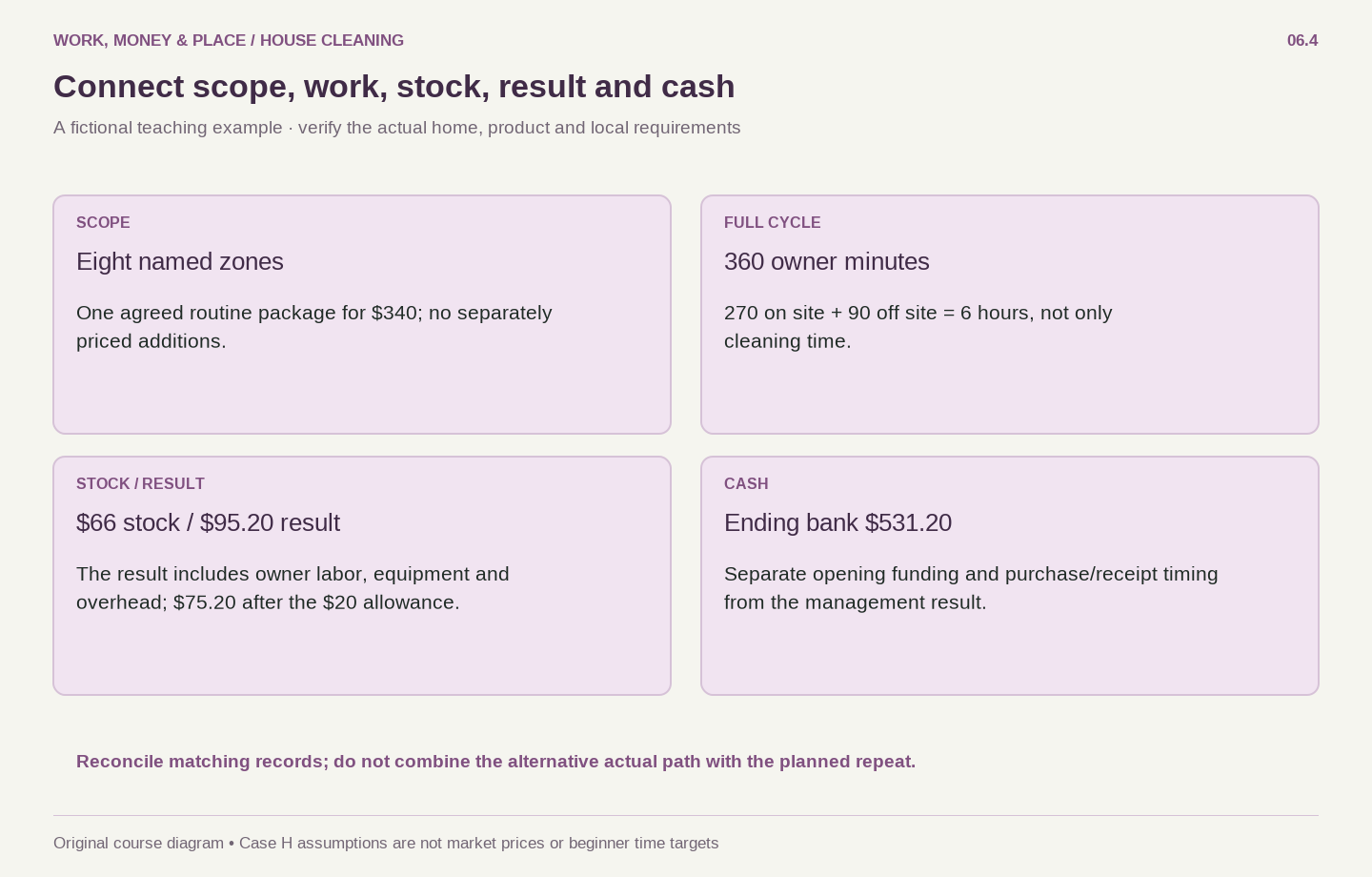
Rebuild the entire fictional job and demonstrate that scope, time, inventory, price, cash and launch funding agree without double counting.
Open the full-size diagram ↗
Example and worksheet
Read the matching Case H records, then complete a separate assessed job using your own verified inputs.
- Case H 01 · Understand the occupied-home service
- Case H 02 · Document the assessed package before pricing
- Case H 04 · Prepare the kit without counting it twice
- Case H 05 · Reconcile purchases use losses and remaining stock
- Case H 06 · Read the management result on a consistent basis
- Case H 07 · Budget the entire owner cycle
- Case H 08 · Fund the visit before its receipt clears
- Case H 09 · Plan the repeat as a separate agreement
- Case H 10 · Reconcile launch cash and the coverage floor
- Case H 11 · Practice tax reserves without changing the base case
- Case H 12 · Preserve the accepted plan and transfer the method
Download the formula planner ↓
Example tab: First plan. Your blank tab: Your estimate.
Save your own copy. Use the named example as a worked record, then enter verified scope, costs, payment events and full-cycle hours in the blank Your worksheets.
Follow one job identifier through the records
Use this lesson as a complete rehearsal rather than another attractive earnings example. Give the fictional visit one job identifier and a dated scope version. Link H07’s eight zones to H08’s accepted task list, H10’s stock entries, H11’s estimate, H12’s cleared-cash events and H13’s actual review. The home has three bedrooms, two bathrooms, a kitchen, living/dining and hall/entry. The floor route crosses those eight zones. It is not a ninth inventory unit or another complete home-cleaning package.
The first service amount is $340, with no eligible additions and $0 customer tax in this qualifying Washington routine-service example. Record the package without multiplying it by the zone count. Confirm the exclusions and assessed access. A financial worksheet cannot authorize a technical task you have not practiced or an unsafe condition you have not assessed. Keep any unpriced or unassessed change visibly unresolved. All commercial amounts in Case H remain fictional; none is evidence of local market demand or beginner performance.
Rebuild the full cycle rather than only the cleaning time
Add the first on-site phases: arrival/protection 15 minutes; bathrooms 70; kitchen 45; bedrooms 45; living/dining 25; hall/entry 10; floor route 40; inspection/handoff 20. They total 270 minutes. Add intake/quote 30, loading/laundering/restocking 20, round-trip travel 30 and invoice/records 10, giving 90 off-site minutes. The complete cycle is 360 minutes, or six hours. At the selected $30 management value, owner labor is $180.
The repeat has 195 on-site and 75 off-site minutes, totaling 4.5 hours and $135 of owner labor value. Travel does not vanish merely because the customer is familiar. These budgets describe assumptions to test, not a required cleaning speed. If controlled practice takes longer, record it and rebuild the estimate. If tasks overlap, avoid counting the same phase twice; if a required protection, restocking or follow-up task is missing, add its own justified time instead of hiding it inside an unexplained percentage.
Show where the purchased stock and customer price go
The $80 consumable purchase provides four $20 category balances. Planned use is $14 and confirmed losses are $0, leaving $66. The repeat consumes $10 from that balance, leaving $56. The alternative actual first consumes $16 from the original $80 and leaves $64. Record total losses separately from the portion attributable to the visit. All loss reduces stock, while only supported job loss joins usage in this job’s cost. A receipt for a purchase is not evidence that every item was consumed immediately.
Rebuild first direct cost as $14 + $10 fuel + $8.80 fee = $32.80. Subtract it, $180 owner labor, $8 equipment and $24 overhead from $340 to get $95.20 before allowance and other business taxes. The $20 planning allowance gives $75.20. For the repeat, $280 − $27.30 direct cost − $135 labor − $8 equipment − $24 overhead gives $85.70; after $15 allowance, $70.70. Each result has a defined basis, rather than the vague label “money left.”
Prove why bank cash is different from the job result
First bank opens at $290 with no held customer tax. The $80 purchase and $10 fuel leave the chosen $200 cushion. The $331.20 net receipt gives $531.20 ending bank. The increase is $241.20. Add $66 closing stock: $307.20, matching $340 service revenue less $32.80 consumed direct cost. Subtract the $180 owner value, $8 equipment allocation and $24 overhead share to obtain the same $95.20. This bridge explains the difference without claiming the bank balance is profit.
In the actual alternative, fuel is $12 and the same stock purchase supports $16 usage. Bank ends at $529.20 and inventory at $64. Cash increase $239.20 plus inventory $64 equals $303.20 before owner value, equipment and overhead. Seven owner hours are $210, so the resulting $61.20 is $34 below the accepted before-allowance plan. The minimum bank is $198, two dollars below the intended cushion. Inventory use, labor value and a cushion shortfall are different records; do not deduct them twice.
Reconcile launch funds and keep the repeat path honest
Launch funding totals $1,530: reusable kit $560, setup allowance $200, first-month overhead cash $480, one buffer $200 and first-job stock/fuel bridge $90. Suitable transport is already owned. The $80 stock purchase is inside the bridge, so adding it separately would incorrectly produce $1,610. Household living costs and buying a vehicle are outside this example and must be added when they apply. The kit allocation and monthly overhead share help judge visits; their full launch payments are not charged again against the same visit result.
The planned repeat begins with $531.20 bank, pays $10 fuel and receives $272.70, ending at $793.90. This isolated path deliberately follows the planned first visit, not the alternative actual. It excludes intervening overhead, owner withdrawals and other jobs. Transfer held tax separately if a taxable arithmetic variant is being tested. Finish the rehearsal by explaining every difference and preserving the accepted plan as a static dated baseline. Then begin a blank, separately assessed job instead of changing the teaching case to make a desired result appear.
Put it into practice
Your assignment
Reconcile Case H from its eight-zone scope to the launch total and identify every place a common double count could occur.
Inputs
- All Case H records and the First plan/First cash/First actual/Repeat sheets
- First: $340, six hours, $80 bought/$14 used, $10 fuel
- Repeat: $280, 4.5 hours, $10 use/$10 fuel; alternative actual: seven hours/$16 use/$12 fuel
Your deliverable
A connected H07/H08/H11/H12/H13 case file and a short written reconciliation.
Working forms: H07, H08, H11, H12, H13.
Saved only in this browser when storage is available. Export this page separately and use fictional identifiers in practice.
Show the worked answer
- First result $95.20/$75.20; repeat $85.70/$70.70.
- First bank $531.20 with $66 stock; planned repeat bank $793.90 with $56 stock.
- Alternative actual bank $529.20, stock $64, management result $61.20, before-allowance variance −$34.
- Launch total $1,530; the stock purchase, kit purchase/allocation and full overhead/allocation are each recognized in the correct record only once.
Show the self-check criteria
- Scope and time records agree.
- Purchase, consumption and stock balance reconcile.
- Bank-to-management-result bridge is explained.
- The planned repeat and alternative actual are not silently chained together.