Write a specific, truthful offer and assemble permission-based evidence that supports routine occupied-home cleaning without inventing customers or results.
Open the full-size diagram ↗
Example and worksheet
Use the separately labeled Case H teaching records, then create a dated record for your own assessed service. Fictional results do not establish practical readiness or local demand.
Make the offer recognizable before making it persuasive
A useful service description lets a household decide whether to ask for an assessment. State that the starter offer is routine occupied-home cleaning of agreed, reachable surfaces, identify the broad service area, and explain that the final task list follows an assessment. Describe the ordinary kitchen, bathroom, room-care, and floor tasks you are prepared to perform. Explain important exclusions in plain language. An oven-interior request should not reach the booking stage under a vague promise that every kitchen task is included.
Use H01 to draft a short headline, a paragraph describing the service, a scope summary, and a clear next step. The next step can be a request for the assessment information, not an invitation to send a security code or pay an unknown price. Case H's $340 first visit is a fictional assessed package. Do not present that amount as a guaranteed quote for every three-bedroom home, or use its result as an earnings claim for a new operator.
Explain trust with facts that can be checked
Households are allowing someone into occupied private rooms. Specific process information helps them evaluate that decision: how the assessment works, how access is confirmed, how finish concerns are held, and what the completion review covers. Say what the business actually does rather than filling the page with unsupported superlatives. If you claim registration, coverage, qualifications, or background checks, verify the claim and describe it accurately. An application in progress is not an active credential.
Avoid promises that all surfaces will look new, all stains will disappear, or every home can be serviced in the same time. Cleaning, disinfection, restoration, and damage repair are different claims. Do not imply a public-health outcome simply because an ordinary room looks clean in a photograph. A small operator can sound professional by being clear about limits and consistent in follow-through. A long list of services that cannot yet be assessed reliably creates a harder promise to keep.
Build an honest portfolio even before paid work
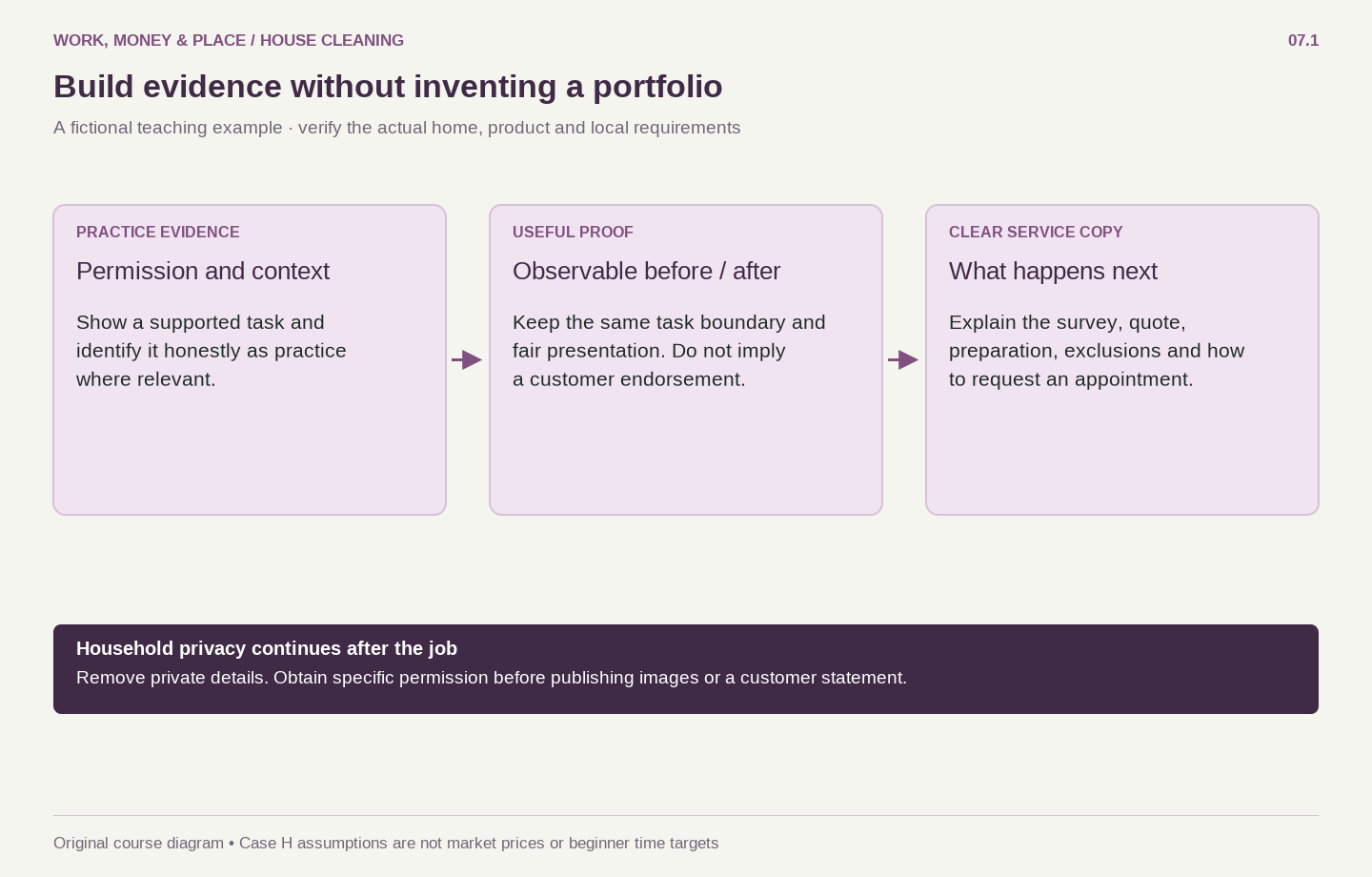
A beginner can show a controlled practice task on an owned or permission-granted surface. Label it as practice and state the actual task, method boundary, and conditions. A useful pair of images uses comparable views and honest lighting, with a caption describing the visible change. Do not describe a practice room as a customer's home or suggest that a staged task proves experience with unrelated finishes. Keep the before record rather than recreating a dirtier scene after the work.
Illustrations can explain a cleaning route, a cloth separation system, or a decision to hold an unknown surface. Label them as illustrations. Generated imagery is not evidence that you performed a job, and it should not be used as a fabricated customer before-and-after. Where images come from someone else, obtain the rights needed for the intended use. Where they show a real household, obtain appropriate permission and remove identifying details. A short truthful caption is stronger evidence than an impressive unexplained picture.
Ask for feedback without controlling the opinion
Use one neutral request process for all genuine customers who completed the service, subject to their contact preferences and the review platform's rules. Do not choose only customers you expect to praise you. Do not first ask whether someone is happy and send the public review link only to positive respondents; that is review gating. The course company policy offers no discount, gift, contest entry, free work, or other incentive for a review. This policy avoids an incentive problem rather than claiming that every incentive is universally unlawful. Invite the customer's own account of the actual visit, positive or negative, without suggesting a star rating. Do not invent endorsements, write a customer's review for them, or ask a person with no service experience to pose as a customer. Keep complaint handling available to every customer and independent of any review. Never make a correction or remedy conditional on posting, changing, or removing a review.
A referral can be requested without acquiring a neighbor's personal details. Give the existing customer an accurate public service page or contact method to share voluntarily. Do not assume permission to contact everyone in their address book or repeat private information about their home. A testimonial used in your own advertising should remain faithful to the customer's words and permission. It is not a substitute for a properly assessed scope or a promise that another home will have the same result.
Publish one version and measure the response
Keep a dated copy of the offer in H14 so you can connect inquiries to the wording people saw. A business listing should reflect the actual service arrangement and area. If you travel to customers rather than receive them at your address, use the platform's appropriate service-area settings and do not create a false storefront. Platform setup is not proof that a location is permitted or that a territory will be profitable; verify those questions separately.
Start with a limited offer you can deliver and review the questions it attracts. If most inquiries ask about excluded work, improve the wording before increasing advertising spend. If people cannot tell how the visit is assessed, explain the next step more clearly. Count inquiries, suitable inquiries, issued quotes, and accepted quotes separately in the following lesson. The purpose of the portfolio is to support a realistic buying decision, not to manufacture a history the business does not yet have.
Put it into practice
Your assignment
Create one routine-cleaning offer, two honest evidence captions, and a neutral review-request process for genuine customers.
Inputs
- The operator has completed a permission-based practice task but no paid home visits.
- A route illustration is available.
- The intended offer excludes oven interiors, hazardous contamination, and unidentified delicate finishes.
- A proposed follow-up survey sends a public review link only after a customer selects happy; it also offers a discount for a review.
Your deliverable
An H01 service paragraph and H14 dated offer version with a practice-photo caption, illustration caption, and neutral feedback request.
Saved only in this browser when storage is available. Export this page separately and use fictional identifiers in practice.
Show the worked answer
- Offer: Routine occupied-home cleaning of assessed, reachable surfaces in the stated service area. Contact us to confirm tasks, access, condition, and an individual quote. Excluded specialist and interior-appliance work is stated before booking.
- Practice caption: Permission-based practice on an identified compatible surface; this is not a client project. Describe only the visible task and result.
- Illustration caption: Example cleaning route for explaining workflow; not a photograph of completed customer work.
- Neutral request after a completed visit, where the platform permits requests: If you choose to leave a review, please describe your own experience with our service, positive or negative. Reviewing is optional. No incentive is offered, and our response to a service concern does not depend on a review.
- Process decision: reject the happy-only link and discount. Apply the same neutral invitation process to genuine completed-service customers without filtering by likely sentiment; respect opt-outs and platform rules. Handle any complaint separately without demanding a review change.
Show the self-check criteria
- Scope and next step are specific.
- No fictional customer, unverified credential, or universal result is claimed.
- Practice, illustration, and real customer evidence are labeled distinctly.
- Image rights, privacy permission, and feedback rules are addressed.
- Requests are neutral, without incentives, selective happy-customer invitations, or review gating; endorsements reflect genuine service experience.