Turn the assessed task list into a dated quote and household preparation plan that states what will happen, what is excluded, and how completion and payment will be handled.
Open the full-size diagram ↗
Example and worksheet
Use the separately labeled Case H teaching records, then create a dated record for your own assessed service. Fictional results do not establish practical readiness or local demand.
- Case H 02 · Document the assessed package before pricing
- Case H 03 · Classify the transaction and planned receipts
- Case H 07 · Budget the entire owner cycle
- Case H 08 · Fund the visit before its receipt clears
- Case H 12 · Preserve the accepted plan and transfer the method
Download the formula planner ↓
Example tab: First plan. Your blank tab: Your estimate.
First plan / Your estimate: preserve the accepted package and receipt schedule. Your actual uses a separate dated static baseline, not a live link to a later price revision.
Quote the assessed package rather than a room label
A useful quote begins with the agreed tasks and conditions. Case H has three bedrooms, two bathrooms, one kitchen, one living/dining zone, and one hall/entry zone: eight named zones. The floor route passes through those zones and is not a ninth room to charge again. The 1,600-square-foot area provides context, but it does not automatically calculate the price. Condition, reachable surfaces, access, furnishings, finish compatibility, and customer priorities determine the assessed package.
Use H08 as the scope source and H15 as the customer-facing confirmation. Name the ordinary tasks that are included and the surfaces or areas held for more information. State the exclusions visibly: interior appliances, interior window washing, household laundry service, organization, heavy furniture moving, raised access, and unidentified delicate finishes are outside the first package. A request for a tidy kitchen should not be left open to several incompatible interpretations. The quote should be understandable without the customer reading your internal cost worksheet.
Connect the price to one dated scope version
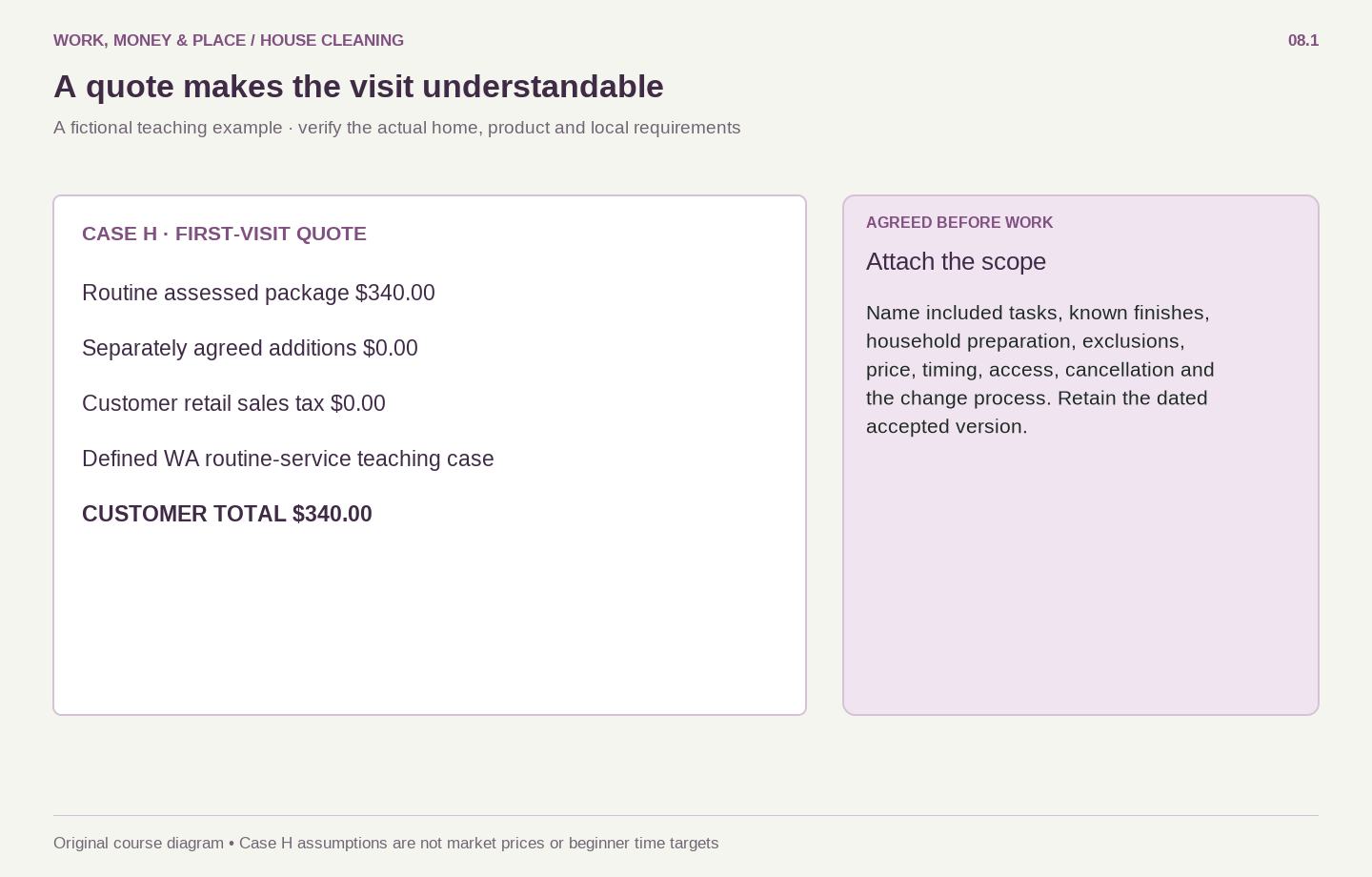
The fictional first package is $340 with zero customer sales tax under its stated Washington routine-janitorial classification. It assumes the separately assessed first-visit scope and one modeled completion payment. Do not advertise it as a universal three-bedroom price or multiply it by the eight zones. Internal owner-time, equipment, overhead, and processing calculations help you judge the package, but they are not an unexplained collection of customer surcharges. Explain any actual customer charges plainly before acceptance.
Give the quote a date, version or identifier, validity conditions, and a clear acceptance method. Preserve a copy of the accepted scope and estimate before making later changes. In the planner, keep the agreed baseline as dated values rather than allowing a new estimate to rewrite the original plan. Confirm what counts as a booking and what still depends on the pre-start safety and access check. Silence, a social-media reaction, or a vague expression of interest is not a substitute for clear acceptance.
Prepare the household for the actual tasks
Send a short preparation list connected to the service, not a demand that the customer clean the home first. Ask for safe access to agreed areas, management of pets and occupants, and removal of loose personal items where they obstruct the quoted task. Clarify who handles fragile possessions, documents, and valuables. Do not promise to move heavy furnishings or sort private belongings when those activities are excluded. If the customer cannot prepare a particular area, discuss the effect on scope before arrival.
Confirm the arrival window, verified contact, parking or building-entry arrangement, and permitted use of utilities needed for the assessed method. Keep entry credentials out of the general quote. Ask for available manufacturer information about surfaces that require identification. Do not ask the customer to guess a chemical or approve a method they cannot assess. An unknown delicate finish remains a hold until there is a supported decision. The customer can choose a reduced scope; consent does not make an incompatible method appropriate.
Define the completion review and payment event
Describe how you will check the agreed work and communicate exclusions or concerns. The completion review should use observable task criteria, such as removal of ordinary loose soil from the included accessible area, rather than an unlimited promise of perfection. Note pre-existing damage and any limitations agreed before work. If a task could not be performed, explain the reason and record any agreed adjustment. A completion checklist is a record of the visit, not permission to hide an unresolved issue.
State when payment is due, which methods are accepted, and how any applicable charges are disclosed. The Case H cash model assumes its single receipt clears after the first stock and fuel payments; actual settlement timing must be checked. An invoice marked paid is not necessarily cleared bank cash. If you use deposits, installment payments, or different fee methods, build that actual schedule into H12 instead of copying the case. Do not promise an access, cancellation, or payment rule that conflicts with mandatory consumer rights.
Read the confirmation through the customer's eyes
Check that the customer can answer five questions without calling again: what work is included, what is excluded, when authorized access is expected, what the agreed price covers, and how the visit will close. Remove internal drafting notes, supplier-shopping tasks, or technical production instructions. Use ordinary language and keep the important boundaries close to the acceptance step. A concise quote with a clear attached scope can be easier to follow than a long document with contradictory promises.
Before sending, reconcile the H08 scope, H11 estimate, H15 quote, and calendar. Confirm that each uses the same version and that any held surface remains held in all four places. Record the customer's response through a consistent process. If a question changes the package, issue a revised version rather than agreeing verbally and leaving the original documents unchanged. This is the handoff from research to an actual commitment, so missing information should be resolved or explicitly excluded before the work begins.
Put it into practice
Your assignment
Prepare a customer-ready confirmation for the Case H first package and identify how an oven-interior request will be handled.
Inputs
- Eight named zones; floor route is not a ninth zone.
- First package $340; customer sales tax $0; one modeled payment after completion.
- The customer requests oven-interior cleaning after receiving the routine scope.
- Private access instructions are shared through a separate controlled process.
Your deliverable
A dated H15 quote linked to H08 and the accepted H11 version, plus a concise household preparation message.
Saved only in this browser when storage is available. Export this page separately and use fictional identifiers in practice.
Show the worked answer
- Quote the assessed routine package once at $340 and describe the eight zones and agreed tasks without multiplying the package by the zone count.
- List interior appliances and the other starter exclusions. The oven request is excluded from this offer; do not add it silently or promise an unassessed method.
- Confirm the arrival window, authorized contact, pets, safe access to agreed areas, and how personal items will be handled. Store actual credentials separately.
- State the payment event and actual methods, preserve mandatory rights, and retain the accepted scope and estimate version for comparison with actual results.
Show the self-check criteria
- Scope, quote, estimate, and calendar identify the same version.
- The package is not priced as nine rooms or a universal area rate.
- Preparation respects privacy and actual exclusions.
- Completion, payment, and change procedures are understandable.