Track a defined acquisition test from inquiry to acceptance, then distinguish cash marketing cost, owner time, completed work, and collected payment.
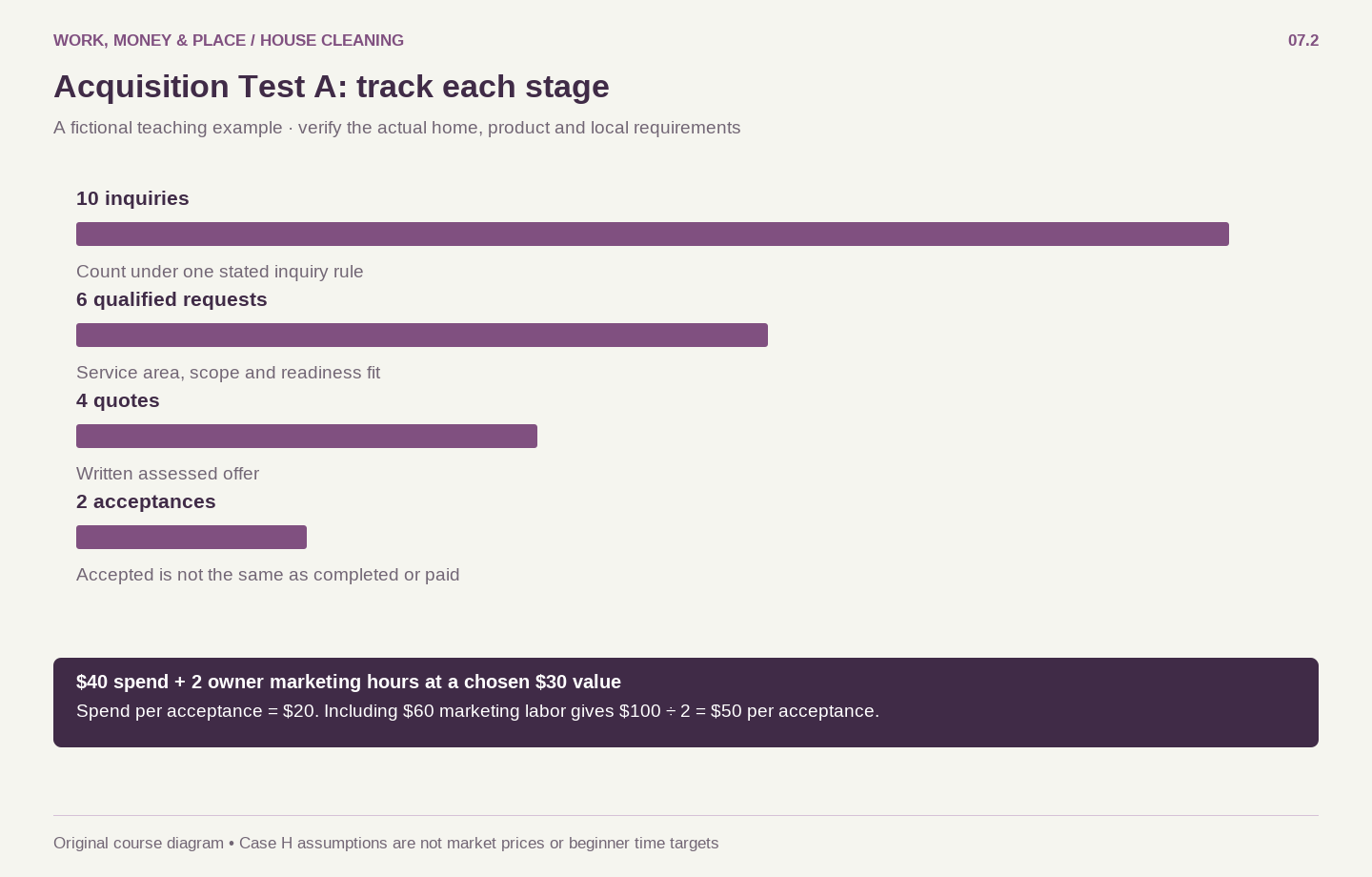
Open the full-size diagram ↗
Example and worksheet
Use the separately labeled Case H teaching records, then create a dated record for your own assessed service. Fictional results do not establish practical readiness or local demand.
- Case H 06 · Read the management result on a consistent basis
- Case H 07 · Budget the entire owner cycle
- Case H 12 · Preserve the accepted plan and transfer the method
Download the formula planner ↓
Example tab: First plan. Your blank tab: Your estimate.
Your estimate: add a documented acquisition cost only when its attribution does not duplicate existing overhead or another cost line. Preserve the original accepted plan.
Create a record for the event that actually happened
An inquiry is a contact requesting information, not a confirmed visit. A qualified inquiry fits the stated area, starter service, timing, and assessment requirements closely enough to proceed. A quote is a specific offer sent after enough information is available. Acceptance is the customer's clear agreement to that offer under the stated booking conditions. Completion and collection happen later. H14 should give each event a date, job or inquiry ID, offer version, source, and current next action.
Use factual statuses rather than optimistic labels. A person who says that the price sounds good but has not confirmed the scope remains a follow-up, not an accepted booking. A customer who accepts a quote but cannot provide safe authorized access has not created completed revenue. Keep the original inquiry ID as the record advances so one household is not counted again as a new lead at every message. Record cancellations and declined requests instead of deleting them to improve the apparent conversion rate.
Calculate the same acquisition test consistently
The separate fictional acquisition test used throughout this course begins with 10 inquiries. Six qualify, four receive quotes, and two accept. Quote-to-acceptance conversion is 2 divided by 4, or 50 percent. Inquiry-to-acceptance conversion is 2 divided by 10, or 20 percent. The four unqualified inquiries and two qualified inquiries that did not yet receive quotes still matter: their reasons show where the offer or process may need attention.
The test spends $40 in marketing cash, or $20 per acceptance. It also uses a separately assumed two owner hours. At the course's illustrative $30 owner-hour value, that time is valued at $60; the test's combined management cost is therefore $100, or $50 per acceptance. Keep the $40 cash cost and $60 owner-time value in separate fields. The two hours belong to this acquisition test, not to Case H's six-hour visit cycle. They are assumptions for analysis, not guaranteed lead-generation productivity.
Keep acquisition cost and job cost from overlapping
A customer acquisition cost helps answer whether obtaining a booking consumes too much value. It is not a reason to deduct the same marketing money or owner time twice. Before combining H14 with H11, identify where your accounting already includes that expense: a separately attributed job acquisition line, a period overhead pool, or an analysis-only comparison. Case H's stated job results do not secretly include this separate acquisition test. Label any extended profitability comparison and keep the original case result intact.
Do not divide by completed or paid visits until you know those counts for the same test. Two acceptances do not establish two collected payments or two repeat customers. If one accepted visit is still awaiting service, mark it pending and keep collection status unknown. A promise of future monthly work does not create today's revenue. Later you can connect the original acquisition ID to actual completed visits and receipts, while retaining the date range and the original denominator.
Read the reasons behind each stage
Review the unsuitable inquiries first. If they mostly request move-out restoration or specialist hazards, changing the offer wording may be more useful than lowering the price. If suitable households stop during assessment, check whether you request too much private information too early, respond too slowly, or fail to explain the next step. If issued quotes are declined, collect the customer's stated reason without inventing one. Price, timing, trust, and unclear scope require different responses.
Use a small repeatable follow-up process with a clear limit. Ask whether the customer needs a clarification and record the answer. Do not press someone who declined contact or chase private information through unrelated channels. Support the quote with the assessed task list, access procedure, actual evidence, and honest limitations. A clearer explanation of what is included can help the right customer decide, but it cannot make a poor-fit job safe or force an acceptable price.
Choose a bounded next test
Set a review date and decide what would justify continuing, revising, or pausing the channel. A small sample can reveal operational problems without proving a reliable long-term conversion rate. Change one meaningful element at a time where possible, retain the old offer version, and state the observation you are trying to improve. Keep enough reserve and calendar capacity for accepted visits; a marketing test that produces bookings you cannot serve reliably is not automatically a success.
At the thirty-day review, use the separate monthly cohort introduced in lesson 12.2: eight inquiries, five suitable, four quotes, and two acceptances. Those figures are not an extension of this 10-inquiry test and should not be added together unless you deliberately create a new, nonoverlapping combined report. Good records let you ask useful questions about demand while keeping claims modest. The business needs collected money and repeatable delivery, not just an attractive count at the top of a funnel.
Put it into practice
Your assignment
Reconcile the acquisition test, including the separate owner-time assumption, and decide which later outcomes are still unknown.
Inputs
- Acquisition test A: 10 inquiries, 6 qualified, 4 quotes, 2 acceptances.
- Marketing cash $40; separately assumed acquisition time 2 owner hours at an illustrative $30/hour.
- One accepted visit has not yet occurred; collection status for the test is not supplied.
Your deliverable
An H14 test summary with dates, denominators, cash and owner-time costs, pending outcomes, and one next-test decision; an H11 note preventing duplicate attribution.
Saved only in this browser when storage is available. Export this page separately and use fictional identifiers in practice.
Show the worked answer
- Quote-to-acceptance conversion: 2/4 = 50%; inquiry-to-acceptance conversion: 2/10 = 20%.
- Cash cost per acceptance: $40/2 = $20. Owner-time value: 2 × $30 = $60. Combined management cost: ($40 + $60)/2 = $50 per acceptance.
- Cost per completed or paid visit cannot be calculated from the supplied data. Do not label two acceptances as two paid jobs.
- Keep this acquisition test outside Case H visit hours and original results. Attribute it once if extending an estimate or period analysis.
- Next test: improve the specific offer wording if unsuitable requests dominate; retain the earlier version and review on a defined date.
Show the self-check criteria
- Every rate identifies its denominator and cohort.
- Cash and owner-time value are separate.
- Accepted, completed, and paid statuses remain distinct.
- Marketing costs are not silently deducted twice.