Complete an agreed kitchen sequence with controlled wiping, protected edges, dedicated tools, and a traceable final check.
Open the full-size diagram ↗
Example and worksheet
Connect this lesson to the complete Case H records. Keep the fictional example separate from your own project.
Set the kitchen boundary before moving items
Read the kitchen row and H18 decisions before opening the blue tool pack. Confirm the accessible counters, sink, cabinet fronts, and particular appliance exteriors that were agreed. A label saying appliance exterior does not authorize spraying its controls, vents, seals, display, or a hot cooktop. Identify those components and follow their own care instructions. If the range is still hot or in use, hold that task. Do not disconnect an appliance or operate unfamiliar controls to create access.
Ask the household to put away food, dishes, knives, and excluded possessions. Move only agreed ordinary small items to a suitable protected staging area and remember their positions. Do not handle medication, loose valuables, paperwork, or a complex coffee machine simply to reach a surface. If access remains blocked, mark that particular area incomplete or conditional and agree on the next action. Oven and refrigerator interiors stay excluded in Case H.
Stop the routine kitchen pass if raw meat, poultry, or their juices have contacted a counter or sink. CDC calls for cleaning followed by sanitizing those surfaces; a general-cleaner wipe alone is not the required next step. Keep the affected area and tools separate, prevent spread, and tell the customer. Resume only under a separately assessed food-contact sanitation method with compatible surface instructions, the exact product label, protection, and required rinse or drying steps. If that task is unsupported or outside your offer, exclude the affected area and arrange a suitable next step. Do not improvise a bleach mix or blend chemicals.
Remove loose soil without carrying grit
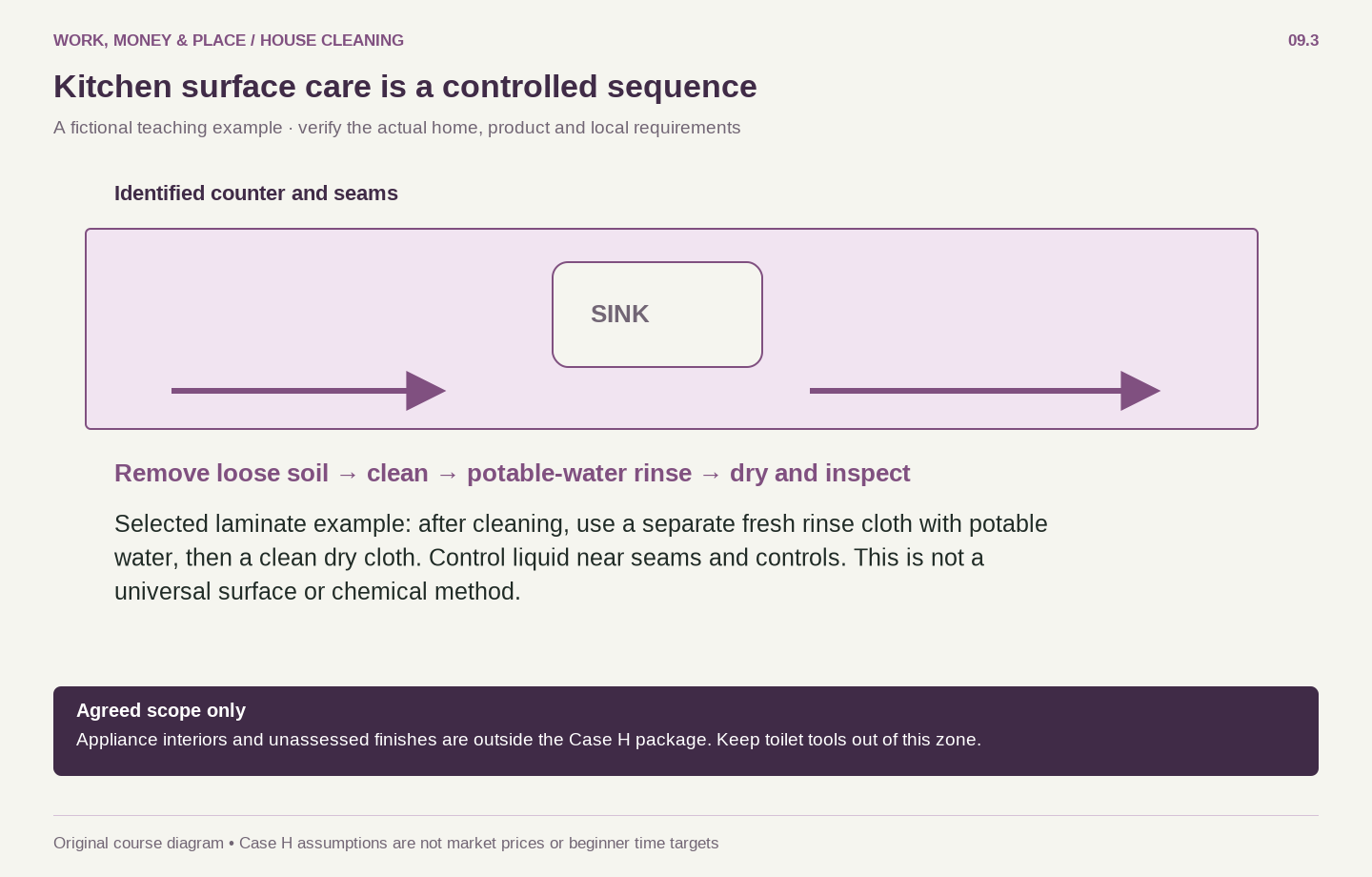
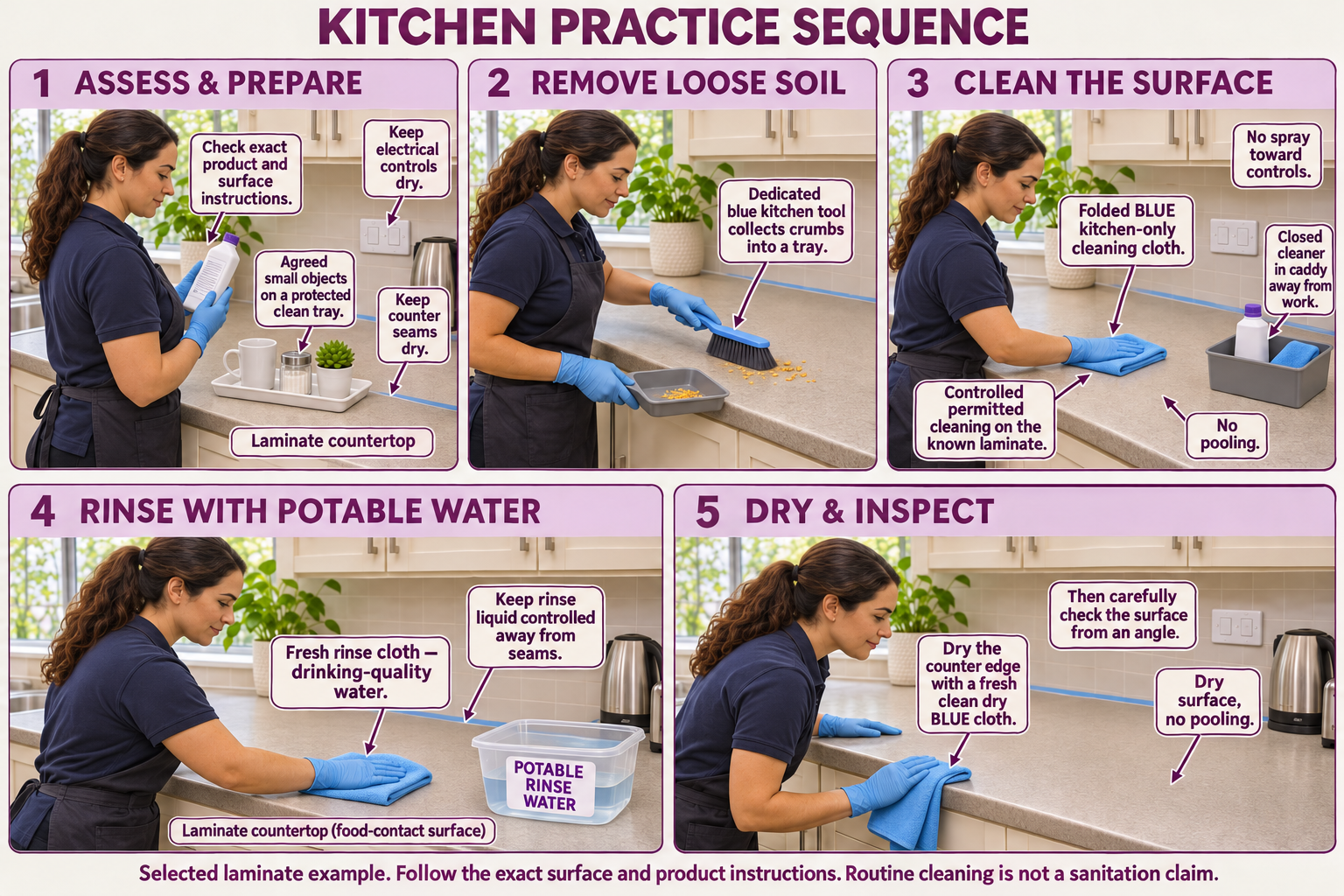
Begin with loose crumbs and dust on the included reachable surfaces using a kitchen-only method compatible with the finish. Work from the higher agreed areas toward the lower ones so new debris does not fall onto a finished counter. Do not dry-sweep crumbs into a sink drain or onto a freshly finished floor. Collect them into the planned waste stream. Examine the cloth or tool face as you work; a trapped hard particle changes the risk immediately.
Fold a clean cloth to expose a controlled face. Wipe a manageable section with deliberate, overlapping coverage so a narrow missed strip remains easy to see. Turn to a genuinely clean face or replace the cloth as it loads. Avoid pushing soil from a seam into the opening. If the kitchen contains an unfamiliar sticky deposit, do not start scraping with a blade or abrasive pad. Record it and use only a separately supported method within the accepted routine scope.
Apply the selected method to one surface at a time
For the identified Wilsonart laminate example, use the Formula 409 general-cleaning method established in H18-A. The cleaner and the surface instructions both matter. Apply only where the method can stay within the selected surface, wipe with the specified clean tool, complete the required food-contact potable-water rinse, and dry. Do not leave residue simply because the first wipe looks shiny. Keep separate clean rinse and drying tools so removed soil is not returned to the counter.
At a seam, edge, faucet base, or appliance boundary, control the working area and remove liquid promptly. If the labeled spray procedure cannot be confined without contacting an incompatible surface, hold that detail and select a separately approved alternative instead of inventing a new application rule. A different counter material, even across the same room, needs its own H18 decision. This course's worked method is not approval for stone, wood, painted surfaces, or coated stainless steel.
Open the full-size illustration ↗
Illustration sources: HT08, HT09, HT10.
Complete the sink and agreed details separately
Treat the sink, faucet finish, backsplash, handles, and cabinet fronts as separate assessed surfaces. Use their own approved methods and tools. A metal faucet may have a special finish; a sink may be coated or repaired. Do not assume the counter product belongs on both. Remove ordinary soil within the routine scope, control rinse water, and dry supported details. Do not use drain chemicals, remove plumbing, dismantle an aerator, or attempt to erase permanent mineral damage during a standard visit.
Complete small-item replacement only on a dry, ready surface. Return approved items to their original locations rather than reorganizing the household. Keep clean tools off the floor and used tools out of the clean pack. If the customer asks for an interior oven clean at this point, record a scope-change request. Assess competence, instructions, time, and price before any acceptance; the first Case H kitchen phase does not contain that extra task.
Check results before the final floor route
Use H19 to inspect the agreed counters, sink, accessible fronts, and appliance exteriors for visible loose soil, missed strips, streaks, and cleaner residue under suitable light. Check seams and adjacent surfaces for retained moisture or overspray. Compare with the starting condition and note any unresolved mark without claiming a cause. A visual check does not establish food sanitation or disinfection. Do not add those claims to the handoff because an antimicrobial cleaner happened to be used.
Collect the blue used tools in their marked container and leave the kitchen floor for its scheduled route unless an immediate spill requires safe attention first. Case H allows forty-five minutes for the kitchen's nonfloor phase. If the actual work takes fifty-five, record fifty-five and why. Do not compress the required rinse or conceal an omitted task to protect an estimate. The final record should show exactly which surface was finished, which was held, and which remains excluded.
Put it into practice
Your assignment
Plan a routine kitchen pass and resolve scope, finish, and food-contamination interruptions.
Inputs
- Known laminate counter with H18-A approval; unknown faucet finish.
- Customer requests oven interior cleaning; original package excludes it.
- The forty-five-minute nonfloor allowance does not include the floor route.
- Separate interruption variant: the customer reports raw chicken juice on the food-preparation counter and inside the sink; no food-contact sanitation procedure has been assessed.
Your deliverable
H17/H18/H19 with sequence, separate surface decisions, and completion statuses.
Saved only in this browser when storage is available. Export this page separately and use fictional identifiers in practice.
Show the worked answer
- Clear approved items, collect loose soil, perform the matched counter method, rinse food-contact area, dry, inspect, and restore items.
- Hold the unknown faucet finish; do not transfer counter approval to it. Record the oven request for a separate assessed agreement.
- Mark kitchen nonfloor work separately from its later floor task. Record actual time even if it exceeds 45 minutes.
- Stop the affected counter/sink work, keep used tools separate, disclose the changed condition, and record HOLD on H17/H18/H19. CDC calls for cleaning then sanitizing these contacted surfaces. Arrange a separately supported sanitation task or exclude the affected area; do not mark a general-cleaner wipe as sufficient.
Show the self-check criteria
- No bathroom or toilet tool enters the kitchen workflow.
- Controls, seams, food, and adjacent finishes are protected.
- Required rinsing and dry inspection are recorded.
- Raw-meat or poultry juice is not treated as ordinary routine soil or resolved by an unsupported general-cleaning claim.