Carry out one fully documented inner-bowl method within a separated bathroom workflow, with exact product instructions, controlled flushing, and a truthful completion record.
Open the full-size diagram ↗
Example and worksheet
Connect this lesson to the complete Case H records. Keep the fictional example separate from your own project.
Identify the bathroom and the individual components
Confirm the bathroom's included fixtures, ventilation, water access, and household timing. Identify the vanity top, sink, faucet finish, mirror, shower, grout, seals, and toilet components separately. A white fixture could be acrylic, enamel, vitreous china, or a repair coating. H18 records the evidence for each surface; a cleaner permitted on one does not transfer to another. Keep both feet on a stable floor-level position with a dry exit. Never balance on a tub, toilet, or wet enclosure to reach a task.
Case H has assessed ordinary soil and intact identified surfaces. Its unknown-vanity exercise is a separate interruption variant, not a hidden condition of the accepted base package. Mold remediation, hazardous contamination, heavy restoration, and plumbing repair remain excluded. Record a dark patch or leak as an observation without diagnosing it. If access, surface identity, chemical history, or ventilation is unresolved, hold the affected work and tell the customer before opening a product.
Finish the non-toilet surfaces with their own tools
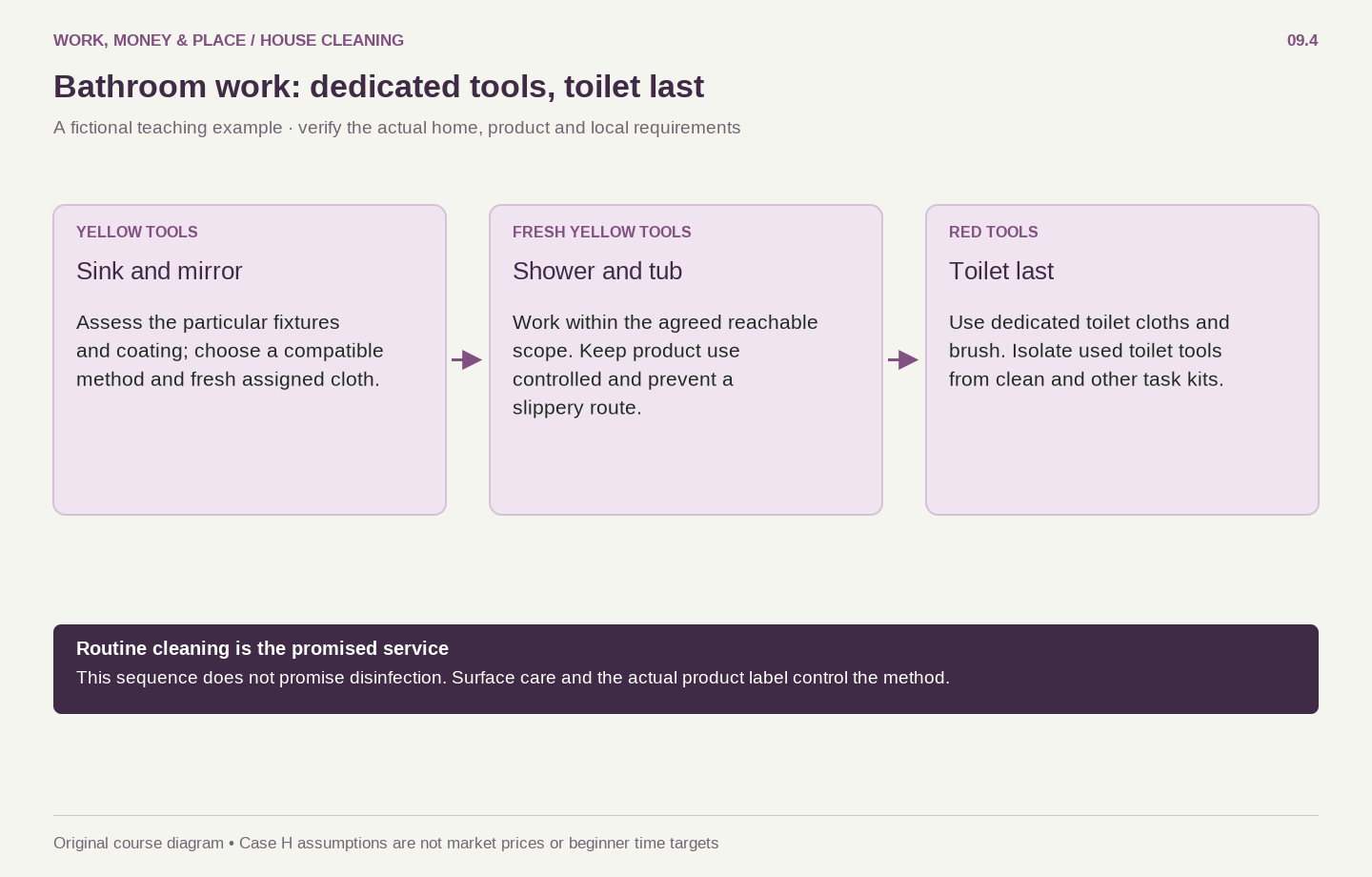
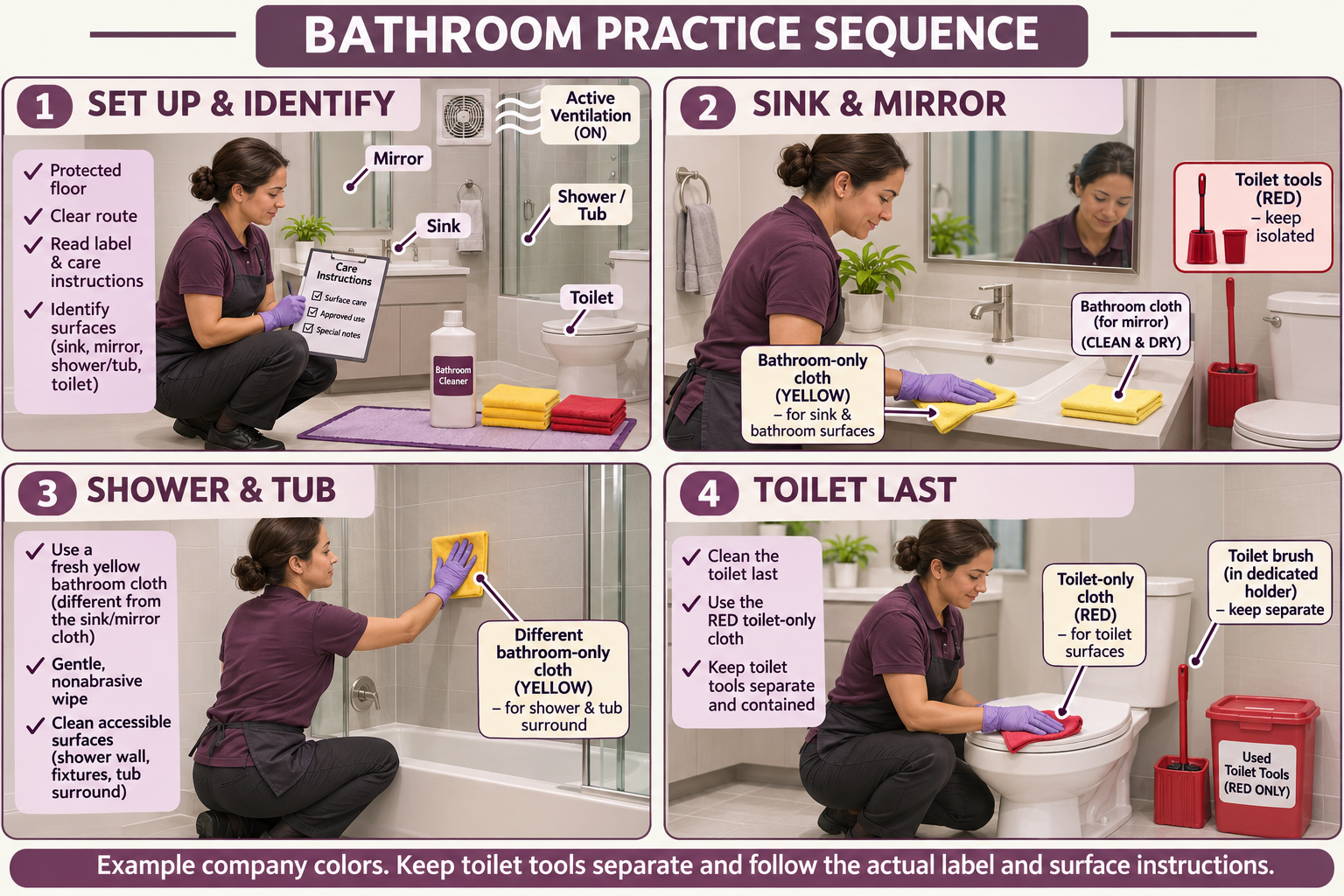
Use the yellow bathroom pack for the assessed mirror, vanity, sink, and shower tasks; keep the red toilet pack separate. Collect ordinary loose hair and dust with bathroom-only tools. Move only agreed small items. Keep liquid away from mirror edges, outlets, switches, and powered accessories. Each selected product and tool must agree with that component's care record. The blue kitchen cloth stays in the kitchen even when both rooms contain the same laminate.
For the assessed tiled shower, work manageable reachable sections using the documented compatible routine method for both the glazed ceramic tile and the identified grout. Complete their prescribed rinse and remove excess moisture without flooding joints, trim, or the surrounding room floor. The shower base is part of that fixture task; the room floor outside it belongs to the later floor route. Persistent scale, a damaged seal, an unknown coating, or a mark left after the supported pass calls for a recorded limit, not a stronger chemical or longer soak.
Prepare the completed inner-bowl example
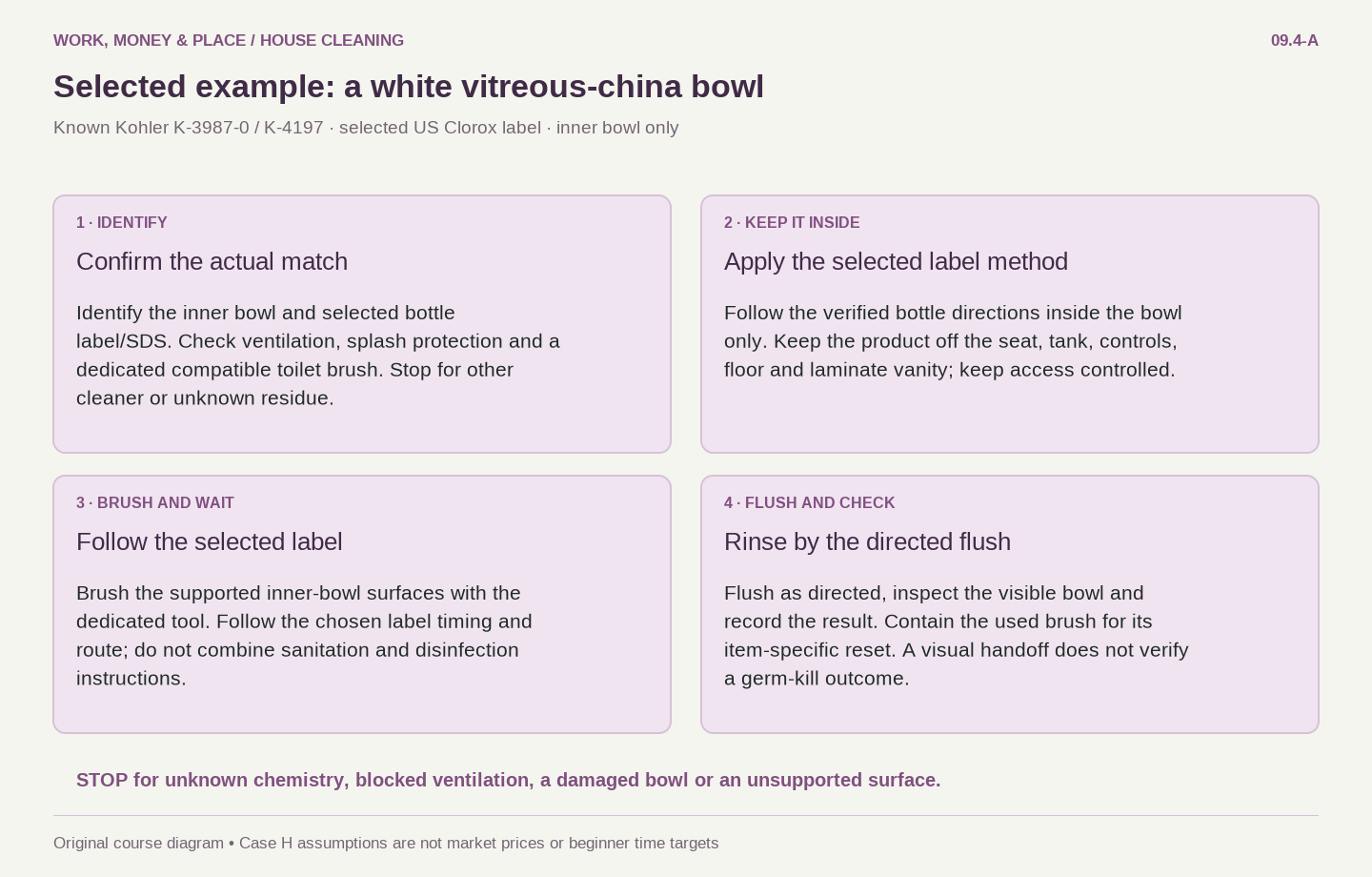
H18-D identifies a white Kohler Wellworth K-3987-0 toilet with a K-4197 vitreous-china bowl and an intact, unrepaired inner surface. Kohler's general vitreous-china care guide supports considering an appropriate bowl cleaner used as directed; it does not approve every formula or name this selected Clorox brand. Match the actual fixture's current care limits too. The example chooses US Clorox Toilet Bowl Cleaner Clinging Bleach Gel, Crisp Lemon, 24 fl oz, UPC 044600316642, EPA registration 5813-89. Compare the actual bottle with the SKU-specific instructions and the current linked US All Scents SDS before practice.
That SDS, revised September 8, 2020, warns of serious eye damage and skin irritation. Prepare the indicated protective gloves and clothing and appropriate splash eye/face protection, adequate ventilation, and the accessible H17 response information. Keep children and pets out. Do not add this bleach product to any other cleaner, acid, rust remover, ammonia product, or unknown residue. Unknown treatment history, an in-tank chemical, unsuitable ventilation, damaged glaze, or an uncontrolled splash risk means HOLD, not an experimental flush-and-add sequence.
Open the full-size illustration ↗
Illustration sources: HT01, HT03, HT05, HT19.
Follow the selected label and finish by flushing
For this specific label route, flush first so only water remains. Keep the nozzle below the rim and direct six fluid ounces under and around the inside rim. Close the bottle. Use a checked, dedicated nonabrasive toilet brush to cover the inner bowl, then retain the product for the five minutes stated by this SKU's SmartLabel procedure before flushing. Maintain restricted access throughout. Do not apply the bowl product to the seat, lid, tank, exterior, sink, or shower. Those components require separate methods.
The selected five-minute instructions describe a sanitizing route; a broader Clorox page presents a ten-minute disinfection route. Do not combine endpoints or substitute a universal timer. Follow the actual matching bottle label; if it differs from the teaching record, reassess before use. This fictional exercise reports visible cleaning observations, not a verified germ-kill result. Flush to remove the product as directed. Follow the bowl-brush maker's own rinse, reset, and storage instructions without carrying the brush into a household sink. Stop for fumes, exposure, unexpected change, poor flushing, or a spill; use H17 promptly.
Open the full-size illustration ↗
Illustration sources: HT23, HT24, HT25, HT26, HT28, HT30, HT31.
Record what was completed and contain the used tools
Inspect the accessible inner bowl after flushing with suitable room light from safe floor-level angles. Record visible soil remaining, residue, leaks, or a new-looking mark against the starting record. A visually cleaner bowl does not establish the absence of fine scratches, latent damage, or microorganisms. Do not keep reapplying product to chase an uncertain stain. Record the task as completed, corrected, held, or outside scope, with a reason and next action.
Keep red toilet tools contained and out of yellow, blue, and green packs. Any separate exterior pass uses its own supported method and fresh toilet-only cloth faces; bowl approval does not cover it. Remove or change gloves appropriately and perform hand hygiene before touching clean supplies. Case H allocates seventy first-visit nonfloor minutes to both bathrooms combined, with room floors counted once in the shared route. Record actual work and interruptions honestly. A label-required wait must be safely supervised and planned, not silently omitted to meet an allowance.
Put it into practice
Your assignment
Complete the H18-D inner-bowl record and resolve two stop conditions without changing the Case H base calculation.
Inputs
- Identified intact white Kohler K-3987-0/K-4197 inner bowl; selected US Clorox Crisp Lemon UPC 044600316642 with matching bottle label, SKU-specific instructions, and EPA 5813-89 SDS.
- Variant A: the customer cannot identify a product already left in the bowl. Variant B: the prepared bottle label differs from the recorded SKU-specific procedure.
- Only the inner-bowl method is covered by this example; the seat, tank, exterior and other fixtures have separate care decisions.
Your deliverable
H18-D evidence and procedure record, H17 controls, and H19 observed result with clear HOLD decisions for the variants.
Working forms: H07, H17, H18, H19.
Saved only in this browser when storage is available. Export this page separately and use fictional identifiers in practice.
Show the worked answer
- After the prerequisite checks, follow only the selected matching label sequence: initial flush, six fluid ounces inside under/around the rim, dedicated brush, selected five-minute wait, final flush. Keep household access restricted and record the limited observation.
- Variant A: do not add bleach product or try a chemical-neutralization recipe; HOLD the affected work and obtain a supported next step. Variant B: HOLD the planned method, identify the actual formulation and instructions, and revise the record before use.
- Do not treat the broader ten-minute disinfection endpoint as the selected five-minute SKU route. The course handoff makes no verified sanitizing or disinfecting claim.
Show the self-check criteria
- Exact surface, product, label and SDS are recorded; category permission is not described as Kohler brand endorsement.
- Toilet-only tools, appropriate protection, ventilation and access controls are established before application.
- No chemical mixing, unknown-residue experiment, exterior-product transfer, or unsupported antimicrobial result is claimed.
Sources: HT01, HT03, HT05, HT18, HT19, HT23, HT24, HT25, HT26, HT27, HT28, HT29, HT30, HT31.