Reset the home, contain used equipment, and close a factual visit record that supports the next job.
Open the full-size diagram ↗
Example and worksheet
Connect this lesson to the complete Case H records. Keep the fictional example separate from your own project.
Reset the household before packing the evidence
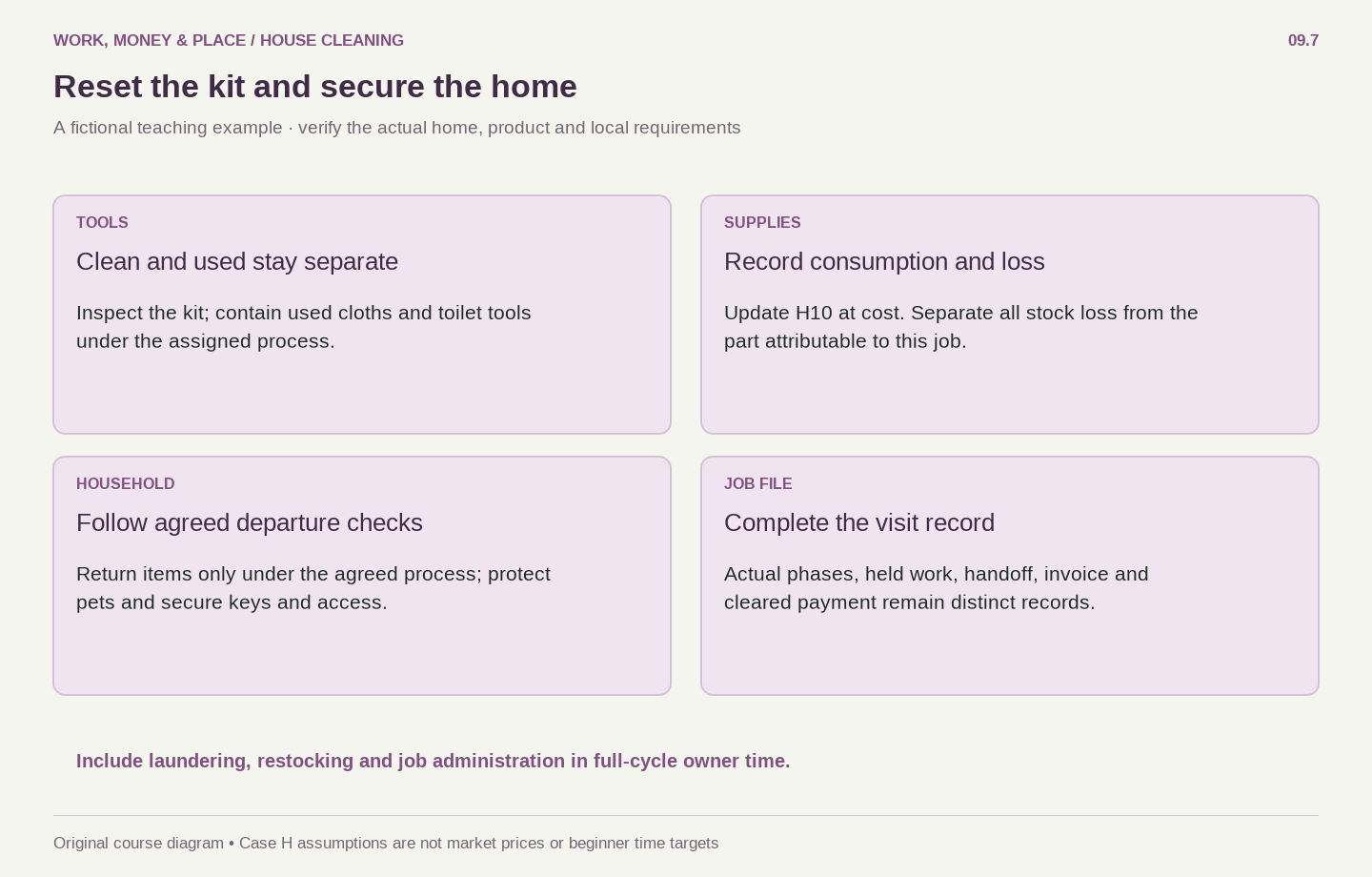
Return approved small items to their documented positions only when their supporting surfaces are ready. Check doors, lights, windows, and access arrangements against the household agreement. Do not change a thermostat, alarm, appliance setting, or lock arrangement without authorization. A helpful-looking change can create an access or security problem. If a pet was kept in a particular area, confirm the agreed release and door status with the household rather than guessing.
Make one last route check while equipment is still available. Confirm that cords, tools, labels, waste, and temporary protection have not been left behind and that no exit is blocked. A floor should be reopened on its actual readiness conditions, not simply because the visit time has ended. If an affected area must remain restricted, state exactly which area and why and arrange an appropriate handoff. Do not leave a warning sign as the only communication about an unresolved condition.
Keep used tools from contaminating the clean kit
Pack blue kitchen, yellow bathroom, red toilet, green general-room tools, and floor pads into their designated used-tool system. Keep toilet items distinctly contained. Do not put a used cloth back into a clean pack to save a bag or assume drying in the vehicle makes it clean. Remove or change protection appropriately and perform hand hygiene at the relevant transitions. Keep used material away from food and personal items during transport.
Close chemicals in their properly labeled containers and transport them secured according to their instructions. Check for leaks without touching unknown residue. A damaged bottle or spill calls for the product-specific H17 response, not a wipe with the next clean cloth. Keep the matching labels and SDS accessible during transport. Do not leave equipment running or connected while packing. The vacuum and each reusable tool return to service only after the maker's cleaning, drying, inspection, and maintenance requirements are met.
Reset tools before the next residence
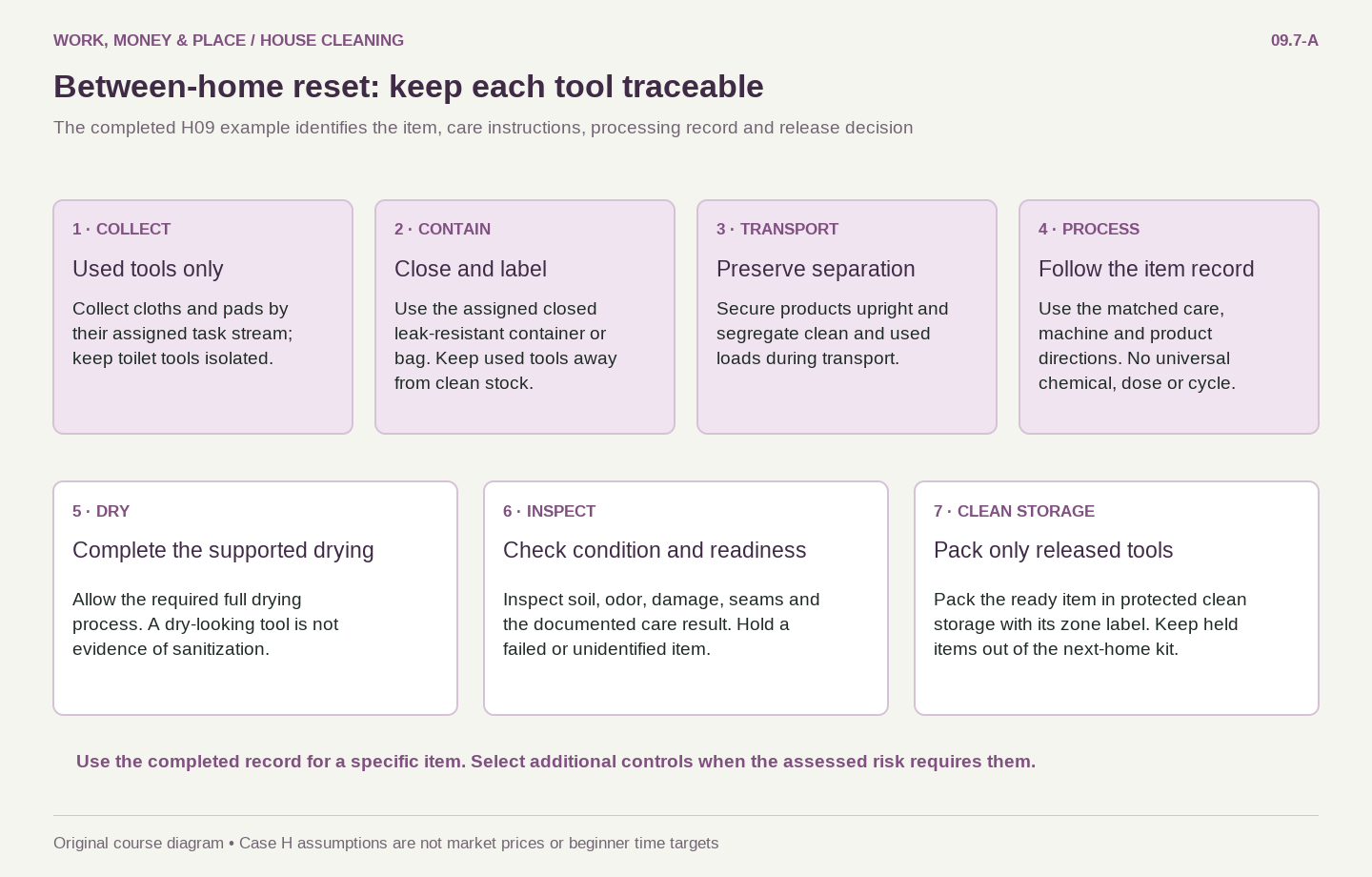
At the designated reset location, follow the actual cloth, pad, tool, and chemical-care instructions. Separate incompatible cleaning processes; do not improvise a universal hot-water temperature, bleach dose, or laundering recipe. Clean and, where the tool protocol requires it, sanitize reusable equipment before it enters another residence. Green Seal's residential standard provides a useful voluntary separation principle; it does not certify this course or your business. Keep the reset traceable through your own written procedure.
Inspect cleaned tools for embedded grit, tears, worn contact edges, odor, or remaining residue and remove unfit items from service. Let parts reach the manufacturer's required dry condition before storage or reassembly. Check vacuum bags and filters by the exact manual, disconnecting equipment for maintenance. Restock clean zone packs so the next job begins with confirmed clean capacity. Record needed repairs immediately; a note hidden in the bottom of a caddy will not stop a defective tool being loaded tomorrow. A mixed toilet pack or an item with unresolved care instructions stays on HOLD; the completed ordinary-cloth example does not release other tools.
Read a completed item reset before releasing the next kit
H09-R1 follows one tagged UNGER general-room cloth all the way from light dry bedroom dust to a closed clean pack. Its used stream stays separate. The operator checks the exact cloth care, laundry bottle, machine and load, completes the supported wash, dries fully, inspects, and records a release for the same bounded ordinary use. The example identifies a real detergent and washer configuration, but every observation and completed event is fictional. It is not a sanitization test or an instruction to apply those settings to every cloth.
Read H09-R2 before declaring the next kit ready: its unknown vacuum attachment, toilet set and caddy remain separately tagged HOLD. Those items cannot borrow the cloth laundry approval. The H17 reset card supplies the six decisions and the mixed-red-cloth response. A verified spare or a changed booking resolves missing capacity; guessing does not. Distinguish ordinary care from a risk-specific or adopted-standard sanitizing requirement. Record active reset labor and actual supplies once; Case H already includes that work, and its 20 active minutes is not a promise that a washer cycle or drying will finish in 20 minutes.
Open the full-size illustration ↗
Illustration sources: HT01, HB16.
Capture real time and stock before memory fades
Use H13 to record the complete owner cycle. In the first Case H plan, on-site work is 270 minutes and off-site work 90, totaling 360 minutes or six hours. Off-site time includes intake and quoting 30, loading/laundering/restocking 20, round-trip travel 30, and invoicing and records 10. Do not count the same loading time again inside the on-site arrival phase. If actual hours differ, retain them as actual rather than rewriting the accepted plan.
Reconcile stock from purchases, use, losses, and closing balance. Planned first use 14 leaves 66 from an 80 purchase; the alternative actual use 16 leaves 64 with no loss. Fuel and payment fees have their own evidence. A discarded, damaged tool is not ordinary stock use merely because it was inexpensive. Record its loss or replacement consistently. Include a short cause note for material differences, such as an extra supported correction or longer household access wait, without revealing private household details.
Close the visit and prepare a bounded next agreement
Complete H19 statuses and confirm how the customer will receive the completion summary and invoice. Explain any held, excluded, or unresolved task in plain language, with the next action and any agreed effect on the charge. Follow the accepted payment terms and record actual payment method and fee in the planner. A card authorization, cleared receipt, and available bank balance are different events. Store access details only where needed and protect the visit record.
A repeat visit is a new assessment of condition and scope, not an automatic promise to perform the first package faster. Case H models a separate 195-minute on-site repeat and 75 off-site minutes, or 4.5 owner hours, but those assumptions must be earned through actual records. Ask whether surfaces, household access, or priorities have changed. Use feedback to improve your method and estimate while keeping the service within your competence. The final product of this lesson is a home reset correctly and a usable record, not simply an empty checklist.
Put it into practice
Your assignment
Close a fictional visit and identify what must happen before the next home.
Inputs
- Actual first-visit owner time: 7 hours; stock used: $16; fuel: $12. Accepted plan: 6 hours, $14 stock use and $10 fuel.
- A toilet cloth is mixed into a general used pack; unused clean packs stayed protected.
- A vanity task remains HOLD for missing finish identification.
Your deliverable
H13/H17/H19 closure packet and a release/hold list for tools and next work.
Working forms: H09, H13, H17, H19.
Saved only in this browser when storage is available. Export this page separately and use fictional identifiers in practice.
Show the worked answer
- Retain 7 actual owner hours and $64 closing stock from the $80 purchase. Preserve the original accepted plan for comparison.
- Keep the affected used tools in the appropriate reset stream and release them only after the documented suitable process; do not put them into clean stock.
- Report the vanity HOLD privately, obtain identification before any later method, and reassess the next agreement rather than marking the task complete.
Show the self-check criteria
- Tools and products are secured without contaminating clean packs.
- Actual records preserve the accepted baseline.
- The household receives clear unresolved-task and access information.
Sources: HT03, HT05, HT10, HT20, HT01, HB16, HB17, HB18, HB19.