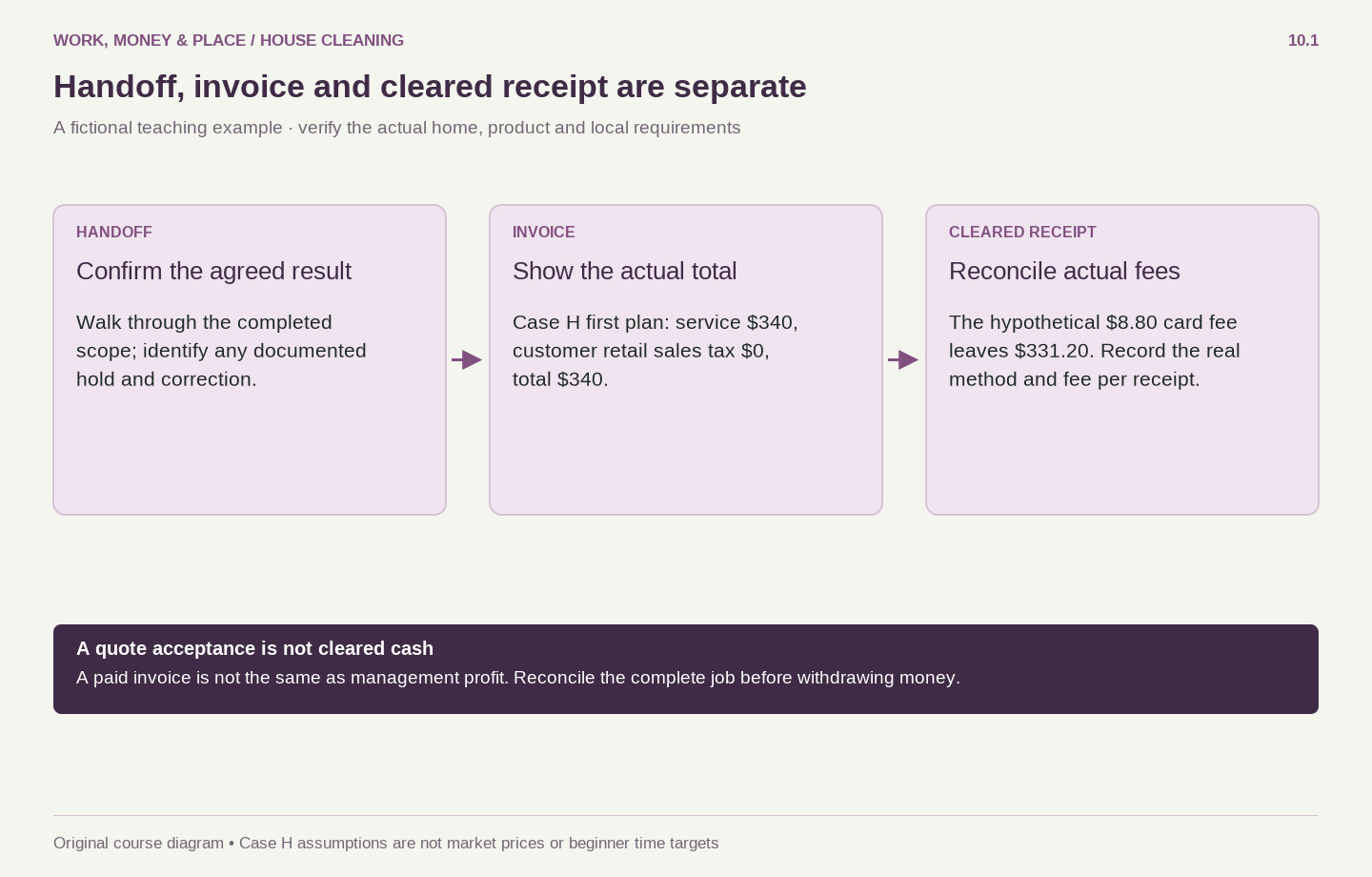
Complete a respectful handoff against the accepted scope, document exceptions, issue a traceable invoice and reconcile the payment without exposing private household information.
Open the full-size diagram ↗
Example and worksheet
Read the matching Case H records, then complete a separate assessed job using your own verified inputs.
- Case H 02 · Document the assessed package before pricing
- Case H 03 · Classify the transaction and planned receipts
- Case H 06 · Read the management result on a consistent basis
- Case H 08 · Fund the visit before its receipt clears
- Case H 12 · Preserve the accepted plan and transfer the method
Download the formula planner ↓
Example tab: First cash. Your blank tab: Your cash.
Save your own copy. Use the named example as a worked record, then enter verified scope, costs, payment events and full-cycle hours in the blank Your worksheets.
Inspect the agreed work before requesting acceptance
A handoff begins with your own final inspection, not with asking the customer to find unfinished tasks. Revisit H08’s agreed checklist and the H19 quality record. Case H has eight assessed zones, with a floor route through them. Confirm the defined result for each permitted task, collect tools and waste, restore agreed movable items and leave the access route in the documented condition. Check that nothing from a kitchen or bathroom task has contaminated the next area during the reset.
Describe what you checked without claiming a result you cannot prove. A routine-cleaning visit does not automatically restore damaged finishes, remove every permanent mark or certify a disinfected home. If a surface’s condition prevented the planned work, record that decision and explain it directly. Do not conceal an unresolved task by moving an object over it or choosing a flattering photograph. If the customer is unavailable, use the agreed handoff method and provide a concise written completion record rather than inventing their approval.
Resolve an exception without changing the agreement afterward
Compare an issue with the accepted scope. If an included reachable surface was simply missed, record and correct it using the already assessed compatible method. If the customer requests an excluded oven interior or another new service, it is a scope request, not evidence the original routine package was incomplete. Pause the affected work, use H16 for the decision and obtain an agreement before performing an eligible addition. Decline work outside the initial offer or capability instead of attempting it to avoid an uncomfortable conversation.
Use neutral records: location, agreed task, observed result, action, time and status. A photograph may help when permitted, but an image alone does not establish a surface’s history or who caused damage. Follow the access/privacy agreement and the incident procedure for a concern. Preserve the original record, including a reported issue and its resolution, rather than rewriting it after a disagreement. The customer-facing message should explain the practical next step; internal investigation notes and speculation do not belong on a public review page.
Prepare an invoice that matches the accepted service
For the unchanged first Case H scope, H20 shows a $340 routine package, confirmed $0 additions and $0 customer retail sales tax under the case’s stated classification. The customer total is $340. Refer to the job and accepted scope version, service date, business contact details and agreed payment terms. If a legitimate approved change exists, identify its authorization and amount separately. A delayed or unexpectedly difficult job does not permit an unapproved extra charge simply because the actual owner hours exceeded the estimate.
Keep the customer price separate from your internal cost review. The fictional $8.80 card-processing fee, $14 supply usage and $180 owner labor value are calculation inputs, not new invoice lines to add after acceptance. Do not introduce an unagreed surcharge or relabel the business’s own taxes as customer sales tax. If the transaction’s classification differs from the research, resolve it using the actual jurisdiction and service evidence. A clear invoice must connect the amount due to the agreement, not attempt to repair a pricing mistake silently.
Reconcile the payment and protect the household record
A $340 customer receipt with an actual $8.80 withheld fee contributes $331.20 to bank. The amount charged, fee and net deposit are three related amounts, not three separate receipts. In H12, enter the cleared date and actual fee on the same event. Record a promised payment as outstanding until it clears. If several payments occur, reconcile each fee and net deposit separately. Cash uses an explicit zero fee when none applies; never let a card assumption reduce the modeled value of a cash receipt.
Keep the invoice, payment evidence and any authorized change together in the private job record. IRS guidance identifies supporting business documents as part of adequate records, but an operational course worksheet is not a complete accounting system. Restrict access to household details and use only information needed for the work and records. Do not place keys, access codes, children’s details or private customer photographs in public marketing, shared practice files or the planner’s job label. A short internal job identifier can connect the financial records without publishing a home’s identity.
Close the visit before offering another one
Complete H19’s result and exceptions, H20’s invoice/payment status and H13’s actual time, usage and travel inputs. Case H’s alternative actual takes seven complete owner hours, uses $16 stock and costs $12 fuel. These do not change the unchanged accepted $340 package, but they change the internal result to $61.20. Capture the observations while they are fresh. A polite customer handoff and a disciplined internal review serve different purposes; one cannot substitute for the other.
Invite a repeat discussion only after confirming what was completed and what may differ next time. The $280 Case H repeat is a new agreement with documented condition and time assumptions, not a promised entitlement to the first customer. Ask about preferences through the permitted contact method and record consent for future communication. Do not promise a review reward, manufacture a testimonial or pressure a household to accept unresolved work. Close the current records, arrange any agreed follow-up and keep the next scope decision separate so it can be priced honestly.
Put it into practice
Your assignment
Prepare a completion and invoice record for the unchanged $340 first visit, including one missed included task and one request for excluded work.
Inputs
- Accepted H08 scope; H19 quality checklist; H20 invoice
- Missed included reachable surface; separately requested oven interior
- Customer payment $340; actual fee $8.80; net deposit $331.20
Your deliverable
H19/H20 handoff record, dated H12 payment event and a private H13 actual-review reference.
Saved only in this browser when storage is available. Export this page separately and use fictional identifiers in practice.
Show the worked answer
- Inspect and safely correct the missed included task, then record its status.
- Treat the excluded oven request separately; do not perform or bill an unapproved addition.
- Unchanged invoice remains $340; its actual fee is not added as an unexpected charge.
- Record gross $340, fee $8.80 and net contribution $331.20 once, on the cleared date.
Show the self-check criteria
- Completion is checked against the accepted scope.
- Exceptions have an action and status without invented customer approval.
- Invoice and authorized changes reconcile.
- Household access information remains private and actual payment evidence is retained.