Reassess a repeat service, compare its full-cycle economics with the first visit, and schedule it only when access, stock, cash, and owner capacity support the agreement.
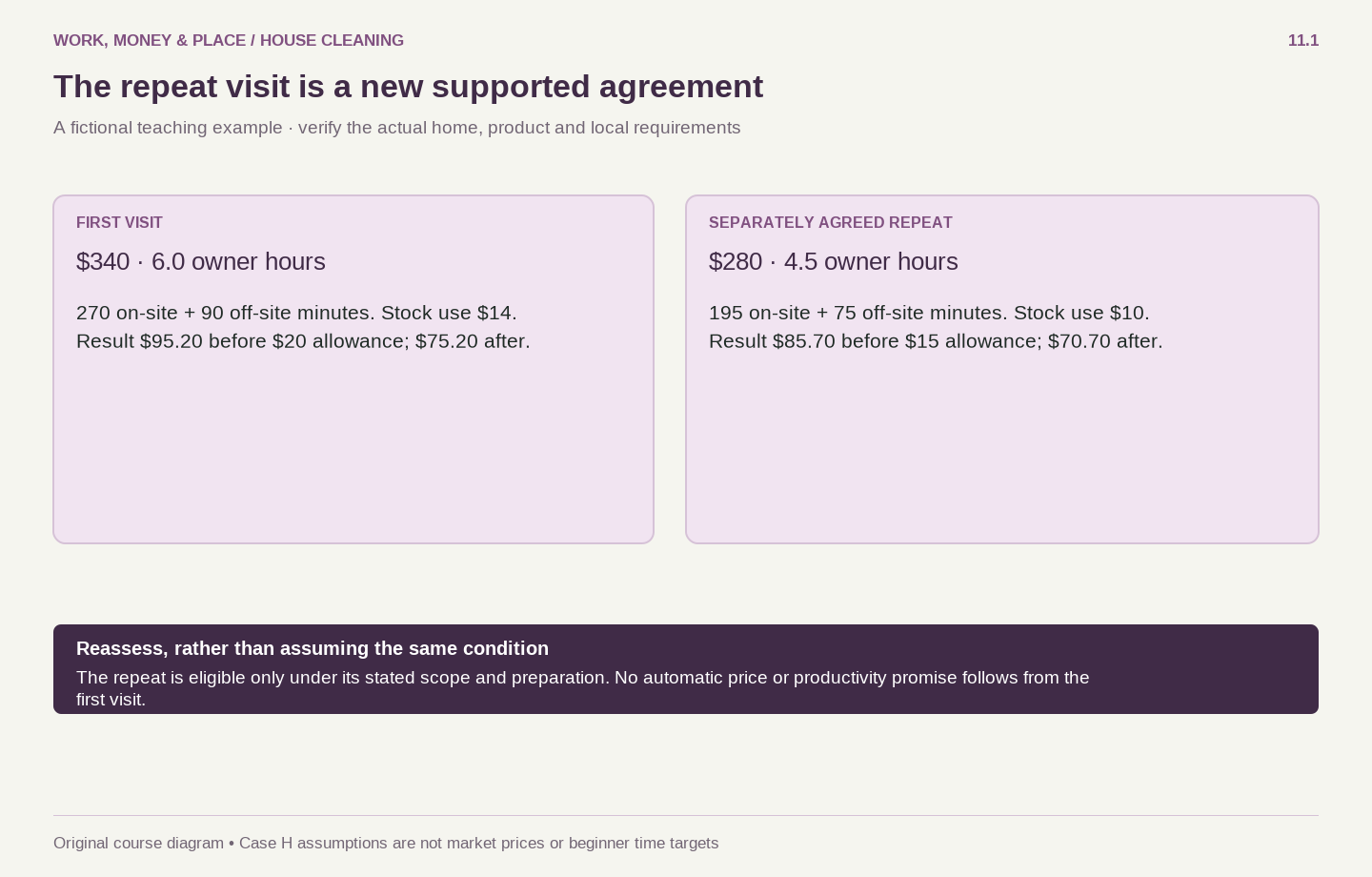
Open the full-size diagram ↗
Example and worksheet
Use the separately labeled Case H teaching records, then create a dated record for your own assessed service. Fictional results do not establish practical readiness or local demand.
- Case H 05 · Reconcile purchases use losses and remaining stock
- Case H 06 · Read the management result on a consistent basis
- Case H 07 · Budget the entire owner cycle
- Case H 08 · Fund the visit before its receipt clears
- Case H 09 · Plan the repeat as a separate agreement
- Case H 12 · Preserve the accepted plan and transfer the method
Download the formula planner ↓
Example tab: Repeat plan. Your blank tab: Your estimate.
Repeat plan / Repeat cash: follow the planned first path only. Your estimate / Your cash: use newly assessed scope, actual usable stock, and a real dated sequence.
A repeat is a new assessed agreement
A customer requesting another visit is useful evidence, but it does not remove the need to confirm the work. Ask whether occupancy, pets, finishes, furnishings, access, priorities, or condition have changed. Check that the previous exclusions still make sense. A missed interval or newly accumulated soil may require a different scope and time budget. Keep the repeat task list in H21 and connect it to a dated quote rather than automatically promising the earlier package or a permanent discount.
Case H's repeat is a separately reassessed visit to the same eight named zones. The floor route remains a task across those zones. It assumes ordinary conditions that support a reduced time budget, not a guarantee that every returning home becomes easier. The customer price is $280. The first visit was $340. Those prices and conditions are fictional teaching inputs, not a market rate, required discount, or offer you can issue without an assessment.
Read the repeat result on the same basis
The planned repeat uses $10 of stock, $10 fuel, 4.5 owner hours valued at $30 per hour, $8 equipment allocation, and $24 overhead allocation. Its one modeled card receipt costs $7.30. Subtracting those costs from $280 leaves $85.70 before the separate planning allowance and other business taxes. The $15 repeat allowance reduces that management result to $70.70. No helper cost or other direct cost is assumed in the base repeat.
Compare like with like. The first visit's result before allowance is $95.20, so the repeat is $9.50 lower on that basis. The price falls $60, while owner-time value falls $45, stock use falls $4, and the fee falls $1.50: total savings of $50.50. A faster visit does not automatically create a larger result when its price also changes. After their different allowances, $75.20 first and $70.70 repeat are also distinct from any amount available after business taxes.
Schedule the entire cycle rather than the visible cleaning
The repeat plan contains 195 onsite minutes and 75 offsite minutes, totaling 270 minutes or 4.5 hours. Its onsite phases are arrival 10, bathrooms 50, kitchen 30, bedrooms 30, living/dining 20, hall/entry 10, floor route 30, and inspection/handoff 15. Offsite communication is 15, loading/laundry/restocking 20, travel 30, and invoicing/records 10. Use these to understand the arithmetic, not as a time standard for an unknown home.
Two unchanged repeat cycles already total nine owner hours. In a separate capacity exercise, suppose a combined route reduces their total travel from 60 to 45 minutes. That saves only 15 minutes, giving 8.75 hours before adding a separate 30-minute break and 30-minute disruption allowance. The day then requires 9.75 hours, exceeding an eight-hour capacity by 1.75 hours. Do not book two visits merely because each onsite block looks short enough. Recalculate actual travel and offsite work without counting shared time twice.
Carry stock and cash forward only along the stated path
The planned first visit leaves $66 of the original $80 consumable purchase. The planned repeat uses another $10 and leaves $56, with no losses in this example. That $10 is a cost of stock consumed, not a new $10 purchase payment. Check usable quantities as well as cost values before loading the kit. A total stock value cannot prove that the particular cloth supplies or compatible product needed for the next task are available.
The isolated planned cash path starts the repeat with $531.20 after the first planned visit. It pays $10 fuel and receives $272.70 net from the $280 payment, ending at $793.90. This short teaching path excludes intervening overhead payments, owner withdrawals, taxes, and other activity. It must not be used as a prediction of actual bank balance. The alternative seven-hour first actual is a different path; do not attach this planned repeat to it without rebuilding the sequence and stock record.
Confirm the next visit and learn from the previous one
Use H21 to record the proposed interval, actual next date or confirmation process, customer priorities, assessment changes, payment event, and any unresolved issue. A reminder is not a fresh acceptance, and a customer's interest is not cleared cash. Give the household a straightforward way to report a change before arrival. Retain the relevant private access arrangement securely, confirm authority again when needed, and avoid keeping outdated entry instructions active simply because the customer once booked a visit.
Review the preceding completion record before promising the next package. If the same task repeatedly takes longer or a finish remains unidentified, address the cause. Revise the future plan, price, scope, or timing openly rather than quietly reducing quality to preserve the old figure. A repeat business is built by delivering a clear agreement consistently within capacity. The decision to accept another visit should therefore pass the same safety, authorization, economic, and cash checks as the first one.
Put it into practice
Your assignment
Calculate the planned repeat result, stock and bank path, then test whether two such visits fit the stated separate capacity exercise.
Inputs
- Repeat price $280; fee $7.30; stock $10; fuel $10; owner 4.5 hours × $30; equipment $8; overhead $24; allowance $15.
- Planned first stock closes at $66 and bank at $531.20; no intervening activity in this isolated path.
- Capacity exercise: two unchanged 4.5-hour cycles, 15-minute combined travel saving, 30-minute break, 30-minute disruption allowance; day capacity 8 hours.
Your deliverable
H21 repeat agreement and an H03 capacity decision, with the isolated repeat estimate, stock, and cash reconciliation.
Saved only in this browser when storage is available. Export this page separately and use fictional identifiers in practice.
Show the worked answer
- Repeat before allowance: $280 − $7.30 − $10 − $10 − $135 − $8 − $24 = $85.70; after $15 allowance = $70.70, both before other business taxes.
- Stock: $66 − $10 = $56. No repeat purchase is assumed.
- Bank: $531.20 − $10 + $272.70 = $793.90, only on the stated isolated planned path.
- Capacity: 9 hours − 0.25 hour + 0.5 hour + 0.5 hour = 9.75 hours; exceeds 8 hours by 1.75. Do not confirm both visits unchanged.
- First versus repeat before allowance: $95.20 versus $85.70. The repeat result is $9.50 lower, not higher simply because the cycle is faster.
Show the self-check criteria
- Repeat conditions and acceptance are reassessed.
- Full-cycle hours include offsite work.
- Cost, purchase cash, and remaining stock are distinct.
- The cash path states its exclusions and is not mixed with the alternative actual.